As the new year approaches, many dealership service departments start thinking about their SERVICE MANAGER goals for 2026 and what they want to accomplish in the year ahead. But as anyone in Fixed Ops knows, setting goals is easy — sticking to them is the hard part.
In this episode of Service Drive Revolution #336, the conversation focuses on what truly determines whether a goal gets hit or abandoned. The discussion explores mindset, systems, intentionality, and the common traps that hold managers back. The insights apply directly to SERVICE MANAGERS, SERVICE ADVISORS, directors, and fixed ops leaders who want 2026 to be their most productive year yet—and who want their SERVICE MANAGER goals for 2026 to actually stick.
Novelty vs. Intentionality: The Real Reason Goals Fail
When the calendar flips, most people get excited about “new year, new goals.” The problem isn’t the goals. It’s the motivation behind them.
Many leaders set goals based on novelty, not intentionality.
- Novelty feels exciting, but fades fast.
- Intentionality requires commitment, structure, and consistent execution.
The discussion points out that people love new ideas, new tools, and new strategies — especially in dealerships. But none of that matters without discipline.
“You don’t need a new way to do something — you need the ability to consistently execute the fundamentals.”
This lesson is crucial in Fixed Ops, where teams often chase new software before mastering basic processes.
(Want more on mastering the basics? Read:
Top Fixed Ops Performers: What Car Dealership Service Managers and Advisors Do Differently)
Why Many Service Manager Goals for 2026 Won’t Stick
A major insight from SDR #336 is simple: motivation is not enough.
People overestimate willpower and underestimate the need for a system.
Without structure, people default to comfort. The podcast breaks down several examples:
- Gym attendance spikes in January… then drops by mid-month.
- Service advisors start strong with processes… then drift back to old habits.
- Managers set new goals… but never build the guardrails that keep them on track.
The conclusion:
If your system isn’t intentional, your results won’t be either.

2026 Goal Setting for Service Managers: What Actually Works
Below are the repeatable, reliable methods discussed in SDR #336 — the same methods that help ensure your service manager goals for 2026 become reality.
1. Reflect Before Setting New 2026 Goals
Before planning 2026, look back at 2025:
- What worked well?
- What didn’t?
- Where did you miss opportunities?
- Which habits hurt your performance?
- Which processes need reinforcement?
This honest review creates a clear foundation for setting strong service manager goals for 2026.
2. Set Goals That Require Commitment — Not Hope
Optional goals are not real goals.
To make goals stick, you need:
- Full commitment
- Clear sacrifice
- No escape routes
- A willingness to push through setbacks
Many service managers fail because their goals are vague or optional.
Intentionality removes the option to quit.
3. Align Your Goals With Your Partner or Support System
Personal support directly affects professional success.
SDR #336 highlights that many managers struggle because they set big goals alone — even though those goals impact family schedules, stress, and work hours.
When you discuss your goals with your spouse or partner, you create:
- Alignment
- Reduced conflict
- Shared expectations
- Team accountability
This support makes hitting your service manager goals for 2026 far easier.
4. Use Coaching or Expert Guidance to Accelerate Success
One powerful idea from the episode is this:
You can’t reach the next version of yourself using the mindset of the current version.
Trying to “figure it out solo” leads to:
- Blind spots
- Repeated mistakes
- Slow progress
- Lack of accountability
Expert coaching provides:
- Fresh perspectives
- Proven systems
- Faster development
- Clear structure
- Consistent accountability
Even top performers hire coaches — because it creates predictable success.
(Learn more in the related blog: The Real Reason Service Managers Get Fired!)
5. Build Systems That Make Quitting Hard
SDR #336 talks about “trap doors” — systems that make it difficult to drift off course.
These include:
- Hiring a trainer
- Joining a coaching program
- Paying for expert help
- Scheduling recurring check-ins
- Joining a performance community
When you invest time, money, or relationships into your goals, you stay committed.
6. Make the Basics Non-Negotiable
Success in Fixed Ops comes from doing the fundamentals well — and every day.
These include:
- Daily one-on-ones
- Technician communication
- Daily performance tracking
- RO follow-through
- Walk-arounds
- Upsells
- Appointment confirmation
These are the building blocks of high performance. Not glamorous, but extremely profitable.
“If you can’t do it on paper, you won’t do it with software.”
Why Your 2026 Goals Matter More Than Ever
Disruption is accelerating across the automotive world.
With AI, rising costs, and shifting customer expectations, service managers cannot afford to stay reactive.
Those who uplevel skills, build structure, and commit with intentionality will rise above the disruption.
Leaders who stay stuck in old habits will struggle.
This is the moment to get ahead.
Final Thoughts: Make 2026 Your Most Intentional Year Yet
SDR #336 delivers one clear message:
Goals don’t succeed because people try harder — they succeed because people build systems that make success unavoidable.
For your service manager goals for 2026:
- Write them down
- Build the structure that supports them
- Get alignment at home
- Invest in coaching
- Commit with intentionality
If you show up consistently, the results will follow effortlessly.
FULL VIDEO TRANSCRIPT
Welcome to the big show. We are so glad you are here. We’re going to talk today about goals for 2026, what Christian and I have learned over the years that almost guarantee that we hit our goals. It’s a system, a mindset, and a process. And we have a great conversation about it that I think you’ll find very, very insightful. And much, much more coming up on this edition of Service Drive Revolution.
The good news is Christian is here because I almost had to do this by myself. I’m here to save the day, barely. If he sounds a little under the weather, it’s because he had full-on bronchitis. Don’t forget the sinus infection. The thing about bronchitis that you’re experiencing, because I’ve had it, is once they give you the antibiotics, that’s when you start coughing and it starts coming up. Clears everything out. Yeah, it’s the worst. You were really sick. I don’t think I’ve ever seen you that sick.
I’m not as… Also, what’s funny is Christian pretends like he’s not contagious, so he’s walking around here on Monday, like, “Oh no, I’ve been sick for a week. I have to be getting over it., I also try to convince myself I’m not sick. I do that, too. And then I also, for whatever reason, I consider it a punishment that I have to work from home. There are so many weird things that I do. I do the same thing, I hate being sick, I consider being sick a weakness mentally. Well, I know I did something to get myself sick in the first place, right? So, it’s like a weak punishment for doing something dumb. Yeah, that should learn me. I agree with that.
Bad news. Would you say bad news? How would you say this? A shock. Devastating. Crazy. Unexpected. Man, it ruined my weekend. It was a hard text. Yeah. So, Tim Kintz passed away. If you’re not familiar with Tim Kintz, he’s somebody that we’ve partnered with in the past that does sales training. He’s just one of those really good guys that teaches how to sell the right way. You know, a Texas good guy, dripping with charisma, you want to be around him and all that stuff.
I was always so impressed with Tim. I met Tim for the first time when he worked for Joe Verde, so he was one of his trainers for a long time. Then he went out on his own, and we shared a lot of mutual clients. I mean, I spent a lot of time with him over the years, not recently though, which it’s so weird that I had this feeling to call him a couple times, and then I didn’t, and he passes away.
Yeah, let that be a lesson, right? Yeah. Life is short. I think he was 57. I don’t know. Yeah. But if you think you need to call somebody, call them. It’s around my age. Yeah, I’m a little younger. Super close to home is what that whole thing is. Yeah. We kind of, you know, we occupy a similar space, and there was just all of it kind of came rushing at me. That was a tough hit, and I just pray for his family and all that. I’m sure that’s a huge shock to them as well. Yeah, condolences and lots of prayers for Tim. Very sad, very final. Nuts. He’s got kids.
When that sort of stuff happens, what goes through your head? I need to prepare. The first thing I thought was, ‘Oh, I got to make sure that if that happens to me, what’s the plan? How do we get Claudia what she needs? How do we get Raylan what he needs?’ The first thing I think about is preparedness, and has everything been done. Made me think about wills and all that stuff. And then, the other thing that… yeah, so you had a pretty introspective weekend, too then? So I did, too. I thought it was just me. But, the leaving things undone, all that goes through your head once someone you know, that you identify as similar to you, passes. It should go through your head to remind you about life being short. Yeah, but I go right into preparation mode is what I would say.
How about you? You know, I had that little scare earlier in the year. I don’t know a lot about it, but they thought I had cancer, and all the signs were that I had it, but then I ended up not having it, which is funny. But for probably three months, I was going through that, like, ‘Okay, well, if I’m going to go, what’s the plan?’ That sort of thing. And it’s interesting how your only choice in those situations is to resolve yourself to it, because otherwise you just go crazy. If you worry about it, there are things that you can control, and then there are the things that you can’t.
And when it comes to your health, it gets so confusing because you get so many different opinions. A doctor here in the U.S. tells you something completely different than a doctor in Europe. The doctors here just want to do surgery. The doctors there kind of want to treat the person. Our medical system is kind of nuts in that way where all the good doctors are booked out and really busy. Yeah, it’s just, you have to let go. It’s the only way. Not the strongest strength for you, by the way. I might be better at that than you think. No, and maybe make sure I’m saying it in the right context.
When you attach something, my thought is you would be the one that would be like, ‘Okay, so what are my treatment options? What do I do here? How do I make sure that I’ve done my best part?’ Almost obsessive in terms of, like when you’re chasing something, that’s a thing. But I did that. I triaged everything. I have, I would say, good connections and good doctors and access, right? Yeah, but it’s still, it’s still there. There are just still a lot of unknowns. Yeah, and you get conflicting…
I’ll tell you one thing you shouldn’t do if you have any sort of diagnosis is ask AI anything. AI can barely get anything right. Well, I don’t know about that, but you’re so anxious that you have any sort of MRI, and then they give you the kind of stats, and then you start putting that into AI and asking it what it thinks, and it presents the worst-case scenario every time. That’s how WebMD used to be. So don’t do that. No, that’s a terrible process.
Did you, I mean, since you brought it up and I never asked you about it, did you… It’s just weird. How did it start? The funniest thing in that scenario, when you think you might have something terminal, is when you’re sitting in a meeting or you’re having a conversation about stuff that just doesn’t matter, talking to people about, ‘Just do your job!’ Like, what are we talking about, going around in circles about something that you’re like, ‘Not only will I not remember this a week from now, I’m certainly not going to remember it a year from now.’
What matters changes very quick. Who matters, the relationships you have, the friendships, that sort of stuff is front and center. The waste. I’ve always understood that the reason why Steve Jobs is who he is, and the reason why David Geffen is who he is, is both of them were misdiagnosed with cancer at a young age, and they got another chance. It was like a reinvention because when you think you’ve lost everything and then you haven’t, your priorities kind of shift.
Yeah, I would guess the world gets a little more colored, right? Gets a little more colored, and you have a little less patience for stuff that doesn’t matter? Time waste because now you have a different understanding of time. Yeah, that makes sense. Exactly. Although I think that they’re going around in circles, even if you’re not thinking in that way, which we all probably should, is super infuriating.
It is interesting to listen to people talk when most of what is said, especially when it comes to conversations where people have really no idea what they’re talking about… Take politics, for example, and people are just wanting you to agree with them just because, and they really are talking about the symptom, not the cause. That’s something we talk about a lot, right? There are the symptoms. You could treat the bronchitis, but the real thing is to figure out how did I get it and not get it again. Bingo. Right? And so in life, a lot of people are living in the symptoms. That’s an outcome of a need for belonging. It’s an outcome of the way our media is, all of that. But we can control it.
The amount of cowardice in this world, too, is pretty insane. Oh, did that become more apparent? Yeah, because you’re thinking, right? You’re thinking, ‘What if I only have a year? Or what if I only have two years?’ All these things go through your head. I mean, what if I only have five years? If I have five years, I’m basically Tim Kintz’s age about, right? So when you think about your mortality in that way, your priorities change, right? If you think that you’re going to pass away in a couple years, the way you see work, the way you see life, the way you see learning, relationships, everything is completely different, right?
And what people are doing most of the time is waiting for permission. Most people are walking around. The whole self-help industry is basically giving people permission, right? The more you pay these gurus or whatever it is, the more permission they give you to do the thing that you should be doing anyways. Yeah, and they don’t tell you you could do it on your own. No, but there is a tremendous amount of cowardice in that. I agree with that because if you pay for it and get permission externally, then it’s not your responsibility, right? If it goes wrong or whatever.
Yeah, I completely get what you’re saying. Yeah, if you say you’re going to do a certain thing, let’s say you accept a job to do a certain thing, but then you don’t do that thing, or you tell a friend you’re going to do a certain thing and you don’t do that thing, it’s cowardice. Also, a lot of people just worry too much to the point where they get paralyzed about what other people are going to think. They’re worried about what other people are going to think to the degree that they do nothing. Yeah.
Other people’s opinions, when there are so many variables to that equation. You want the opinion of people that matter, of people that are accomplished. But usually the people that are accomplished or matter don’t just give their opinion. You have to ask for it. The people that just give their opinion, usually it’s worth about what it costs you to get it. Yeah, that’s a really good point. Like people commenting online or, you know.
I do not think… One of the things that I was noticing is, you know, I went to the gym the other day, and there were a bunch of people that I’d never seen before, and I was kind of like, ‘What is going on? Is there an event? Am I missing something? Is there an event or something?’ And then I realized, coming up, what is it, the new year. The “part-time warriors.” They’ll be at the gym, but by the middle of January, they’ll be gone. Yeah, and there were a bunch of them, all new faces, never done this before.
Yeah. You know, the gym I work out at isn’t really a public gym. It’s a trainer’s gym, so you have to have a trainer to be there, which is funny, too. There aren’t a lot of people that work out there. But there were a bunch of people. I’m like, ‘What’s going on?’ And that is exactly how most people approach goals. Right? It’s the novelty of the thing, not the intentionality. The novelty of, ‘I’m going to do this new thing. I’m going to make this new goal.’ It’s like going to Disneyland on New Year’s Day. It’s the busiest day. Why would you do that? It’s funny, Disney, their whole business model is predicated on that.
They sell annual passes. They sell a couple million of those, but they couldn’t handle a couple million people at a time. You know who was the original starter of that whole thing? Columbia Music. Remember way back in the day? What you had to do is you got the thing out of the magazine where you signed up, and you got 10 cassettes, when I was doing it, 10 cassettes for a penny or a dollar or whatever it is. And then if you didn’t send in their postcard every month, they send you another one every month for like $14.99.
You’d send in a postcard to say, ‘I don’t want this month’s selection.’ Exactly. So, that’s what’s going on with people’s goals. They’re not intentional, so they don’t follow through on the thing. They do it for a week or two, and then they forget about it. It’s like those part-time warriors. They’re doing it because it’s a new thing. It’s a shiny object. And then by the middle of January, they’re gone.
That is how most people approach goals, and that is why most people don’t hit their goals. I’m a big proponent of back to the basics. No new ideas. And that doesn’t mean that we’re not looking to innovate, but what it means is we love the new thing.
We love software, we love tech., we love AI, we love all this stuff. But at the end of the day, the real money is made in the blocking and tackling. You don’t need a new way to do something. You need the ability to execute on something that’s boring and consistent. Turns out that still works really well. Yeah. I mean, we talk about it all the time. But the number one thing you can do for goals is write them down.
You know, the Bible talks about writing down your goals and making it plain. It’s in the Bible. So, it’s not a new thing. It’s an old thing. I write down my goals every year, and I’ve been doing it since I was in my early 20s. And the reason why is because it works. It doesn’t work 100% of the time. There are always a couple goals that you miss, but you get pretty close. In my early 20s, I wrote down that I wanted to be a service manager, and I wanted to be a million-dollar producer, and I wanted to have a black belt in jiu-jitsu.
And I hit all those goals. I hit all those goals within five years, I hit them all, I made a lot of mistakes along the way, but there was nothing that was stopping me from doing that thing, that goal, to the point that after that, I was afraid to make goals, I write them down, and I put them on my mirror in the morning, and I look at them every day. It’s funny, my significant other was telling me a couple weeks ago, she goes, “I looked at our goals for last year, and we pretty much hit them all.” And I mean, that’s usually the case. I usually hit them. There are a couple that I haven’t.
One year, I wanted to buy a sailboat, and I didn’t. I just ended up buying a bigger boat, which is still kind of the same thing. I would say it’s an upgraded goal. Yeah. I wanted a 40-foot sailboat. I ended up getting a 55-foot boat. It was fine. Yeah. The goals don’t have to be monetary either. They can be about your family, your relationship, your health, your business. There are all kinds of goals. What I’m talking about is the intentionality of the thing. The number one reason why people don’t hit their goals is because they don’t commit to them. They don’t write them down, and they don’t look at them every day,They don’t talk about them with their significant other, with their wife, with their husband, with their kids.
They don’t do that. That’s a good one. That’s a huge thing. Because if you can get your partner on board, then you’re a team, and you’re working towards something. Then when you’re stressed, how can I help you, because it’s in service of this mutual goal, not an individual goal. Yeah. And then we’re less passive-aggressive, there’s less tension, that sort of thing. I remember you told me a thing a long, long time ago is that in a healthy relationship, that person is always the soft place to land when you walk in the door. You remember when you told me that? Oh, yeah. That’s part of my… Such great advice. It turns out that those people that come in here and they’re usually complaining about their spouses and everything like that are the same ones that don’t do the goals together. They don’t do them together.
It’s such a simple concept, but it’s rarely executed. The other thing is that the goals you have the most agency over come out of intentionality. So you will learn more. You will put yourself in situations where you have to stretch and push yourself when you are intentional about something, when you are committed to doing it no matter what, versus, “I’ll try.” Try is basically giving up. There’s no try. It’s doing it. And so that novelty versus intentionality, I think, is a big thing for most people. Then getting your significant other to have the same goals, if you’re a team, it should be a team goal. Then talking through, ‘What are the variables here? What adjustments do you have to make?’
I think the number one variable that people have is they don’t take into account that they’re going to lose their job, or they’re going to get fired, or they’re going to get divorced, or they’re going to get sick, or there’s going to be a downturn in the economy. They don’t take that into account. That’s the biggest variable. You have to plan for the worst and hope for the best. Another thing that I see people do a lot is they don’t understand how to measure the thing.
They don’t understand how to break it down. Say your goal is $100,000 in sales. You need to break that down into: ‘What does that mean per day? What does that mean per hour? What does that mean per customer?’ You have to get that granular with your goals. The average service advisor needs to sell $1,000 per customer for every 10 cars. What’s their effective labor rate? What’s the cost of parts?
We go through that in our classes. They walk out of there, and they’re like, ‘Wow, nobody ever explained that to me before.’ That’s so funny. How are you in the industry for 20 years, and nobody explained that to you? It’s crazy. That’s why I get so fired up. I lose my stuff about it. It’s frustrating. It’s an industry that doesn’t train people. They don’t invest in people. They don’t give people the tools they need to be successful. That’s why we’re here. We are doing the thing that the industry should be doing, and we’re doing it better than anybody else. But it’s frustrating that it’s still where it’s at.
Another thing that I think about with goals is that you have to invest in them. You have to pay for them. Say you want to get in shape and work out. My goals for next year, and I’m thinking of a person that I’m going to hire to coach me, right? You know this, I hire people to coach me all the time. I’m always finding people that are doing the thing that I want to do. We, as a company, are very progressive in getting outside opinions and people to help us, but I’m thinking, when I’m going to invest in hitting my goals, I’m going to pay for it. The reason why is because when you pay for something, you’re vested in it. You’re committed to it. If it was free, you’d be less likely to do it.
There’s something about paying for a thing that you’re going to do. If it’s a significant amount of money, you’ll show up. You’ll do the work. I’ve had so many times where I don’t feel like doing the thing, or I don’t want to go to a meeting, but because I’m paying for it, I go. There was an event in November that it wasn’t super convenient for me to go, but I’m paying, and then I learned so much at that event, and I was so glad that I went. Jazzed up when you came back.
But if it was free, and I wasn’t vested in it, I wouldn’t have gone. Yeah. Another thing with your trainer, I think that just because your natural connection abilities, it’s not just that you’re paying him. I think it’s also that he’s your friend, and you don’t want to let him down. Yeah, it’s the accountability, right? It’s the accountability. So, I think that’s a big thing that people are missing is they’re not holding themselves accountable. They’re not finding people to hold them accountable, They’re not paying for it, They’re not invested in it. So, there’s no consequence for not doing the thing.
It’s funny, I was talking to somebody this morning about that, and they were telling me about how they had this great idea, and they were going to do this thing, and they were so excited about it. They were telling me about it, and I said, ‘Well, what’s the consequence if you don’t do it?’ And they were like, ‘What do you mean, consequence?’ I said, ‘Well, if you don’t do the thing, what’s going to happen?’ And they were like, ‘Nothing. I guess I’ll just keep doing what I’m doing.’ I said, ‘Well, that’s not a goal. That’s a dream. A goal has a consequence for not doing it.’ So, that’s why they don’t hit their goals. It’s because there’s no consequence. So, you have to create a consequence. You have to create accountability. You have to be intentional.
I had a moment where I was on a flight, and I was looking at a magazine, and I saw this ad for a guy that was doing this thing, and I was like, ‘Oh, I want to do that.’ So, I wrote it down. That’s what I’m going to do. And I did it. I’m always kind of like, ‘Where do I get my ideas?’ I get them from everywhere. I don’t know. If I remember, I’ll tell everybody, but it was one like that. I was just like, ‘Oh man, it’s so obvious, too.’ That happens all the time. The fresh set of eyes. You know, we have that piece of artwork that’s like, ‘You can’t read the label of the drawer you’re in.’ It’s so true. It’s so true. More today than ever. Yeah, I try to remind myself of that.
The thing that I would advise for people who are thinking about their 2026 goals is that you have to be intentional. You have to write them down, You have to be specific, You have to be measurable, You have to be attainable, You have to be relevant, You have to be time-bound. That’s the system. It’s an old system, but it works. And you have to find people to hold you accountable. You have to invest in it. You have to pay for it. That’s the secret sauce, That’s the mindset, That’s the process.
And then, once you have that, you’re unstoppable. The level that we need to be performing at… If your department isn’t profitable and you don’t have a great customer experience, and you think, and you can maintain systems and build feedback loops, pricing, if you really know what you’re doing and you’ve done it over and over and over again to the point where you could execute it in many different areas on many different planes and levels, you’re going to be okay.
But the people that are just sitting around waiting to see what happens, it’s not going to be good. That was Christian shaking his head. If you’re wondering, he’s like, “Yeah, I agree.” You know, you have to do the work. The work is not glamorous. The work is boring. It’s consistent, It’s intentional, It’s all that stuff. And people don’t want to do the work. They want the outcome without the work. That’s not how it works. That’s the novelty versus the intentionality. The novelty is, “I’m going to start this thing,” and then the intentionality is, “I’m going to do this thing until it’s done.” That’s the difference between success and failure.
You know, I wanted to do this Chris Collins thing, and I’m always kind of torn with that because I tried it on us, and nobody wanted. It was too much money. Nobody wanted to spend it. I was going to do it either way. I was just hoping that everybody would buy in, and it didn’t happen because of the money. Sort of because of the money, right? But for the thing that we’re talking about, it was that you had to spend the money because I didn’t get…
I got 1% of the people to do it, and it didn’t work. Who knows if that wasn’t timing or the way we did it or whatever, right? Agreed. Yeah. But that’s been a really good, it’s a very big eye-opener. That was one of my 2025 takeaways, if you will, was that my mind automatically goes to, ‘How can I find somebody to teach me this thing? How can I find somebody to get me unstuck?’ Right on. There are a lot. There are like 300 million people or something in this country and more in China.
I guess like 350 million now. Wow. It’s gone up. Well, make some goals. 2026, make some goals. If we can be a part of those goals, we would love to help. But write them down. Put them on your mirror, and look at them every day. I know people say to write them down every day, like The Rock, he does. But intentionality, burn your ships, commit to it. 2026 is going to be exciting. I’m eager to experience what is coming. I think it’s going to be a lot of fun. So thank you, and we’ll see you next time on Service Drive Revolution.
Thanks so much for watching this episode of Service Drive Revolution. We’re uploading new stuff every day, so make sure you subscribe and click the bell icon so you don’t miss out. If you have a question you’d like us to answer on the show, call 833-ASK-SDR, and we’ll answer your question on the show. That’s 833-ASK-SDR. For special deals on our books and training, head over to offers.chriscollinsinc.com. I’m Chris Collins, and I’ll see you in the next video.
🔗 Related Resources
- Top Fixed Ops Performers: What Car Dealership Service Managers and Advisors Do Differently
- 9 Reasons Why Service Managers Fail
- The Real Reason Service Managers Get Fired!
Feel free to explore the linked articles above for deeper insights into each strategy. If you have any further questions or need additional resources, don’t hesitate to ask!
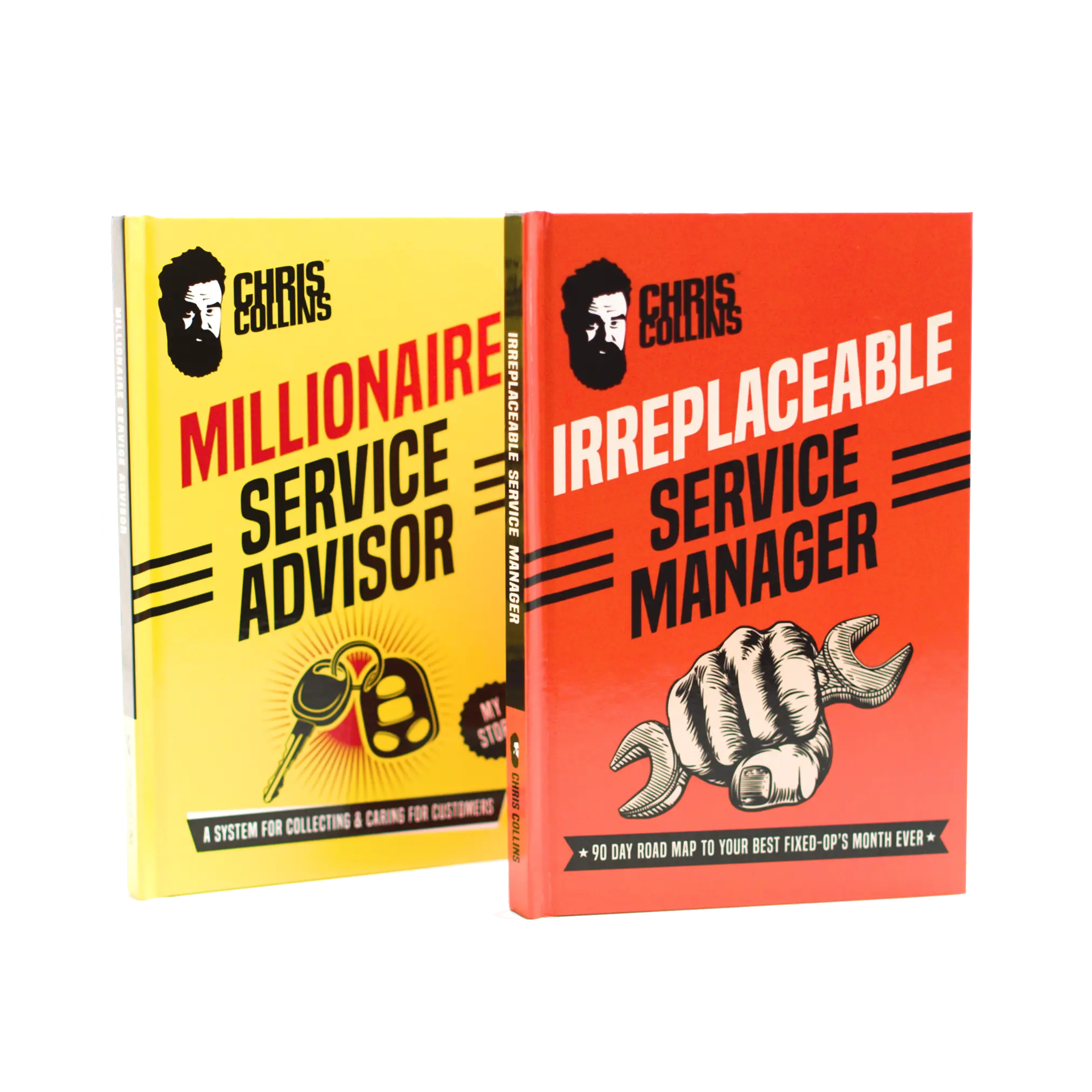
Achieving and exceeding your goals is possible when you have the right systems in place. With Service Drive Revolution OnDemand, you’ll gain access to the proven systems that have made thousands of SERVICE MANAGERS IRREPLACEABLE. Start transforming your department today!
Need help updating your playbook? Let us know how we can support your team’s growth.
Book a 15-minute strategy session with our team. We’ll explore how to unlock your dealership’s real value.