If you’re a SERVICE ADVISOR or SERVICE MANAGER, you’ve probably felt the sting of a customer saying “no.” Whether it’s an alignment, a brake job, or recommended maintenance, objections can feel like rejection—and too often, ADVISORS are trained to “push harder.”
The truth? Objection handling isn’t about comebacks—it’s about systems that prevent “no” from happening in the first place. It’s about fixing the system so customers rarely say no in the first place. In this episode of Service Drive Revolution, Chris Collins and Christian explain why chasing objections is short-term thinking—and what top-performing service departments do instead.
The Wrong Way: Treating “No” Like a Sales Objection
A lot of training in our industry comes from sales trainers who never wrote service a day in their lives. They teach ADVISORS to “ask three times” or keep pressing until the customer gives in. That might work in car sales—but in the service drive, it destroys trust.
But let’s be honest: how many customers enjoy that experience? It doesn’t build trust—it breaks it. And worse, it damages CSI and retention. Customers don’t want to be sold at; they want to be taken care of.
Think about it: by the time a customer says no, you’ve already lost the sale. Pressuring them further doesn’t build loyalty—it pushes them away for good.
🔧 Fixed Ops Reality Check: If your team is constantly trying to “overcome objections,” it’s a symptom of a deeper problem: broken systems, rushed write-ups, and a lack of trust-building early in the process.
The Better Way: Build Trust from the Start
Top-performing SERVICE ADVISORS don’t wait until pickup time to recommend work. They:
- Greet customers immediately at the vehicle (instead of leaving them waiting).
- Connect on a human level—talking about more than just the car.
- Present recommendations early and with clear value, not just price.
When customers feel respected and understood, they’re more likely to become “key throwers”—handing over the keys and saying, “Do whatever it needs.”
💡 SERVICE MANAGER Tip: Train your team to focus on connection and clarity, not pressure. ADVISORS who build trust upfront see higher CSI, stronger retention, and fewer objections overall.

Fixing the Real Cause, Not the Symptom
Instead of treating “no” as something to overcome, top performers ask: why did the no happen in the first place?
Most of the time, it’s because of weak systems:
- Advisors writing 25–30 ROs a day with no time to build trust
- Recommendations presented too late in the process
- Overemphasis on price instead of value
- Customers left to figure things out on their own during check-in
These proven SERVICE ADVISOR objection handling strategies help reduce friction, build trust, and eliminate unnecessary nos.
👉 Curious how other countries are solving the technician shortage while U.S. dealerships fall behind?
Read What Canada Does Better: A Fixed Ops Lesson for U.S. Dealerships
Why Systems Matter More Than Scripts
If your ADVISORS are writing 25–30 ROs a day, they don’t have time to connect with customers. That’s not a “sales skills” issue—it’s a system issue. High-performing stores redesign their processes so ADVISORS can:
- Spend time listening to customers.
- Use techniques like the table of contents method to build value before price.
- Involve customers visually (through inspections or walkarounds) so recommendations feel transparent.
This is where leadership makes the difference. As Chris says, “Don’t treat the symptom—fix the cause.”
What Top Performers Do Differently
SERVICE MANAGERS who last aren’t just good with numbers—they’re students of the game. They coach daily, not just in meetings. They recruit constantly, not just when someone quits. And they design experiences, not just fix cars.
Great advisors know:
- Trust is built at write-up, not at checkout
- Value should be explained before price
- Customers want relationships, not transactions
When you do this, objections disappear. Customers throw you the keys and say, “Just take care of it.”
👉 Want to know what top SERVICE ADVISORS are doing differently to outperform the rest?
Check out The Service Advisor Benchmark Breakdown: What Top Performers Are Doing
The Takeaway: Stop Playing the Short Game
If your ADVISORS are still being trained to “overcome objections,” you’re setting them up for churn-and-burn relationships. Customers might buy once—but they won’t come back.
If you’re focused on “overcoming objections,” you’re already behind. The best dealerships don’t train advisors to push harder—they train them to connect deeper. Build trust. Lead with empathy. Create systems that prevent the no from happening in the first place.
Instead, build systems that reduce friction, create trust, and turn “no” into “yes” before the objection ever happens. That’s how the best SERVICE MANAGERS lead—and why their departments consistently outperform the rest.
🔥 Final Thought: In the service drive, trust beats tactics. Build relationships, not rebuttals. Stop recycling the same objections. Build a system where customers want to say yes—because they trust you. That’s the real win.
Full Video Transcript
Welcome to the big show. Today we’re going to talk about how do your advisors overcome objections? How do they overcome a no? We have an exciting announcement about Top Dog and one of our speakers and much more coming up on this edition of Service Drive Evolution.
[Music]
Have we told anybody who the speaker is for Top Dog? We have a few, but the big name is a pretty big name. So, October 23rd and 24th is Top Dog. You have to be in our coaching or on demand in order to come, right? Yes. It’s included. It’s not open to the outside world, but Chris Voss. Never Split the Difference. That’s his book. Yeah.
I feel like never such a strong word. Like there’s got to be one time you would split the difference.
He’s the nicest guy, too. Yeah. He’s really cool. We’ll get him on SDR also coming up. But yeah, I think that’s soon. Really good. And then we have other guests that we don’t want to talk about yet, but it’s going to be a really fun event. I’m pretty confident and this happens every year that we topped the last year. I’m pretty sure we’re gonna top this will be the best ever. We’re on like our 13th straight year of being the best ever pretty much.
Yeah, we always try to outdo the one before. Do you think that’s because the way that we take that feedback that helps? It’s all of it. Yeah. But it’s definitely super intentional.
Yeah, it’s good. I took Winston in for service.
How’d that go?
I had to. Did you know that I got a flat tire? I did. So, I offered to change it and you laughed at me. Oh, really? Yeah. That is funny.
You were going to change it? Whatever you need. Do you know who changed it? You don’t? Michael, do you know how it happened?
I don’t. So, I’m ready for the story.
So, I was leaving here one evening. I forget what we were doing, but Missy, my significant other, was parked in the parking lot. Now, if you’re not familiar, you’ve never been to our office, we’re in downtown Los Angeles. Downtown Los Angeles isn’t the safest place at night. It’s a little suspect. I mean, during the day, it’s better. Still see some weird things during the day. But yeah, we’ve had three employees have their cars stolen, not just broken into. And you know what happens when your car is stolen and you call the police here?
What do they tell you?
There’s nothing they can do about it. You got to come down and fill out a report. They don’t even come to you. That’s where we’re at here in Los Angeles with the highest taxes in the country.
That’s so funny to put it that way. We have the highest income tax, highest sales tax. I don’t think our property taxes are the highest, but they’re not good. So we were leaving here and she was parked in that parking lot around the corner, and I was like, “Hey, let me drive you to your car.” So she gets in and I don’t know what I was doing or what, but I whacked the curb. She had a drink in her hand and it went all over. I just I don’t know. I was moving too fast. I wasn’t paying attention, but I whacked the curb and I was like, “Oh, but okay, it’s a Range Rover. I’m going to be fine.” No, she gets out and you hear. So then I’m like, “What do I do?”
Also, I was late for something. So I had Bustamante. Bustamante had just done Books That Changed My Life. That’s what it was. And he was coming to my house with his wife and kids, and I needed to get there. Be there. Yeah. And he’d left already. So that’s great. So, you know what I did is I went to the new building, parked it, and then hopped in with Missy. And then it took me, I don’t know, two days. But anyways, I put the spare on. So, it comes with a spare. This is the first car I’ve had in a while that had a spare. Yeah. I didn’t know if it did or not. And it’s like a half a spare. It’s like, “Okay.” So, it’s still a space saver. Can’t go, you can’t do much.
But I took it in. I made an appointment and I took it in for service, and waiting for the advisor, the whole, when it’s just when they’re not a client and you don’t know, it’s just the worst.
Yeah. Do you appreciate what we do? Yeah. But so the kid was super nice though. He eventually comes to his desk. I’m sitting there and he’s writing me up, and he says something to the effect of, “Aren’t you famous or don’t I know you or something?” And I was like, “No.” And then I got myself a new tire. They never offered an alignment. I feel like that’s the second time that’s happened to you. Yeah.
You know, I was torn. Would you have asked for it? Like I whacked that thing pretty good, but the rim wasn’t bent. I probably would have asked for it. Really?
Yeah. I didn’t because I wanted to see what happened, and then there have been a few times where I haven’t gotten service because I was testing to see if they’d ask, and then I should have done it. Alignments a couple of times. He didn’t even ask what happened. Like none of that.
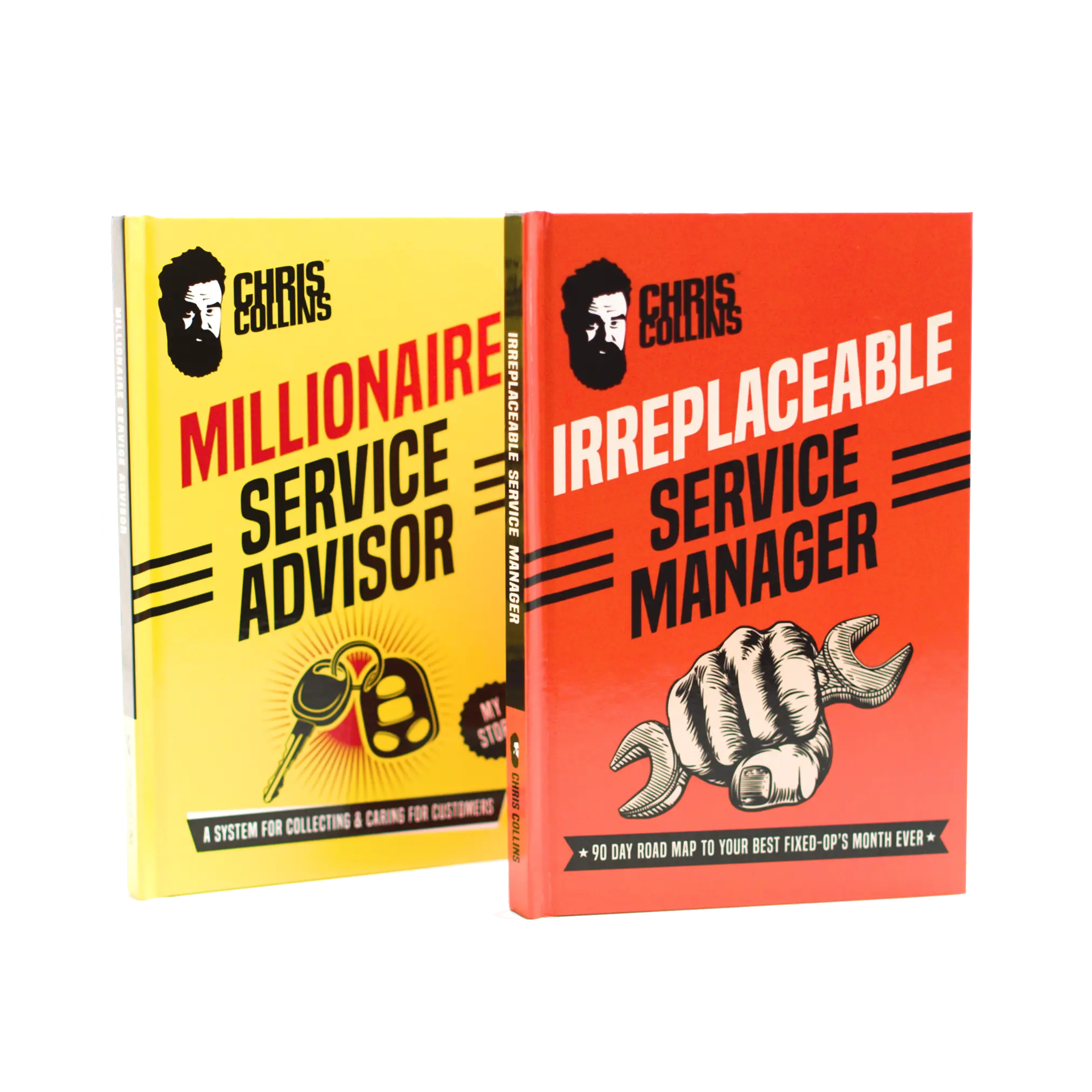
And then when I went to pick it up, I mean, they got it done. Everything was really good. Good communication, the whole thing. I went to pick it up. He goes, he pulled the car up himself, the advisor, and he said, “Hey, I just want to let you know, like when I first started, I read Millionaire Services.” And I was like, “Oh, damn. He knows who I am. Figured it out. Got me.” That’s great.
Did he compliment the beautiful color of the car? No. Oh, that’s such an easy thing to say. Oh, wow.
When he wrote me up, it was that whole thing that happens, is like you’re greeted by a greeter with a clipboard that’s like, “Do you have an appointment or not?” kind of a thing. And then you’re put an advisor desk and there’s no advisor. And then you wait. And then the advisors on the other side are like, “Oh, I don’t know where he is, but he’ll be back.” And then you’re just sitting there. Yeah. And then he just walks up and writes you up. Like they don’t, it’s not our system. Yeah. And it just is a reminder of how off-putting the system of go find the advisor is. You just feel kind of like, “Oh, am I going to get helped? What’s going to happen?” It’s that sort of thing. Yeah. But he was really nice. He was great. So it was nice. But with a little bit of direction, he could be amazing. Yeah. Yeah, like I don’t understand why they didn’t offer an alignment. Also, give you a little bit of better direction.
Aren’t they pretty close to the first oil change? How many miles you have on it? 6,000 maybe. It’s almost been a year. Yeah. With an alignment and an oil change.
I thought about you the whole time, though. I was like, “Oh, Christian would love this.” Yeah. Not only because if you have to choose between the two of us, which is who is most likely to hit a curb and blow a tire, it’s not you.
Oh, I know. I don’t know. I’ve had a string of like that where I’m just dropping stuff. Like I go to open a bottle and the cap falls on the ground or something. I don’t know. I noticed I’ve got soreness that I haven’t had before. Like I’m finding new places to be sore on my body. I went hiking. It’s getting old. I went hiking last week and I thought I was going to die.
How far did you hike? Four miles. It’s a lot. Yeah, it was a good walk. And we saw a rattlesnake. I’m not into that.
Yeah, I thought of you. And I think someone even said, ‘cuz I was with a group of co-workers, and some even said like, “Oh, I think Chris would like this.” And I said, “No, no, he wouldn’t.” I can’t believe when I was a kid, we used to kill rattlesnakes. Like, it seems insane to me. I have no stomach for that now.
No. And it was so crazy, like the rattlesnake was there, and like it just shaker like the whole thing. So it had a shaker but it wasn’t shaking, so it was pretty calm, but I’m probably 10, 11 feet away.
Where’s Claudia? Right up on it trying to take a picture. Oh my gosh.
My wife, like she, it’s a beautiful unobstructed picture, man. She’s got to have. Claudia is good at taking a picture, though. She is not afraid of rattlesnakes or taking a picture. That was the second rattlesnake encounter we had together. The other one I almost stepped on one a few years ago, and she was totally calm, and I was running down the hill like a just crying. Not crying, but screaming.
It’s funny. There’s been times where Claudia’s taking pictures, and in the moment I’m like, “God, I wish you wouldn’t do that.” And then later I’m happy she did it. Yep. Kind of torn with that. This is another one of those things kind of breaks the fourth wall in a sense. It does. And this was advice that you gave me many years ago that you have all these things where I think you’ve given me advice and you don’t remember that you probably did this, but you said ‘cuz I was like I was probably complaining to you that I was annoyed about how much she does it, and you did a thing where you’re like, “Hey, look at her when she takes the pictures and she does the videos and like how special she feels.” And you said, “Don’t rob her of that moment.” And since that day, I’ve supported the whole thing. And it’s like she’ll go through I’ll look at her, and in a month she’ll look at those pictures from that hiking excursion like that. It’s a thing. So it does, it’s no skin off my nose, that she wants to take pictures. But that was Chris Collins advice that has really stuck.
Yeah. Also, the younger somebody is, the more that’s their reality is taking pictures. Yeah.
I always think that you can not have an experience if you’re just worried about the photo. Yeah, me too. Like I want to have the moment. Breaks the moment to me. So you also like you’re worried about the photo sometimes. Yeah.
So I don’t take those photos so I don’t worry about it. But she does. That’s funny.
It’s good though. So, Top Dog, Chris Voss, here in Los Angeles, October 23rd and 24th. It’s going to be fun. It’s going to be some surprises. Make your reservations pretty quickly. I would suggest that it’s going to fill up. Yeah, we’re doing it here at the library, and it’s going to fill up pretty fast. Yeah. But it’ll be fun. I guarantee there will be at least two jokes.
We will see. Okay.
What’s in the news? Like, man, some dealers are struggling with inventory, huh? Yeah. I was looking to see if I could find because we were talking about that the other day. I didn’t find any specific inventory articles, but I know that it’s a thing. Like there’s some people have none. Like Toyota dealer, a lot of Toyota dealers have two cars, and then other brands have just miles of inventory. It’s super crazy. But first I just thought I would let you know that this just came out yesterday. 312,000 Fords were just recalled. No, you’re lying. Super weird. That’s impossible. So, I thought that was pretty funny.
But it’s a loss of power brake assist. Like, who needs brakes anyways? Honestly, that’s so good for the dealers ‘cuz people have to come back. Yeah. It’s okay. It’s a great retention tool. Let it happen. Do you think they do it on purpose?
No, because most Ford dealers probably don’t even do an inspection. Well, they should start. And then this was something I thought was very important to you is that letting you know that Uber has purchased 20,000 Lucid self-driving vehicles to use in their fleet. But I don’t want you to be too worried because they’re going to be pre-programmed with the same five stupid questions that current human Uber drivers ask. Which on what? Where you coming from? You in town for business or pleasure? Where are you staying?
Well, you’re making it sound like you only take Ubers when you’re out of town. I do. I only take Ubers when I’m out of town. I take Ubers here. What do they ask you here? Nothing.
Most of the time they’re Russian and they don’t speak English, and they look nothing like the picture in the app.
That’s funny. I do like that you and I’ll say that, too. I’ll be like, “Hey, this doesn’t, I think this is the wrong, doesn’t look like you.” And they get real quiet.
Oh, that’s my wife. Yeah, they have the selection on there now where you can choose to tell him to be quiet. Did you see that? No. Yeah, you don’t have to talk to him anymore. All right.
See, what else do I got? This is also I thought you might find this a little bit interesting. There was just like a plethora of net income losses. They everybody blamed the tariffs, but I want to see. So I’m going to have you. This is a surprise loser. This company had a net income drop of $3.3 billion. What company do you think it is? No idea. Toyota.
Really? See, I told you you’d be surprised. What’s that from? They blamed it on tariffs. It says is the tariff 25% out of Japan, right? Yeah.
I think that’s the problem is 15. Well, they source stuff from other parts of the world, right? Yeah. I don’t think they make any sort of metal or earth or anything like that in Japan. They’re importing all their raw materials. That’s right. Let’s see. Ford had to take out a $3 billion loan amid tariff uncertainty. So the tariffs really hit a lot. And then you got Hyundai. They didn’t talk about net, but they talked about they had a record high revenue of 35.2 billion in quarter 2. So Hyundai kind of seems like an up-and-comer. Volkswagen down 1.58 billion. It’s a tough time to be in variable, I guess. But you know what cars are still going to do, Chris? Break. They’re going to break. They’re going to need maintenance. Yeah. And tires. And people are still going to hit curbs.
You want to know how much? So, did you know, like on Winston, my trusty Range Rover, I hit the mirror on the passenger side on one of those Breaking Bad RVs on my way into work.
Wow. So, there was like a garbage truck on the left and I had nowhere to go, and I whacked this RV that was parked there, actually kind of in front of a school, too, which is so weird. And so, I asked the advisor, I’m like, “Hey, check that out for me. I need to get that or whatever.” Guess how much the mirror is on that thing?
2,500 bucks. Let me preface this by saying, “You should call your insurance company,” is how he started. 4,000. More? 6,000. Five. There’s like 4,800, I think, or something. It’s never good when it’s got a camera in it. Is that not crazy? That parts manager has got to have a matrix. He calls it the mirror. It’s all parts. The mirror spot. Oh my gosh. That $5,000 mirror. Freaking Breaking Bad RVs.
Okay. What do you do when a customer says no?
So, this subject is prompted by Christian doing a strategy session with the dealer that he declined to do business with. Cuz the customer or the dealer was just adamant that all he needs is his advisors to learn how to overcome objections. That fixes all his problems. That was it. It was so interesting. I tried to pivot to things like profitability and customer experience, and it was just so far back the other way.
And isn’t it funny when people get on that strategy session, they don’t know that you’re interviewing them more than they’re interviewing us?
They have, I would say they don’t know. Yeah, for sure. I think that’s. Well, that’s kind of the industry, right? Like in a lot of cases, I think that there’s a lot of people out there that would just take whoever they could get. But we have a very specific person environment that works really well. And it’s not for everybody.
No. And I just think that we’re small enough that we can go where we want to go. This inspired this topic because people think, “Oh, I just need my advisors to learn how to overcome objections.” And so we kind of have a different philosophy on that. I know that there is advisor training out there that works on this, and it’s a big deal. But I will say a couple things in response to that. One is that is a symptom. You’re treating a symptom, not a cause. That’s right. And if your training is based around fixing symptoms, you’ll always be in business, but you’ll never get ahead.
And you know what’s different about the way we approach things is we judge oursel, our coaches are compensated on the profitability of our clients, not time spent or training spent. It’s on the outcome. So what we do is we gravitate towards the things that are more effective, and to just treat the symptom is not effective. We want to fix it. We want to fix the thing.
Also, I would say that in my experience, advisors that overcome objections usually have pretty low CSI and low retention, because people don’t want. Like, by the time somebody’s saying no, it becomes date rape. Yeah. Like just imagine back when you were 16, and you had all that testosterone running through your body, and let’s say I don’t know where you went with girls in your car. Boy, what was that like for girls with you driving them on a date? Yeah. Did that ever ruin things?
Definitely. I do remember one night I was taking a girl home, and possum ran out in front of me, and I swerved and totaled the car. That affected. We didn’t have a date after that.
What kind of car was it? It was a ’78 Mercury Zephyr. How old were you?
Exactly 16. How was the insurance after that? Or did you just push the thing in a ditch? You know what? Well, yeah. So, we didn’t do an insurance claim. We took it to the junkyard, but there was nothing after that. Nothing after that. So, that was my driving has probably caused me a couple of really potentially decent relationships.
But let’s just say like you’re 16, and you’re on a date with the girl, and then you’re like, “Hey, let’s make out.” And then the girl says, “No.” Now, is it a good idea? Like a bunch of guys are listening to this going, “Oh, I got a line for that. I could overcome that objection.” It’s verging on date rape. Yeah. Don’t do it. Don’t ask. You’ve already. If you get to that point and the girl says no, it’s too late in my opinion. Like I don’t know. I try to do things where I don’t have to ask permission or have to ask for something that I would get a no. Like just the idea that you’re asking a yes or no question, in a sense you’ve already lost before it started, because now you’re flipping a coin. It’s a 50/50. Yeah. You could have it so set up, the road so beautifully paved that you wouldn’t have to worry about a thing. And there is advisor training. One of the top advisor trainings in our industry teaches you go ask again. You ask them when they pick up the car. You ask over and it’s date rape. I’m telling you, like it’s too much. Like the perception that customers have of us already. We’re at a disadvantage. What we want is we want to build relationships. We want key throwers, right? And so the whole basis of our advisor training is that we create relationships and we connect with customers on a human level that when they come in, they’re throwing us the keys and they’re saying like do whatever it needs, and we’re good stewards of that trust versus “Hey, do you want to do that alignment? Hey, do you want to do that alignment? Hey, remember you got to do that alignment.” Like it’s date rape. Yep.
I remember it was one of the first things. I think I was sitting in right when I started with you. You were doing an advisor training class, and you said, “Hey, if you ask somebody five times to do an alignment, you will never see them again.”
Yeah, I wouldn’t. Would you come back? No, it’s too much. Like it’s so funny, too, in our industry sometimes, that if you were the consumer, you would never come back, but you’re okay doing it to other people. Like what was I doing the other day where somebody was like, who was somebody goes, it was somebody trying to fix some I told them to go fix something and they were like, “Yeah, but I’ve never been that.” And I was like, “Yeah, but you’ve been a customer.” Like we don’t, you don’t have to know every. Like what we’re doing is we’re designing systems around the customer experience. The way you do that is to see it from the customer’s point of view. Yeah. Not from our point of view. And if you’re a customer, then that’s an easy thing to. It’s easy for me to understand how awkward it is for a customer because I am a customer. And so we want to design it from the customer’s point of view, not from what we think.
Here’s what happened in the old days at NADA is they’re all sitting around and they’re all sales trainers, right? And there’s Joe Varity and all these guys. And then the worst of all the sales trainers, they were like, “Hey man, why don’t you do advisor training?” And he goes, “I don’t know anything about service.” And they’re like, “It’s just sales. Just teach them how to sell.” And they’ve never written service a day in their life. They don’t understand what it’s really like. And then they’re like, “Oh, ask three times.” You can ask three times when you’re selling somebody a car. It’s a completely different transaction. I would still contend that that is a symptom, but that you’re not looking for them to come back and buy another car, right? Most people buy one car, and then three years later they’ll buy another car. You have enough time to, once they buy the car, that they’re in this new car ether, that you can mend whatever it is that you did being a little heavy-handed in the transaction.
Yeah. The service side, it starts out broken. Yeah, it’s different, and unless you’ve written service, you have no idea. So when you apply sales training, and this idea of “Oh, overcome objections, ask three times,” you have never written service or cared about customers. Yeah, that’s well said. You’re all about skinning instead of shearing, right? That analogy of you can shear a sheep over time or you skin them. That’s you’re one and done. Yeah.
So, overcoming objections to me, when you get an objection, you already lost, and you should trace back to the birth of where that went wrong. Right? And so if we’re just kind of going through the process for the customer, most advisors lose it. They lose the trust at the write-up. And so if you want to sell more and have less objections when customers pull in, and our systems are designed around immediately putting the customer at ease and taking away decision-making. Like when I took Winston in for service, somebody greets me, but then I’m wondering who’s going to help me. And then I go sit here and I’m sitting there by myself and I’m wondering, “Did you sit at the right desk? When am I going to get out of here? Who’s going to, like, how long is it going to take?” You want to take away all of that because, and you know this is real psychology and how it works with people, is people have frames, right? And so if somebody feels awkward and uncomfortable in a situation, what does that regress them to most of the time? Childhood, like being a little scared kid in elementary school, and your first day of school going to a school dance by yourself. Those sort of frames and those feelings create chemicals in our body that hit our brain, and when they hit our brain, they remind us of the other things that have had those same chemicals. So you either consciously or unconsciously regress back to those awkward feelings. When you regress customers like that to an awkward feeling, they are in fight or flight, and they want to get out of there as quick as they can.
Now a customer comes in, and you greet them right away. You go meet them at their vehicle. You talk about them and not just the vehicle. You connect with them like they’re humans. Treat them like real people, not like a transaction. That’s close. Well, now we’re regressing them to a friend or to family, right? That’s where you lose it more than anything. Like, if you’re doing that and you’re really connecting with the customers on a human level, if you’re getting an objection, it most likely is going to be because they can’t afford it. Right. Really? If you’ve connected, right? Yeah. So then all of this is based on the system that you’re running, and so that’s the first part. The second part would be when you’re recommending it. So are you recommending it at write-up? Are you recommending it when they’re on their way to pick it up? The earlier in the day, the better chance you’re going to have of sale. Right. Yep. And then probably the next one is are you presenting it when it’s all about price? Are you using the Table of Contents Technique, which is a technique we teach that keeps you off of price and builds value. Are you building value? Because once you drop the price, that’s all they hear. And that’s one, you know, it’s out there that people say, “Oh, Chris Collins doesn’t like video inspections.” That is not true. That’s the furthest thing from the truth. But if you bypass the understanding of human behavior and human psychology and you think that a video inspection is going to make things better, but you’re introducing price at the wrong time in the wrong way, it’s going to hurt you. It’s not going to help you. So, just like anything, it’s about the system and how you do it. And garbage in, garbage out. Like that’s just, a video inspection can be very powerful if it’s presented and done in the right way. But unfortunately, [Music] most of us think that it’s a band-aid and a fix-all, and we’re not paying attention to how, when, and the nuances of what we’re doing in a sense, right? So just going right to price is going to get you more objections than building value and listening, and then how you package it, how you present it, all of that.
Yeah. I’ve had a ton of times when I was an advisor where I call someone up, and I mean you probably had this too, like where if you have it all done, it’s like, “Hey, we need to do this and this.” It’s like, “Okay, get it done,” but they don’t even ask what the price is. Like it’s so far from the truth, because they, or from what their head, that they just want to be helped out.
Oh yeah. When I was an advisor, I would have key throwers. Customers would say, “Chris, just do whatever it needs.” And then I would be like, “Yeah, but man, it needs two grand. I need to call them.” And I would call them and I’d be like, “Hey, Chris.” They’re like, “I told you just do whatever it needs.” I go, “Yeah, but I just want to run you this by.” And then you’re like, “Well, it’s going to be two grand.” And they’re like, “Well, what is it?” And then you tell them, they’re like, “Yeah, no, do it. Can you get it done today?” Like, but that’s because of trust. And it’s also because I didn’t betray that trust. I wasn’t doing things that they didn’t need either. Like we say in our training all the time, treat it like it’s your mom’s car. Like would you tell your mom to do an alignment? I would if it was due. Yeah. I would tell her to do a fuel service. Like and so if you treat them with that sort of respect, you have long-term relationships and it’s not just a churn and burn.
The other thing I would say about the objections and the no is if you’re running a quick lube and you got your least talented advisors writing 25 or 30 a day, and you’re handing them over to other advisors, you’re breaking the trust. There’s no relationship there. It’s all just about volume. The other thing is if your advisors are writing 25 ROs a day, they don’t have time to connect with customers. And so yeah, you’re going to get more objections, but once I would just go back to it’s date rape, they’re not coming back. Yeah. And then if you’re not looking at all those other things, the only thing you have to go off of why they said no is price. But it could be 14 other reasons they said no.
And the thing that I always think about, and I thought about this when I was an advisor, is if a customer needs brakes, and they decline the brakes, does that mean that they’re not going to have to do their brakes? No. It means they hate you. It means that they’re going to go somewhere else, or they don’t trust or believe in me. Yeah. And that’s a deeper thing that isn’t about how do you overcome that objection? I don’t know.
The another thing I would say too, when I was an advisor, is there were certain things that I knew that I would get a no on, and so I would make sure that I had the car up in the air. Like for example, I wrote service for Subaru, and those Subaru loyals, bless them, the head gaskets would leak. It wasn’t even a real head gasket. It was the liquid stuff, wasn’t it? Yeah. And they would leak. Like they would leak sometimes after we replaced the head gaskets. Like it. And so just at a certain time you knew, like around 100,000 miles, those Loyals, they were going to be leaking coolant out of the head gasket. And if I called a customer and I said, “Hey, your head gasket’s leaking,” and then I said, “It’s $1,200.” More than not, the customer would say, “Okay, I don’t want to do that.” But I learned by doing a car clinic and showing customers that the visual of them actually seeing the dried coolant on the engine, they felt different about it, and I got more yeses. And so to avoid having a no, I learned from the tech how to put them up in the air. I would ask the customer, “Hey, Christian, what time are you planning on picking it up? When you come in, I have something I want to show you.” And then I would take them back in the shop and I would show them and they would go, “Oh, I’ll leave it.” Most of the time they’d be like, “Yeah, I’ll leave it. Do it.” Because it took a couple days to do that job. But once again, when I would get nos, I would fix my system or the process beforehand, not get better at overcoming objections.
Yeah. You let the no be data. Yeah, that makes so much sense. There’s no training for overcoming objections in service that is effective long term. It might be effective in the minute. Like, yeah, you might sell a little more, but they’re not coming back. Yeah. It’s the short game. It really is. We got to think big. So, don’t treat the symptom. Try to figure out what the cause is. That’s the way to overcome objections or overcome no.
And then I think another one too, you would say this is one thing that leads to that more than anything is car talk. Like when you’re talking about viscosity, and things that customers have no idea. No, at all. So, putting things in simple terms that is human that they can understand while you’re building value is a big part of it, too. Because when you start talking about things people don’t understand, they feel like they’re not smart or they’re dumb, and they don’t want to ask, and so they just decline it because it just seems crazy. So, it’s really important to present it in a way that’s customer friendly, not car talk. I feel like that’s. I don’t know if insecure people, insecure advisors, do that because they want to feel like they’re superior to the customer, but I’ve never had that work.
And thank God, I don’t know anything about cars.
Well, I also just think that all of the training that the chemical companies do on explaining the benefits of this and the temperature and this and that. Never once did I ever need any of that to sell anything. Like, it’s maintenance. It’s due. I have your trust, and they’re going to do it because they trust and like me, not because of science. In fact, science scares them away in my experience. Yeah. Like, “Well, your brake viscosity.” Like, what?
That’s so funny. That’s good. Let’s see. Is that? Yeah, it’s pretty much your whole list. I had a couple other ones. One was like the repair planning, right? When you get a no, but it’s like, “I can’t afford it,” and then work out the option for them to do it over time. I thought that’s really good, breaking it down in terms of the different sections that you could do. And then the last one I had when someone tells you no is you cry the way you get out of a speeding ticket, and see if that changes everything.
Yeah. I was going to see if you want to hear a joke.
I always want to hear your jokes. So it’s an animal joke. One of your favorites. So a penguin walks into a bar, waddles up, hops up on the bar stool, looks at the bartender, says, “Hey, you got any fish?” Bartender looks at the penguin, “No, I don’t got any fish. It’s a bar. Like we have Schlitz.” So the dejected penguin hops off the bar stool, walks out of the bar. Next day comes back in, hops up. “Have any fish?” Bartender says, “No, I didn’t have any fish yesterday. Don’t have any fish today. I probably won’t have any fish tomorrow because it’s a bar.” And the penguin gets down off the stool, heads out, comes back in the next day, looks at the bartender, says, “Hey, you got any fish?” He says, “If you ask me that question again, I’m going to nail your beak to the bar.” And the penguin quickly gets up and goes out. And then comes back in the next day and says, “Hey, you got a hammer?” The bartender says, “No.” “You got any nails?” Bartender’s like, “No.” “Do you have any fish?”
And we’ll see you next time on Service Drive Evolution. Thanks so much for watching this episode of Service Drive Evolution. We’re uploading new stuff every day, so make sure you subscribe and click the bell icon so you don’t miss out. If you have a question you’d like us to answer on the show, call 833-3-ASK-SDR, and we’ll answer your question on the show. That’s 833-3-ASK-SDR. For special deals on our books and training, head over to chriscollinsinc.com/services. Now that’s chriscollinsinc.com/services. I’m Chris Collins, and I’ll see you in the next video.
🔗 Related Resources:
- What Canada Does Better: A Fixed Ops Lesson for U.S. Dealerships
- Top Fixed Ops Performers: What Car Dealership Service Managers and Advisors Do Differently
- The 9 Reasons Why Service Managers Fail (And How to Avoid Them)
- The SERVICE ADVISOR Benchmark Breakdown: What Top Performers Are Doing
Feel free to explore the linked articles above for deeper insights into each strategy. If you have any further questions or need additional resources, don’t hesitate to ask!
Achieving and exceeding your goals is possible when you have the right systems in place.
With Service Drive Revolution OnDemand, you’ll gain access to the proven systems that have made thousands of SERVICE MANAGERS IRREPLACEABLE. Start transforming your department today!
Need help updating your playbook? Let us know how we can support your team’s growth.
Book a 15-minute strategy session with our team. We’ll explore how to unlock your dealership’s real value.