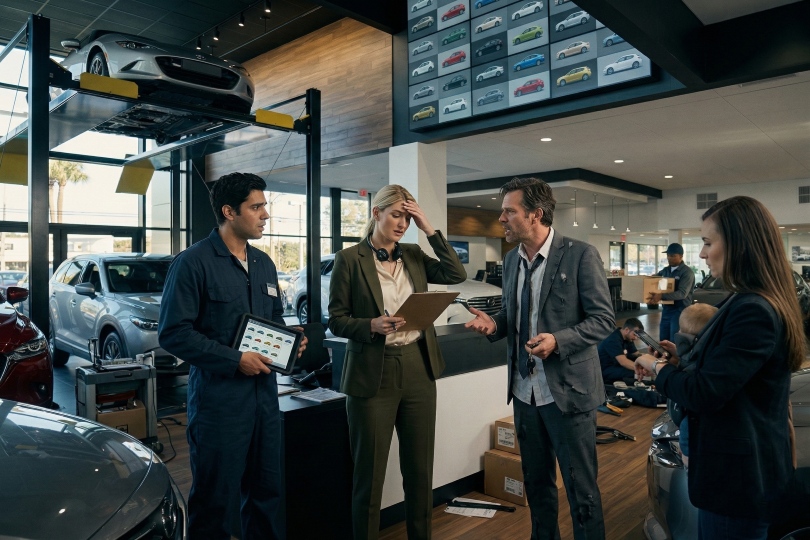
When everything is moving smoothly, your team feels unstoppable. But then, suddenly, things slow down. Calls go unanswered, customers are frustrated, and your staff feels stretched too thin. These are the cracks caused by peak demand bottlenecks—and if left unchecked, they can disrupt your entire operation.
So, what can you do? It starts with identifying these bottlenecks and tackling them head-on with smarter processes, solid teamwork, and the right tools. This blog breaks down the key steps to keep your service lanes running efficiently, even when demand peaks. Keep reading to find out how small changes can lead to big results for both your team and your customers.
Key Takeaways
- Manual workflows and paper forms slow customer interactions and reduce profitability.
- Misassigning expert technicians to basic tasks wastes labor value and stalls complex repairs.
- Digital systems improve technician accountability and automate routine communication.
- Proactive off-season outreach and organized parts inventory prevent department overloads.
- Protecting peak phone windows and providing automated updates reduces lost leads.
- Standardizing shop organization via the 5S methodology removes physical barriers to efficiency.
What Slows Service Departments During Peak Demand
Service managers frequently find that while high demand is the goal, the internal friction of the shop becomes a significant barrier to profitability. While a lack of personnel is a common complaint, the root causes of these slowdowns often reside in organizational habits and decision-making processes. Identifying where these “gremlins” hide is the first step toward clearing the path for a smoother season.
● Disorganized Workflows
Clunky, manual processes act as invisible speed bumps throughout the day. Relying on old-school paper forms for multi-point inspections (MPIs) or check-ins adds unnecessary minutes to every customer interaction. When digital systems do not communicate with one another, a routine five-minute vehicle drop-off can easily balloon into a 30-minute ordeal for the client. These delays compound, creating long lines at the service desk and a general sense of chaos that frustrates both staff and customers.
● Approval and Diagnostic Delays
Productivity often halts when communication breaks down during the repair process. Technicians frequently find themselves waiting for customer authorizations, and “phone tag” keeps service bays occupied by non-productive vehicles. Furthermore, modern vehicles require comprehensive diagnostic procedures that rely on specialized equipment. If a shop only possesses a few scan tools, technicians end up wrestling over resources or waiting for a tool to become available. This lack of specialized capacity creates a literal bottleneck where work cannot progress despite having the labor and parts available.
● Poor Talent Matching
Wasted talent is a hidden drain on a dealership’s potential. Inefficient scheduling occurs when a master technician—a highly skilled expert—is assigned to handle basic tasks like oil changes or tire rotations. Meanwhile, complex diesel or electric vehicle (EV) repairs sit untouched because the right specialist is busy with a generalist’s workload. Failing to align the right job with the right skill level reduces the overall throughput of the shop and prevents the dealership from maximizing the value of its most expensive labor.
● The Cost of Waiting
Time represents the true inventory of the service department. Every minute a technician spends searching through a messy parts room or waiting for a manager’s instruction is cash disappearing into thin air. If the shop layout requires employees to walk long distances for tools or dodge clutter to reach a lift, the facility itself becomes a bottleneck. When technicians are not “turning wrenches” due to poor organization, the dealership burns money. Managers focusing on how to grow profits with service sales funnels must first establish a smooth operational baseline.
● Communication Gaps
Internal silence is the enemy of efficiency. If the parts department fails to notify advisors when a special-order component arrives, cars sit idle in precious bay space for days. Recognizing how parts department inefficiency hurts your dealership helps leaders address the root of the problem before it escalates.
Advisors who are overwhelmed by phone calls may fail to provide timely updates, leading to a breakdown in customer trust. Such gaps in transparency ensure that by the time a vehicle finally rolls out, it may have hit three or four different bottlenecks, resulting in a declined repair order (RO) or a lost customer.
Five Ways to Prepare Your Service Team
Proactive planning with modern management tools enables teams to work smarter rather than harder. By taking specific steps during the off-season, managers can squeeze more efficiency out of their existing resources. Preparation should ideally begin in the late fall or early winter to forecast demand accurately.
1. Start Early Outreach
Don’t wait for the spring rush to see your customers. Smart managers reach out months in advance to schedule routine maintenance, check-ups, and critical software updates. Offering pre-season maintenance specials, such as bundled oil changes and blade sharpening, encourages clients to bring in equipment before the chaos begins. Such a strategy levels out the service load and prevents the department from becoming overwhelmed by a sudden bulk of requests in the spring.
2. Organize Your Parts
Surprising a customer with an “out of stock” notification is a recipe for a poor reputation. Use digital inventory management tools to monitor essential parts and automatically adjust seasonal supplies based on historical customer demand. This is also the perfect time to identify obsolete or “dead” inventory that is taking up valuable space and tying up capital. Having fast-moving maintenance supplies like filters, spark plugs, and belts ready on the shelf reduces repair turnaround times significantly.
3. Go Digital with Timing
Manual, paper-based timesheets are labor-intensive and prone to error. Transitioning to a mobile app as part of a dealership management system (DMS) allows technicians to digitally document their time with high accuracy. This shift eliminates the stress of the service office trying to decipher handwriting and guarantees better accountability. Managers can then coordinate tech schedules in real-time, prioritizing urgent jobs and providing transparency for the entire team.
4. Automate Regular Tasks
Repetitive tasks should be handled by software to free up your human talent for complex problem-solving. Service automation tools can track job progress and provide quick, consistent communication to customers via reliable digital messaging features. Online portals give clients a convenient way to review work history, pay service invoices, or make new requests from their mobile devices. These tools ensure that even on days when service calls reach triple digits, the dealership maintains a high standard of professional communication.
5. Study Your Data
Data collected during the busy season should influence decision-making for the rest of the year. Use DMS reporting to break down seasonal sales data, identify top-moving models, and track inventory turnover rates. Knowing your service department’s load during past peak weeks helps you staff correctly and avoid overstocking slow-moving items.
Solving the Staffing and Space Puzzle
A significant bottleneck can often be traced back to the physical layout of the shop or the way the dealership manages its human capital. Addressing these structural issues requires a long-term commitment to a culture of improvement. Industry leaders like Chris “Bulldog” Collins advise breaking down old processes to build new operational frameworks that clear bottlenecks.
● Focus on Retention and Careers
The technician shortage is a national challenge, with technician turnover often exceeding 35% annually. To compete with independent shops that may offer higher starting pay, dealerships must focus on offering clear career paths and comprehensive benefits. Building relationships with local trade schools and sponsoring scholarships can help create a pipeline of fresh talent. Through fostering a culture where learning is celebrated, you create an environment where master technicians want to stay, reducing the 90-120 days it usually takes to fill a high-level position.
● Cross-Training
Flexibility is the antidote to a department being “stretched thin”. Cross-training employees allows them to jump between roles when one area becomes a bottleneck. For example, if a technician is waiting for a part, they can assist with a quick job in an adjacent bay rather than standing idle. Such a collaborative approach ensures that the momentum of the shop never grinds to a halt.
● Clean and Standardize (5S)
The 5S Methodology provides a systematic way to keep a shop organized: Sort, Set in Order, Shine, Standardize, and Sustain. Sorting involves clearing out the clutter of old o-rings and half-empty cans that slow down work. Setting in order ensures every wrench and scan tool has a designated home, making them easy to grab.
Managing the Phone Rush
The most damaging bottlenecks are often those you cannot see—the missed calls and on-hold hangups that drive customers to your competitors. Your phone system may be costing you significant revenue if it is not designed to handle peak volume.
● Protect Peak Hours
Industry data from nearly 3,000 dealerships shows that Monday morning from 10:00 AM to 12:00 PM is the universal peak window for inbound calls. Managers should “protect” this window by banning all-hands meetings, training sessions, or deep-work blocks during these two hours. Treat this time like a Saturday showroom rush, guaranteeing every available staff member is ready to answer the phone. Failing to do so can lead to a 31.8% hang-up rate as customers lose patience while sitting on hold.
● Separate Status from Booking
High-value booking calls often get stuck in a queue behind low-value status inquiries like “Is my car ready?” Dealerships can fix this by dedicating a specific phone line or menu option to service status updates. Proactively using automated SMS updates can also reduce the number of people who feel the need to call for an update in the first place. That will make your advisors focus their energy on the calls that actually generate new revenue.
● Avoid the Voicemail Trap
Voicemail is often just “deferred abandonment” in the eyes of a customer. Research indicates that roughly 70% of callers who hit a voicemail will dial a competitor within 30 minutes instead of waiting for a callback. During peak hours, nearly one-third of non-connected calls go straight to voicemail, and most of those prospects never convert.
Frequently Asked Questions (FAQs)
Service departments experience severe bottlenecks when customer vehicle drop-offs heavily outnumber available technicians and service bays during morning rush hours. Insufficient staff scheduling combined with parts shortages quickly stalls repair progress and creates massive backlogs across the shop floor.
Service advisors spend too much time handling walk-in customers and writing up repair orders instead of communicating with technicians. Mechanics then sit idle waiting for diagnostic approvals or component deliveries from the parts counter to finish current repair jobs.
Treating every incoming vehicle with equal urgency forces simple oil changes to wait behind lengthy engine repairs. Dispatchers fail to route quick jobs to lube technicians, leaving highly trained mechanics tied up on basic tasks while diagnostic work piles up.
Service managers fail to pre-order items for scheduled appointments, forcing mechanics to wait for standard inventory deliveries. Poor communication between the service drive and the main shop leaves advisors unable to update customers on accurate completion times.
Bottom Line
Now, that’s a wrap! Keep in mind that in order to stay ahead and keep customers coming back, addressing peak demand bottlenecks is a must. Ignoring these issues risks losing sales, hurting your team’s efficiency, and frustrating customers enough to look elsewhere. Take the steps now to streamline operations and protect those critical hours that impact your bottom line the most. If this was helpful, share it with others so we can keep building valuable conversations!
Achieving and exceeding your goals is possible when you have the right systems in place. With Service Drive Revolution OnDemand, you’ll gain access to the proven systems that have made thousands of SERVICE MANAGERS IRREPLACEABLE. Start transforming your department today!
Need help updating your playbook? Let us know how we can support your team’s growth.
Book a 15-minute strategy session with our team. We’ll explore how to unlock your dealership’s real value.