Getting customers to choose your service department can get a bit challenging. People have so many options, and standing out while keeping them interested isn’t easy. If they don’t know what you offer or why you’re the right choice, they’ll likely go elsewhere.
A well-structured service sales funnels can change that. It guides potential customers through each step—from learning about your services to booking an appointment and returning in the future. Using a clear process that focuses on their needs will let you build trust, boost loyalty, and increase sales without overcomplicating things.
Want to know how to make this work for your service department? Keep reading, and we’ll break it down step by step.
Key Takeaways
- Dealerships map the customer journey through six stages to improve the buyer experience and increase profits.
- Digital marketing through SEO and social media captures interest where most shoppers begin their search.
- Easy booking systems and personalized communication from the consideration stage to a service appointment.
- Retention efforts like loyalty programs and automated reminders lower costs compared to finding new leads.
- Monitoring specific metrics reveals service sales funnels gaps and helps managers allocate marketing resources more effectively.
Understanding the Service Sales Funnel
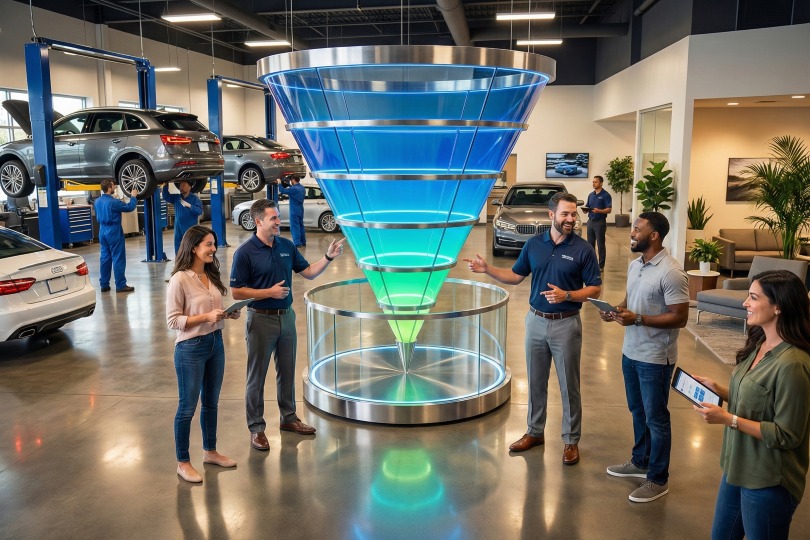
The service sales funnel acts as a visual map of the path a customer takes. It tracks the journey from a person first learning about your dealership to becoming a repeat client. Through identifying how leads move through various stages, your dealership can better meet the needs of car buyers. A structured funnel improves the customer experience while increasing overall profitability. Dealerships use various tools to capture interest and build trust in an environment where many shoppers begin their search online.
The journey typically follows six distinct stages:
- Awareness begins when potential customers first learn about your service department, often through digital marketing efforts, local advertising, or search engine results.
- As interest grows, curiosity develops around your specific services and how your team can solve their vehicle-related concerns.
- During the consideration stage, customers actively evaluate your pricing, online reviews, and technical expertise while comparing your dealership with nearby competitors.
- Once confidence is established, intent is formed, and the customer decides that your dealership is the best option for their needs, preparing to move forward.
- The purchase phase occurs when the customer books and attends a service appointment, officially completing the transaction.
- Finally, loyalty is built as satisfied customers return for future maintenance and recommend your service department to friends, family, and colleagues.
Attracting New Customers
You must proactively draw people to your shop to maintain a steady flow of business. This requires a mix of digital and traditional marketing efforts. Since over 60% of car shoppers start their journey online, your digital presence serves as the first impression for your brand.
● Search Engine Optimization (SEO)
Search Engine Optimization (SEO) helps your website appear when local drivers search for help. Use specific keywords like “oil change,” “brake repair,” or “auto service near me” within your site content. Regularly updating your pages with informative text improves your search rankings. Visibility guarantees that your shop stays at the top of a shopper’s mind, especially since 39.8% of all clicks go to the first organic search result.
● Content Marketing
Content marketing builds your reputation as an expert. Create helpful guides, blog posts, and videos that address common car issues. For example, a tutorial titled “How to Revamp Your Car’s Engine” can attract owners seeking advice. Sharing infographics or service tips educates your audience and builds early trust.
● Social Media
Social media platforms allow you to reach a broad audience in your community. Use these channels to showcase your expertise, share special offers, and post real customer testimonials. 71% of consumers who have a positive experience with a brand on social media are likely to recommend it to others. Engaging with followers through comments or live Q&A sessions makes your dealership feel approachable. Consistent posting keeps your brand active in the local conversation.
● Targeted Ads
Targeted advertisements provide a way to reach local car owners directly. Paid search and social media ads can use geo-targeting to focus only on people living near your dealership. You can also use data-driven direct mail strategies to identify customers at specific maintenance intervals. This targeted approach ensures your advertisements reach people who actually need your services.
Also Read: Books That Changed My Life: E.A. Hanks
Turning Interest Into Action
After attracting potential clients, you must nurture their interest and push them toward booking. The goal at this middle stage is to reduce uncertainty and prove your value.
● Personalized Emails
Personalized emails are highly effective for keeping prospects engaged. Campaigns featuring personalized subject lines generate 26% higher open rates than generic ones. Collect email addresses through website forms or service promotions. Send regular newsletters containing maintenance tips and reminders for upcoming services based on the customer’s vehicle type. These reminders help move a lead closer to making a purchase.
● Trust Building
Trust building happens through social proof. Encourage your satisfied customers to leave reviews on Google, Yelp, Instagram, TikTok or Facebook. Positive feedback influences people during the consideration stage. Displaying these reviews on your website proves that you do quality work and treat people well.
● Easy Booking
An easy booking system removes friction from the conversion process. Implement a user-friendly online scheduling tool on your website. The convenience of booking a service appointment from a phone can greatly increase your conversion rates. A clear call-to-action button on an attractive landing page guides the user to finish the process.
● Helpful Staff
Your service advisors play a central role in sealing the deal. Make sure that your staff is knowledgeable, approachable, and ready to answer any questions. High-quality customer service helps resolve queries and assists people in making better decisions. Following up with a prospective customer within 24 hours can increase your response rate by 25%.
To see how top-tier leadership influences these interactions, watch Chris Collins discuss advisor behavior and shop scheduling on Service Drive Revolution. In the video, Collins explains how systems like “Service Drive Judo” ensure advisors perform vehicle walk-arounds every time by meeting the customer at the car. He also shares a technique called “Repair Authorization” to handle high diagnostic costs. By asking for a specific repair amount upfront, advisors save up shop time from jobs the customer cannot afford. Clear communication regarding costs builds immediate trust and keeps the sales funnel moving toward a successful repair.
Keeping Customers for Life
The most successful dealerships focus on customer retention to boost long-term profits. Retaining an existing customer costs 5 to 25 times less than acquiring a new one.
● Follow-Up Surveys
Follow-up surveys help you gather honest feedback after every visit. Use these surveys to identify any issues and resolve them promptly. Being responsive to customer concerns shows that you care about their experience. This feedback also provides data you can use to improve your overall service quality.
● Loyalty Programs
Loyalty programs reward people for their repeat business. Offer perks like discounts, free services, or referral rewards to thank customers for coming back. These programs increase the lifetime value of each client and encourage them to ignore competitors. Creating a sense of community around your brand builds lasting advocacy.
● Regular Reminders
Regular reminders maintain the connection between service visits. Send automated texts or emails for upcoming maintenance, like oil changes or tire rotations. Continuous communication keeps your dealership relevant to the customer’s needs. This ongoing engagement turns one-time visitors into loyal, repeat clients
Measuring Your Success
Tracking specific numbers allows you to see where your funnel is working and where it needs help. Measuring these metrics leads to higher revenue and better resource allocation.
● Total Leads
Total leads tells you how many people are entering your funnel. You should segment these leads by their source, such as social media or paid ads. This identifies which marketing channels attract the most qualified buyers. Monitoring lead volume at each stage shows the strength of your generation efforts.
● Conversion Rate
Conversion rate is the percentage of leads who take a desired action. This could be signing up for a newsletter or booking a repair. A healthy rate indicates that your messaging and follow-up processes are working efficiently. If you see a low rate at a specific stage, it might signal a need for better user experience or clearer offers.
● Customer Lifetime Value
Customer Lifetime Value (CLV) predicts the total revenue a single customer will generate over their entire relationship with your shop. Understanding this number helps you identify your most valuable clients. It also helps you decide how much to spend on finding new customers versus keeping old ones.
Also Read: A Brother’s Story: The Book That Changed Kelsey Grammer
● Drop-Off Rate
Cost Per Acquisition (CPA) measures how much you spend to gain one new paying customer. You can calculate this by dividing your total marketing spend by the number of new customers. A high CPA might suggest your funnel has inefficiencies that need fixing.
Optimize Your Fixed Operations for Maximum Profit
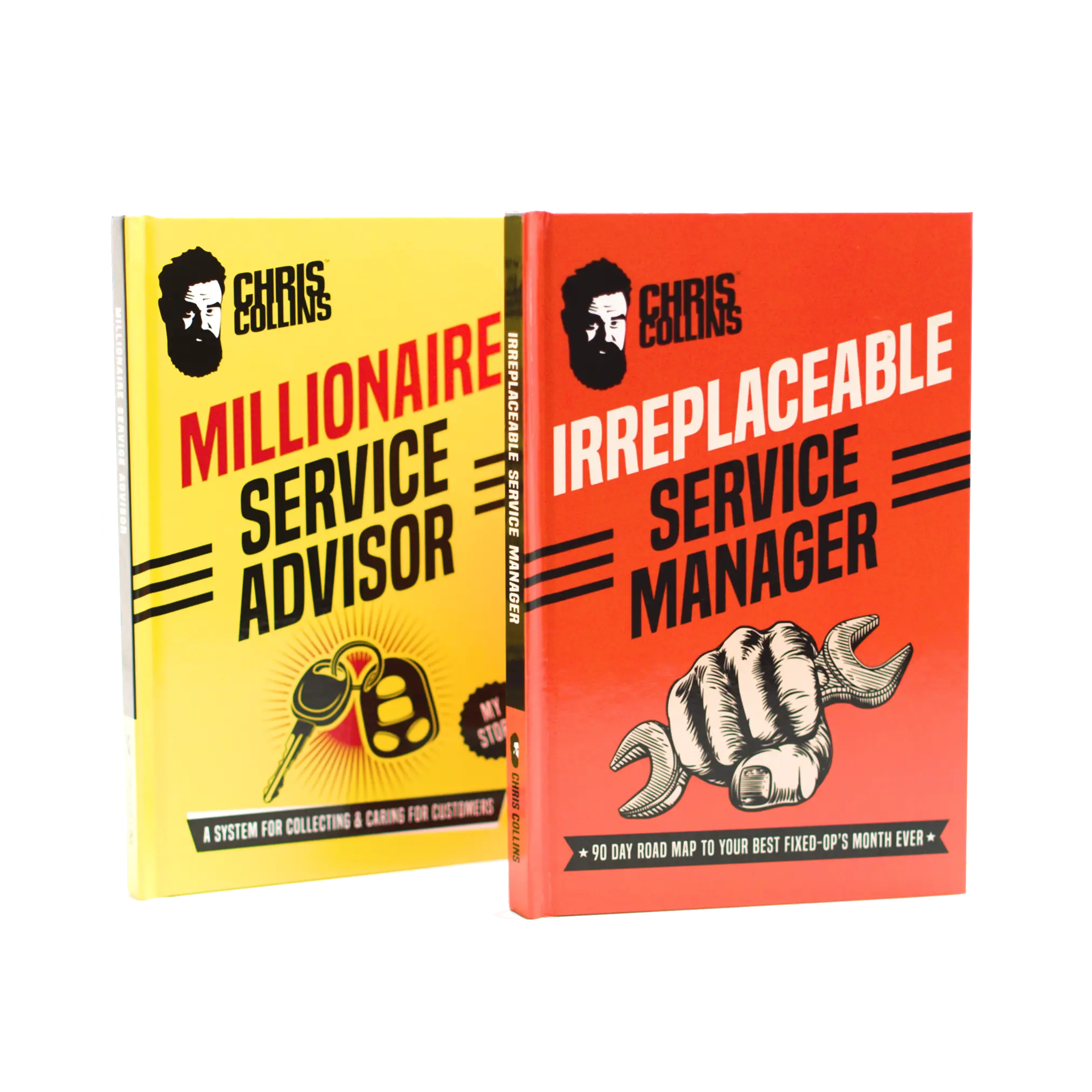
Overall dealership sales have dropped significantly as people choose to keep their vehicles longer. While new car sales fluctuate, vehicles always require maintenance and repairs. Chris Collins Inc. helps dealerships capitalize on this reality by shifting the focus toward “Fixed Ops”—the Service Drive where real money is made from existing vehicles.
Over the last 25 years, Chris Collins has built a team of coaches who use a customizable suite of services to improve accountability and produce results. The company provides specialized training for service managers, advisors, and automotive technicians to streamline processes and create a winning culture. Through optimizing these operations, dealerships increase customer satisfaction, boost retention, and raise the overall value of the business.
Book your 15-Minute Opportunity Analysis today to see how these coaching systems can transform your service department into a profit-generating machine.
Frequently Asked Questions (FAQs)
A sales funnel represents the visual journey a potential client takes from first hearing about a service to finally signing a contract. Prospective customers enter the top of the model through marketing efforts and move through stages of interest and evaluation. Business owners track various stages to identify where leads drop off and optimize conversion rates.
Automotive service sales funnels begin when car owners encounter digital ads or service reminders for maintenance needs. Customers move through the middle of the funnel by researching prices, reading reviews, and checking appointment availability online. The process ends when a vehicle owner schedules a repair or oil change through the dealership website.
Maximizing technician productivity remains a primary driver of financial growth in the shop. Service managers increase revenue by implementing consistent multi-point inspections on every vehicle. Clear communication regarding repair costs builds the trust needed to secure high-ticket service approvals.
Fixed operations, which include parts and service, typically generate the highest margins for a dealership. While vehicle sales bring in large sums of money, the service lane provides the consistent gross profit needed to sustain the business. Data shows that thriving dealerships rely on service bays to produce roughly half of total earnings.
Service departments boost retention by sending automated text messages for appointment reminders and vehicle status updates to keep customers informed. Offering transparent digital inspections and clear pricing builds the trust necessary for drivers to return for future work. Providing convenient features like mobile payments and shuttle services simplifies the repair process and encourages long-term loyalty.
Bottom Line
Indeed, building effective service sales funnels is the key to attracting customers, boosting conversions, and creating loyalty that lasts. These strategies are easy to implement and can make a big difference for your dealership’s service department. If this guide helped you, consider sharing it with someone who might benefit too. Let’s help more people create effective strategies that work!
Achieving and exceeding your goals is possible when you have the right systems in place. With Service Drive Revolution OnDemand, you’ll gain access to the proven systems that have made thousands of SERVICE MANAGERS IRREPLACEABLE. Start transforming your department today!
Need help updating your playbook? Let us know how we can support your team’s growth.
Book a 15-minute strategy session with our team. We’ll explore how to unlock your dealership’s real value.