Service drive system improvement starts with understanding one thing: your results are coming from your system—whether you like it or not.
Most dealerships don’t have a people problem. They have a system problem.
They have a system problem.
And the hard truth? If your service drive isn’t producing the results you want—higher RO count, better customer retention, stronger trust—it’s not because your advisors or technicians don’t care.
It’s because the system is broken.
In Service Drive Revolution #357, Chris Collins and the team answered real questions from the field—and uncovered a common theme: dealerships are focusing on the wrong things.
The Purpose of a System Is What It Does
One of the most powerful takeaways from the episode came from a simple quote:
“The purpose of a system is what it does.”
Not what it’s supposed to do.
Not what you hope it does.
What it actually produces.
If your service drive:
- Feels chaotic to customers
- Struggles with communication
- Has declining RO count
- Creates internal friction
Then that is your system working exactly as designed.
That’s a tough pill to swallow—but it’s also where real improvement starts.
This is why strong Fixed Ops leaders don’t just tweak processes—they evaluate the entire system and its outcomes.
Stop Treating Symptoms—Start Fixing the System
A lot of dealerships fall into the same trap.
RO count is down?
→ “We need more marketing.”
Advisors struggle with objections?
→ “We need more sales training.”
Technicians aren’t producing?
→ “We need better dispatching.”
But these are symptoms—not root causes.
If your system:
- Doesn’t create a smooth customer experience
- Doesn’t support clear communication
- Doesn’t allow advisors to control workflow
Then no amount of training or marketing will fix it.
Top-performing stores understand that process drives performance.

Why Dispatch Systems Create Bottlenecks
One of the biggest system issues discussed in the episode? Dispatch.
On paper, dispatch sounds efficient. In reality, it often becomes the biggest constraint in your service drive.
Think about it:
- Multiple advisors write up vehicles
- Everything funnels through one dispatcher
- Then gets distributed to technicians
That middle step creates:
- Delays
- Miscommunication
- Lack of control for advisors
The result? Slower throughput and frustrated customers.
Instead, a more modern approach—like team-based or lateral support systems—gives advisors more control, improves communication, and increases efficiency across the board.And that’s exactly what a strong SERVICE MANAGER should be evaluating regularly.
Your System Should Make Communication Easier—Not Harder
Another issue that came up: BDCs handling all inbound calls.
While BDCs can be powerful for generating appointments, they can also create friction if misused.
If customers:
- Can’t reach their advisor directly
- Have to go through multiple layers for updates
- Experience delays in communication
Trust starts to break down.
Here’s the reality:
If customers are constantly calling for updates, the problem isn’t the phone system—it’s the communication process.
Top advisors:
- Set clear expectations at write-up
- Establish when and how they’ll communicate
- Follow through consistently
That eliminates the need for constant inbound calls—and builds trust naturally.
Connection Beats Knowledge Every Time
One of the most important questions asked in the episode:
What matters more—technical knowledge or building relationships?
The answer: connection wins. Every time.
Customers don’t care about:
- Technical jargon
- Diagnostic theories
- Industry terms
They care about:
- Feeling heard
- Being informed
- Trusting you
In fact, many top-performing advisors don’t come from technical backgrounds at all.
They succeed because they:
- Communicate clearly
- Build rapport quickly
- Focus on the customer experience
If You’re Relying on Objection Handling, You’re Too Late
Here’s another hard truth:
If your advisors are constantly “overcoming objections,” the system has already failed.
Objections happen when:
- Trust hasn’t been built
- Expectations weren’t set
- The process feels unclear
A strong system prevents objections before they happen.
It creates:
- Confidence
- Transparency
- A clear path for the customer
The Real Goal of Your Service Drive
At the end of the day, your system should do two things:
- Build trust with the customer
- Generate profit for the dealership
That’s it.
If your current process doesn’t consistently deliver both, it’s time to step back and evaluate the entire system—not just individual pieces.
Because chasing RO count, adding more staff, or tweaking scripts won’t fix a system that isn’t designed to succeed.
Final Thought
Most dealerships are trying to fix outcomes without fixing the system.
But the best operators know:
If you build the right system, the results take care of themselves.
And if you don’t?
The system will keep producing the same problems—over and over again.
FULL VIDEO TRANSCRIPT
Introduction and New Vehicle Regulations
Welcome to the big show. Today we are going to take questions from YouTube—comments from YouTube. Some great questions, some really interesting conversations. If you’re a fan of learning and talking about shop, you’re in for a treat today. We also talk about the new kill switch that is installed mandatorily in all cars after 2027 and our thoughts on that and much more. I’m Chris Collins. That’s Hogi, Adam, and this is Service Drive Revolution.
Did you guys see this? It’s old news, but it’s new news to me that in 2021, Biden signed into law that by 2027, every car has to have monitoring in it that watches your face and eyes, your behavior and movements, and has breath or cabin sensors.
I didn’t know about the breath and cabin sensors. That is interesting. Every car sold after 2027 by law has to monitor where you are and what you’re doing. Even if you own the car, you don’t own the car. There are no rules in place about how long they keep that information or what they do with the information; it’s completely wide open.
Connectivity and Data Collection
Yeah, that’s crazy. I remember hearing about that as it was kind of happening and then I haven’t heard anything about it for a long time, which is probably by design. You guys don’t seem as upset as me about this. Adam’s laughing like he thinks it’s funny. I think it’s part for the course. We could have talked about it back in ’21 and it would have been called a conspiracy; now it’s happening.
Hogi said a long time ago that he thought Tesla would get in trouble because they were collecting all kinds of information that nobody else was. Remember when we had that conversation, Hogi? You were like, “I don’t know how Elon gets away with it”.
They definitely do. That was always kind of a funny thing; even in the first Teslas you could turn the GSM off. I remember talking with one of the engineers that was training me and I was like, “What’s that do? How is that not really connected to anything?” He’s like, “Oh, it doesn’t do anything. It just makes them think they’re turning it off”.
It’s the same thing with telematics even in a lot of new cars. You can turn off certain privacy things but it doesn’t turn off; it’s transmitting information. I guess I’m not surprised by it at all. Where is the line? Is it going to have a 90% reduction in DUI fatalities? Probably not. If we’re not impacting something like that, then what’s the point? It sounds good, right?
Feature Masking and the Kill Switch
What also I think they’re masking it as—I just bought that ’25 F-150 and they’re like, “Oh, you get BlueCruise or whatever and it’s got LiDAR and all this other stuff.” They’re trying to sell it as additional features or some sort of security feature that you can buy into a subscription. They are still monitoring and looking at all that stuff. Even if I don’t want it or I do, it’s always going to be monitoring something. It’s a masking.
Oh, it’ll monitor the vehicle right back to them if you miss a payment. That’s what it’ll do. So, the other thing is it has a kill switch. Every car after 2027 has a kill switch. You don’t even own your own car. If I pay cash for a car, I don’t own that car in a sense; they have control over my car.
Did you see the one segment where somebody was actually testing out—they were acting erratic, just an emotional response with all those different cameras—and the vehicle actually shut off? Even if it’s not trying to decipher if somebody’s drunk or impaired, he basically debunked that if you’re having a really emotional state or some sort of fight and you get in a vehicle and you try to drive, you can’t go.
His scenario was about what if there was an accident? Most trucks are on farms. Can you imagine if you had some sort of incident on a farm or out in the middle of nowhere and you can’t start or run the vehicle because the logic thinks you’re impaired? That’s nuts.
Commercial Compliance vs. Individual Privacy
I don’t support this. I don’t like it. I think if you’re driving for a job—last year I was at an event where I was speaking to leaders in the room about compliance of the software their insurance companies have them put in every truck that watches what the drivers do. To be honest, they were playing clips of drivers and accidents that they had caught on video. It feels wrong to be watching that. You feel very voyeuristic, like you’re watching somebody in their bedroom. But I get it if it’s a job, like driving a school bus or a pilot flying a plane.
But an individual in their own car on their ranch or just driving to work? Watching somebody pick their nose—it’s gone too far for me. First I can’t kill turkeys on my own land and nowadays…
Hold on. You did a little pattern interrupt right there. I have to share this quick little story. It is still getting towards the end of turkey season. My father-in-law comes to our house in the afternoon and as I pull up, he’s already sitting there right in front of the house. He’s calling in a turkey to our front driveway with the kids in the car. I could not believe it.
It was a hen, so we couldn’t shoot it, but I said, “Hey Bob, if that was a tom, what would you have been doing?” He’s like, “I would have gone in your gun safe.” I’m like, “I’m pretty sure you can’t do that,” and I don’t have a tag in our county. But he still called in that turkey at four o’clock in the afternoon; it was pretty impressive. If it’s on my land, I’d ask forgiveness. I don’t understand that.
Legal Challenges and Future Value
Are there tons of lawsuits? I’m sure you guys are familiar with all the rules and laws that were passed about the black boxes in cars; the information belongs to the owner of the car in a lot of states, but it’s state by state. There are all kinds of lawsuits going on and I imagine that you’ll be able to opt out of it eventually, but it’s going to take years.
I guess the suggestion is to look at what your state is. I’m in Illinois, so I’m pretty sure they just give it away—you have no rights. Well, probably the same in California, but it does make you think that a 2025 vehicle is going to be worth more. People are going to start looking for those with less electronics.
Reviewing this is interesting. I remember when they were talking about those black boxes. They like to point over here and say if there’s an accident we can use this as a positive, but they don’t really tell you the negative repercussions that they can always be looking or pulling something. That black box is always running. I think that’s when it first started.
Where does that line stop? You could say domestic violence happens, so we should watch everybody in their homes; you could make that case in just about every situation. At what point does connectivity stop serving us and start being too much? Your toaster has Wi-Fi connectivity—why does my toaster need to talk to the refrigerator? I don’t want either one of those things on Wi-Fi.
Personal Privacy Habits
I don’t have the Amazon one that you can talk to. My phone is in one place. I don’t wear any of the stuff—no Whoop, no Apple Watch. Adam just held up his Apple Watch. I’m not doing it because I know too much. It’s easy to hack.
I read something the other day that for the first time in 10 years, wired headphones are outselling because of security issues with cordless headphones. Even my iPods know where I’m at. It doesn’t make sense that your AirPods know our tracking location; all of it is nuts. They sell it differently though: “Oh, it’s so you can go find them.” No, it’s so you could find me.
I don’t know if this is interesting for our listeners, but it’s fascinating to me that we just keep losing more and more of our privacy. I was joking with somebody last week; we were talking about this exact thing—not in regards to cars tracking the driver—but we were just joking that we feel like a bunch of old men sitting at the diner on a Saturday morning talking about the conspiracy of the government. I don’t think anybody really knows what to do about it, but they know it’s a thing.
Cloud Updates and the Service Department
As it applies to the service drive, my Rover will update to the cloud, completely cutting out the service department. It’ll say, “It has an update. Do you want to do the update?” and everything that happens in that update completely cuts the dealer out of the transaction. Whether it’s free or not, there’s no reason to go to the dealer.
I’ve always thought with BMW and some of the brands, if they would have told me, “Hey, we have a software update for $1,000 that’ll make your phone sync up and show the music you’re playing,” I would do it. In the absence of more maintenance—since cars are more reliable—there’s no reason to be cutting the dealers out on that. But the manufacturers kind of loathe the dealers in a lot of ways with that sort of stuff anyway.
YouTube Comments: Matrix Pricing
We’re going to do some of the comments from YouTube. The first one is: “Does everyone use matrix pricing for customer labor or do they use straight labor hours for quotes?”
I would say a little over half of the stores we go into are already using some type of matrix pricing. It’s definitely a good idea and it seems a lot more common than it was even a few years ago. A lot of these brands right now are very repair intensive and this can be a pretty deep pricing strategy conversation. The more intensive some of these repairs are, you can utilize matrix pricing to get a little bit better effective labor rates on those things.
Anything specialty, like EVs and diesels, usually have a separate rate and separate grid for it. It’s way more common now than it’s not. You can have different pricing for a truck versus a car in a Ford dealership. We teach in our system how to maximize a matrix. It isn’t just about it going up, but it’s figuring out through an RO audit where your leverage is. We are fans of it and scientifically try to figure out where it can show the most benefit.
A lot of your friends over in the parts department have been doing that same principle for a long time—finding their sweet spot and maximizing their matrix. It’s the same principle for labor and a very effective tool.
Dispatch vs. Lateral Support
I have two more questions about the same thing. One says: “I wouldn’t let another tech out-flag me. You may be more skilled than me, but you wouldn’t outwork me. Now I dispatch for two dealers. How do you stop the blame game? Seems like people don’t care to raise their standards; they lower their standards to meet others. Minimal effort expecting maximum results. Also, how do you pay ‘cannot duplicates’ (CNDs) on warranty infotainment nightmares?”
The other one asks: “What’s your favorite way or what do you think is the best way to dispatch to techs?”
We would never run a system that had a dispatcher. If it was ours to set up, dispatch is a constraint. Lateral support is a way better system where the advisors are dispatching to their techs and you break things down into smaller groups. Dispatch is a really hard thing. I know that’s probably not the answer you’re looking for because if your job is a dispatcher, you don’t want to lose your job. But I would rather make a dispatcher an internal advisor than have them dispatch.
If you have four advisors writing 50 tickets today, those tickets go to one dispatcher and then back out to 12 techs. It’s pretty easy to circle where the biggest constraint is. It’s amazing how much it opens things up when you put lateral support in. I’ve had it time after time where the first day we run out of work at 1:00 PM when we were booked out three days before that.
Strategy and Advisor Communication
Not only does it increase efficiency, it makes it way easier on the advisors to communicate to their customers. If you’ve ever been an advisor in a dispatch system, you don’t know how to communicate whether you can get a waiter done or how long a car is going to take because there are too many variables. When you control your own destiny and are communicating directly to your techs, you can pull cars in front of other cars to serve the customers.
In our system, we try to get the customers back to the advisors in a forced relationship. The same thing happens with the techs: if the same techs are touching the same cars, they get familiar with those customers and issues. It’s a better outcome for the customer by a long shot. I don’t understand why anybody in the last 25 years would be running dispatch; it’s archaic. People do it because it’s familiar, not because it works.
One thing that has pushed people back to that is scheduling systems that schedule off the time available in the shop for the repair, which is crazy. If they allot 30 minutes for an oil change, they are shooting themselves in the foot because the main purpose is to inspect the car and find other things. Then they think they need a dispatcher to manage that. It’s important to look at the whole throughput machine holistically to make sure what you’re doing makes sense.
Managing Talent and Accountability
Does lateral support take away the blame game? If it’s mismanaged, there can still be an issue. If you’re a tech and you get a bad advisor, it forces you to have talented advisors. If an advisor can’t keep three techs busy, they’re not an advisor in our system. But we’ve had advisors with nine techs that are just so good. Lateral support allows you to address the capacity issue by the talent of the advisor.
If a tech is out of work, I want them to come write their name in the office on the glass so I know who is running out of work. You need good communication. If the techs are running out of work on one team, we find them work from other teams while addressing the advisor issue. The blame game does go down because it’s easier to manage with fewer techs and more transparency. The politics that happen with one central dispatcher never get squashed. In a team atmosphere, techs bond with the advisor and morale is much higher.
BDCs and Status Calls
Here is another question: “In our service department, we have a call center where calls come in through a BDC and then they transfer calls to the advisor. I find it very annoying when requesting a call back from my customers. Do you think that is a good system versus direct calls to the advisor?”
I would definitely have direct phone lines for service advisors. Everything going through the BDC is going to mess it up. It’s going to be hard for the BDC too, because customers you want to make an appointment for are going to be on hold longer. The purpose of the BDC is to develop business—making appointments, doing outbound calls to reminders or lost customers—not doing status.
The advisor’s job is status. If you’re getting a lot of status calls, it means the advisors aren’t doing well or the system isn’t set up for them to communicate with their customers. It’s been my experience that advisors who complain about the BDC the most are the least effective communicators. If you have an inordinate amount of inbound phone calls, there’s something wrong with that.
When you’re at write-up, set up a time and how you’re going to communicate. Get that commitment: “Hey Mr. Customer, I’m going to call you no later than 2:00 PM. Is this still a good phone number?” When you make that outbound call at the time you set up, I promise you’ll get way more answers. You’ll get a lot of that stuff out of the way at write-up.
Certifications and Career Growth
This one is for you, Hogi: “Do you feel having any of the more basic ASE certifications—C1 service advisor, G1 maintenance, light repair, or P2 parts—is beneficial for being hired as a service advisor?”
I don’t think they’ll help get you hired. I came up as a BMW technician and I had every ASE you could—L1, L2, A1 through A8. They did me absolutely no good and didn’t help my pay one bit. But I’m always taking different classes because you want to be a master of your craft. I don’t discourage it, but check with your manufacturers; having your ASEs can sometimes let you jump ahead in manufacturer certifications.
As an advisor, I don’t know of any outside qualifications that allow you to jump in their certifications. In this field, your results are going to get you your next job. If you’re getting results, people are going to seek you out.
Connection vs. Technical Knowledge
Last one here: “As someone currently being considered for the next service advisor role, would you say that building a connection with a technician or customer is more valuable than having extensive knowledge about cars?”
The answer is a resounding yes. You want to be a master of your craft, but some of the best advisors don’t have mechanical knowledge. They prepare before they call on a quote by having the tech explain it to them. New advisors fall into the trick bag of thinking the most important thing is to learn the DMS or warranty history. If you learn to connect with people, you’ll be further along.
The top advisor is almost never a former tech. Former techs usually make bad advisors because they take shortcuts and try to fix it in the drive; it backfires more than not. Connecting with the customers is way more important than knowing how to fix a vehicle. When people asked me technical questions I didn’t know, I would say, “Let me go ask a tech,” and then call them back. I still couldn’t change the oil on my own car.
Don’t try to be somebody you’re not. If you tell a customer it’s probably an O2 sensor and then it’s not, you’ve led them on the wrong path and lost trust. Your role is to connect with the customer and set the tech up for success. Technical knowledge makes people fall asleep. If you are charismatic and people like you, that will get you further in life than anything else.
Trust and the Goal of the System
Most people want to be able to trust the person on the other side of the counter and have somebody who is going to call them back. We build more trust by it not being chaotic and customers feeling like there is a plan. People think it’s advisor training or overcoming objections, but by the time you’re at that point, you’ve lost.
There is a great quote by Anthony Stafford Beer: “The purpose of a system is what it does. There is after all no point in claiming that the purpose of a system is to do what it constantly fails to do.” This makes me think about the service department. We have all these systems that don’t serve the outcome. The two things that matter most are the customer experience—wanting them to come back—and making a profit.
Many times you ask what the goal is and nobody knows. Human nature is to follow what everybody else has always done, but it negates the question of intention. The intention of the system is to build trust and increase sales; anything else is a waste of time. Overcoming objections is the end of the road.
Addressing Symptoms vs. Problems
There is no magic pill or easy button that fixes RO count. You need a system and a great customer experience. People will come back to that. Many people go and try to treat the symptom and not the problem. One of the best ways out of that trap is to look at your system as a whole and the outcomes it’s creating, then work backwards from there.
We want the competition thinking it’s hard to hire techs and that RO counts are down. But how many managers are complaining about RO count when they can’t take a walk-in? It costs way more to get a customer that doesn’t know about you than the one calling right now. If you just build it a little bigger and organize a better system, you’re not talking about RO count; you’re maximizing the opportunity on what you have.
If you’re just chasing RO count, you’ll probably go broke because you have a low average and you just want more of that. It costs a lot to get new customers in.
Great stuff, you guys. The purpose of a system is what it does. Mic drop. See you next time on Service Drive Revolution.
Final Outro
Thanks so much for watching this episode of Service Drive Revolution. We’re uploading new stuff every day, so make sure you subscribe and click the bell icon so you don’t miss out. If you have a question you’d like us to answer on the show, call 833-ASK-SDR, and we’ll answer your question on the show. That’s 833-ASK-SDR. For special deals on our books and training, head over to offers.chriscollinsinc.com. I’m Chris Collins, and I’ll see you in the next video.
🔗 Related Resources
- How Service Managers Should Handle Difficult Customers in Fixed Ops
- 9 Reasons Service Managers Fail in Fixed Ops (And How to Avoid Them)
- Why Fixed Ops Systems Matter More Than People in Dealership Service
Feel free to explore the linked articles above for deeper insights into each strategy. If you have any further questions or need additional resources, don’t hesitate to ask!
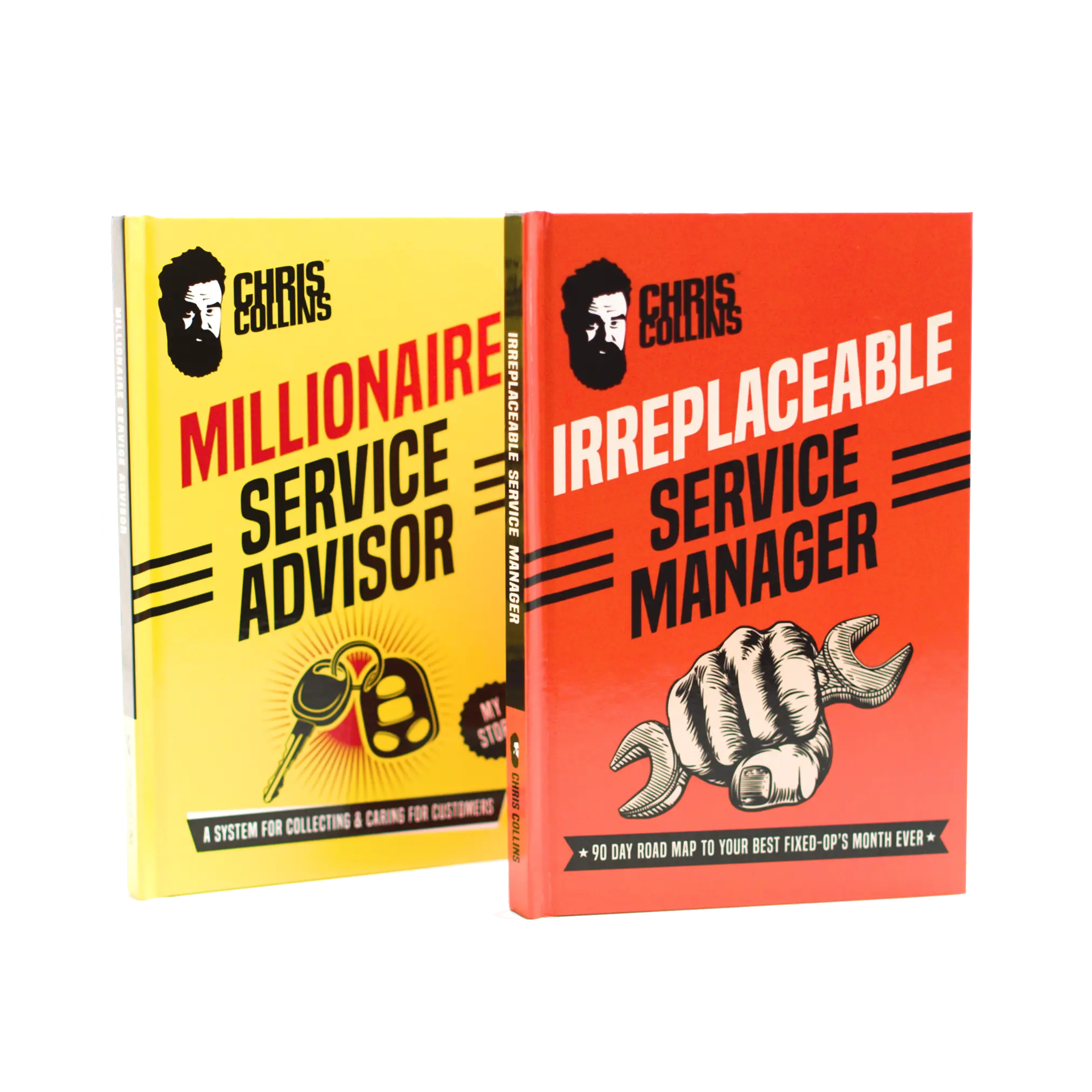
Achieving and exceeding your goals is possible when you have the right systems in place. With Service Drive Revolution OnDemand, you’ll gain access to the proven systems that have made thousands of SERVICE MANAGERS IRREPLACEABLE. Start transforming your department today!
Need help updating your playbook? Let us know how we can support your team’s growth.
Book a 15-minute strategy session with our team. We’ll explore how to unlock your dealership’s real value.