The Fixed Ops side of the automotive industry is at a crossroads. Many dealerships are busier than ever, yet service departments continue to struggle with SERVICE MANAGER training gaps, leadership turnover, and outdated systems that hold the entire business back.
In this episode of Service Drive Revolution #335, the conversation turns to the deeper issue:
Why does an industry this large, profitable, and essential continue to operate without the foundational training and leadership development it desperately needs?
We argue that the system itself—not the people—is often the real problem preventing SERVICE MANAGERS and SERVICE ADVISORS from reaching their true potential.
The discussion highlights how the system itself—not the people—is often the real problem.
The Training Gap No One Wants to Admit
A recurring theme emerges: despite the massive financial impact Fixed Ops has on a dealership, most managers and SERVICE ADVISORS are never taught the basic skills required to succeed.
Not advanced strategies.
Not elite-level concepts.
But the fundamentals of SERVICE MANAGER training:
- How pricing strategy actually works
- How to read and interpret a financial statement
- How to hire and onboard correctly
- How to organize shop workflow
- How to build a customer experience that consistently performs
Many professionals spend 10, 20, even 30 years in automotive retail without ever receiving structured, relevant training.
It’s not because they don’t want to learn.
It’s because the industry never made training a priority.
This lack of investment leads to widespread learned helplessness—managers doing the best they can with tribal knowledge passed down from someone who also never received proper training.
This is the opposite of how a modern service department should operate.
The Myth of Osmosis: “They’ll Just Figure It Out”
The conversation points out a painful truth:
Too many stores assume performance will improve by osmosis.
- If a manager has been there long enough, they’ll eventually “get it.”
- If an advisor is experienced, they’ll naturally improve.
- If a technician is productive, leadership skills will magically appear.
But time in the job does not automatically build competence.
Osmosis is not a strategy.
It’s a fantasy—and it’s the reason so many service departments stay stuck.
Related reading: Top Fixed Ops Performers: What Car Dealership Service Managers and Advisors Do Differently

The Auto Industry’s Biggest Blind Spot: No Shared Responsibility
Another major issue explored in the episode is how fragmented the automotive ecosystem has become.
- Dealers.
- Manufacturers.
- Associations.
- Vendors.
Each group operates in its own silo.
But there’s no unified effort to improve Fixed Ops at a national level.
For example:
- Industry events prioritize attendance over actual dealer improvement
- Manufacturers often build training programs no one is required to take
- Dealers want improved performance but resist pulling employees off the floor to learn
- SERVICE MANAGERS want better teams but aren’t given the development needed to lead one
This creates a cycle where everyone needs improvement, yet no one takes ownership.
The result?
A weakened industry vulnerable to disruption from companies like Tesla—who gained market share while automotive retail was asleep at the wheel.
The Real Cost of Avoiding Training
The lack of structured training and leadership development creates enormous losses:
- SERVICE MANAGER turnover rates near 50%
- Departments “breaking even” despite record volume
- 80% of customers leaving after warranty
- Millions in missed labor and parts revenue
- Unstable CSI due to inconsistent processes
All of these problems share the same root cause:
A system that refuses to invest in its people.
But when training does happen, the results are immediate and dramatic.
During the discussion, examples are shared of managers who, after just a short orientation or boot camp, leave with clarity, confidence, and a blueprint for real performance—not wishful thinking.
That blueprint includes:
✔ Building pricing strategies that work
✔ Using shop organization to add $20–$50K monthly
✔ Leveraging service drive systems that increase CSI and gross
✔ Creating efficient technician workflow
✔ Hiring and retaining better talent
✔ Understanding how to grow profit, not just gross
See also: 9 Reasons Why Service Managers Fail
What the Industry Needs Next
The discussion ends with a clear message:
Fixed Ops doesn’t need small improvements. It needs a system-wide reset.
A reset built on 5 Pillars:
1. Shared Responsibility
Dealers, manufacturers, trainers, and associations must stop working in isolation.
2. Mandatory, High-Quality Training
Not optional. Not “send one advisor.” Comprehensive training for all leadership roles.
3. Real Collaboration
A commitment to actually improve the customer experience, not just talk about it.
4. Performance-Driven Standards
SERVICE MANAGERS should understand financials, pricing, workflow, and hiring—before taking the job.
5. Leaders Who Build Leaders
A healthy shop culture grows when people feel capable, empowered, and confident.
Final Takeaway
The current system produces confusion, burnout, and wasted potential. But when SERVICE MANAGERS, SERVICE ADVISORS, and leaders receive real training and real support, everything changes—profitability, customer satisfaction, retention, and morale.
The industry doesn’t need more “events.”
It needs commitment, accountability, and leadership development that finally sets Fixed Ops up for long-term success.
And that starts with us.
FULL VIDEO TRANSCRIPT
Welcome to the big show. On this one, I lose my stuff. Off the reservation a little. It’s okay, though. “Off the reservation,” that’s a good way to put it. I’m very upset about a few things and I have to get them off my chest. Do you feel better? No, because nothing’s changed. It’s been four minutes. That and much, much more coming up on this edition of Service Drive Revolution. Okay. What is my system for deciding if I want to go to a speaking engagement or not? Very easy.
The formula is known across at least you and other people in the company, which means two of us know this, besides me and Chris, two other people. What’s my formula for deciding if I want to go on a speaking engagement? Somebody calls and they’re like, “We want Chris to come talk to the Association of Zookeepers in Ontario, Canada. What would I do? How would I figure out if I want to go or not?” The speaker fee and time would have to be greater than the desire, or what you would pay, to not do said engagement. Correct. Good.
So, let’s take the Zookeeper Convention, the Zookeeper 20 group in Ontario, Canada, which I’m in on. What would I want to pay to not do that? Would there be a direct flight to Toronto? What do you think zookeepers are like? How much fun would that be? Do I think they smell like pee? Oh man, yeah. The number is going to be high. That would be the point: the number that I would pay not to go. You probably would pay $25,000 not to go, US dollars, which is $275,000 Canadian if you do the conversion. Yeah, which is so funny. It’s rough up there, right?
We’re recording this before the Thanksgiving holiday, and I got to go to the Northwest, not to talk to zookeepers, though. Well, you’re going to Portland, so who the heck knows? I don’t know. What would I pay not to go? That’s the question. The great equalizer on that to me is your mom’s strawberry rhubarb pie. Okay, that’s payment. But then LAX, it’s 5:30 in the morning. You can’t fly Burbank to Portland, huh? I sure would do that. Alaska is the one that flies, and they were twice as much as Delta. The fees are insane, aren’t they? I wasn’t going to pay it. It’s too much. It didn’t make sense, and Delta’s better. Burbank in and of itself isn’t worth paying twice as much. I agree, that’s fair. So, that’s why.
I had to cancel my Thanksgiving plans to go to Florida. It was just too much. Yeah, it’s crazy. It’s just too much, and I was like, “I could go there for a day and a half.” So instead, we just video call more during this time of year. It’s really cheap to video call, but the prices are insane right now. We had a boot camp here last week. We do this thing internally where some of us call it a boot camp and some call it a master class; we’re trying to fix that. What it is in a nutshell is new coaching member orientation.
When somebody joins our coaching group, the General Manager, dealer, service, and parts manager come out here for a couple of days, and we kind of lay out the architecture. There’s a lot of “ahas.” If you watch a testimonial video from that, people are pretty excited. They usually are like, “Wow, nobody explained this to me before. I’ve been in the industry for 20 years, and I never knew what I learned in a day and a half hanging out with Hogy, Christian, and me.”
Have you heard how I’m describing it to people? I don’t know if it’s landing yet. How do you describe it? I describe it like the movie Pleasantville, where everybody was in black and white to start, and then as they got creative, they started to see things in color. You come in here and see fixed ops as black and white, and you leave and that thing’s in 4K HD. That’s a good analogy. That’s how I describe that. The outcome of that feeling is you feel powerful because you feel like, “Oh, now I understand. Now I can do things that have a direct outcome instead of guessing or doubling down on the thing that didn’t work but is the only thing I know.”
Does that make sense? For sure. Throwing wet toilet paper against a wall to see if it sticks. Think about this: how much more could somebody running a service department make in additional sales or gross, just by understanding a pricing strategy? How much more could they make in a month? Being conservative, could someone make another $30,000 to $50,000 a month just by understanding how to use a pricing strategy?
I was going to say $20,000 to $30,000 on average, but there are some that would go way beyond that. Could somebody easily make another $50,000 a month by understanding how to set up the shop? By setting up the shop, we’re talking about the way that the work is handed out, how the technicians are organized, and how you hire. So, we’ve priced things better, and we’re getting more set hours done. Could they do another $50,000 a month just doing that? We already forgot about the menu thing. Could they make another $50,000 in sales by doing that? It’s a lot, but yeah.
Service Drive Judo, or a system in the drive, could that make them another $50,000? I would contend that makes people more money than anything, I don’t because of what it does to the customer psychologically, I think that Judo is more money and better Customer Satisfaction Index. We’re measuring it by money right now, Dr. Christian. That’s the conversation we’re having. You don’t want me to talk about any ancillary benefits? There are tons of ancillary benefits. How many more of those sorts of things could you easily make another $50,000 a month if you knew it, understood it, and applied it? Seven, maybe more. If you did seven $50,000 things, that’s a lot.
It’s okay. You’re like a chiropractor, not really a doctor. You got your degree online. Could you imagine the prescriptions I’d write people? It’d be awesome. Oh, that reminds me. Hold on before you talk. What do you call someone that studies beef in outer space? I give up. A meteorologist. Yeah, it’s pretty good. I’ve got a better one. It’s coming later. Would you agree with the concept that I see things differently than most people, than anyone I’ve ever met in my life? People can disagree with me, but they can’t say that I’m wrong. They’ll say, “You’re wrong,” and come back and say, “You were right.”
They can disagree with me, but they can’t say I’m wrong. The reason why they often disagree with me is because it’s not expected or it’s not what they’re used to, and it takes them a minute to get over that. Correct, 100%. In the long run, it works out for them. There’s sometimes a moment of processing and getting through that the way they were looking at the thing before was not the way that was going to get them where they wanted to go. For sure, but it requires a little disruption in the process.
I’d agree with that. You can disagree with me, but you can’t say I’m wrong. The thing I was thinking about when we were doing the boot camp last week was that I don’t understand how our industry is where it’s at. There are really talented people out there running service and parts departments, or even dealerships for that matter, but our industry has not trained them. Nobody has decided it’s a priority for the people doing the thing to know how to do the thing, and we’re talking about the most basic, lowest level of training.
Just understanding where a dollar goes and what happens, why you would price something the way you do—simple stuff. I think about this a lot, I understand people are going to say that I look at things in a different way, but one of the reasons why is because I’m trying to get to the outcome more than anything else, I don’t feel like that is always the case for most people. Take, for example, my experiences with NADA, the National Auto Dealers Association.
I thought for a long time, growing up in our industry and being an advisor and watching my boss go to NADA every year and attend all these workshops, you would assume the reason they’re going is to get better. You’d assume the training given there is meant to make them, or inspire them, to be really good at the job they’re doing. I thought of it as the benchmark for excellence. Meanwhile, I assume that manager I used to work for still doesn’t know what he’s doing.
Oh, for sure. He didn’t know what he was doing when I worked for him; it was a disaster. I assume he doesn’t—I don’t think that dealership I used to work at really understands what they’re doing when it comes to fixed ops. So, you grow up thinking that going to NADA, to their workshops, and attending that event is about the industry getting better.
Then, I would apply to be a speaker at NADA. They say that you are chosen independently of whether you are buying a booth there. But I will tell you that I never got selected to speak until I bought a booth. I applied a bunch of times and never got chosen. The one year I bought a booth, I got chosen to be a speaker there. The very first time I went and was a speaker, it was not a great experience. You spend close to $100,000 having a booth there because you have to get a staff, have to pay union guys that don’t really care about what they’re doing to set your thing up.
You can’t even take your stuff on the floor; they have to carry it. It’s very stressful and cumbersome. You do a workshop, and to do a workshop for them, you apply for it. Then they have this committee of sometimes three, sometimes five people that work for NADA who then give you feedback on the thing you’re going to teach. They curate it, but it becomes very obvious that they’re curating it not to have the best content or to teach somebody something, but to make it as user-friendly and as broad as possible without offending anybody.
The second time I went, I got chosen to do two workshops. I was really interested in providing value to the people that came to my workshop, I wanted to inspire them that we could be better, I think of NADA as a mechanism that could take a leadership role in our industry, really inspire it to be better, fill some gaps, and do incredible things, none of which has really happened ever. I got chosen to do two workshops, but they dumbed down my content. They told me I couldn’t talk…
…about commissions, which is another subject that the industry does a poor job training on and giving people options. So, they didn’t want me to talk about any of that. They didn’t want me to talk about my experience or how I actually did it in the dealership; they wanted me to be very theoretical, which is really hard for me. The other thing that’s crazy if you actually work in a dealership is to take criticism on information from people that have no retail experience.
It’s infuriating because they don’t understand how hard it is to be on the front lines. They don’t understand that it’s a nuance; it’s not idealized and as perfect as everybody wants it to sound in a meeting. They’ve changed my whole thing, and then they don’t even deliver on their thing. We’re turning people away for this one. The workshop was on gamification, a universal subject. Interestingly enough, some of the bigger names in training in our industry don’t do NADA. I asked a couple of them why, and they said, “It’s a waste of time. You’ll get just as many clients without doing it as you will with.” I was the underdog. We’ve never been in that inner circle of those people. We’re always on the outside looking in, and I was trying to get on the inside because I really wanted to make a difference. I thought that what we had would benefit the industry, and I thought that NADA shared that as a common goal.
Even the logistics, they had me in a room that only held 50 people for a universal subject. They wouldn’t let me use the full audio/visual setup. We had the screens blacked out, meaning you can’t use your slideshow, which means you have to speak. I had to speak without slides, which I do anyway, but I felt like they were setting me up to fail. They were not supportive or helpful, they didn’t even have somebody checking people in. They had some old volunteers there that were taking notes on what I was saying that weren’t even from the industry. It was crazy.
The second workshop, I was supposed to be the last one, and I asked for a big room, like a 500-person room, which is not that big. I asked for them to really set up the room the way it was supposed to be. Despite all the rehearsals we did, all the maps of the room I had, they had to turn a couple hundred people away. People were lined up, and I don’t think they understood who I was. I don’t think to this day they understand because we recently offered to do SDR from there.
Now, think about NADA. Look at any of their channels and how many views and subscribers they have, and then look at ours. We’re the number one podcast show in the automotive industry by a mile. It isn’t even close. The amount of downloads we have on iTunes and Spotify is more than all of them combined, which is a fun fact, but it’s also very sad because they’re the National Dealers Association. Their mission is to get people to come in. They don’t do a very good job of that.
they don’t promote their speakers, they didn’t even get the speaker’s name right on the wall, they got the title of the thing wrong, and the room wasn’t set up right, they didn’t have the audio/visual. There were people lined up they had to turn away. It’s frustrating because I was looking at NADA like it was a partner, that we could share common goals and help the industry, and it was the opposite of that. It was very political, cumbersome, not customer-focused, and not training-focused. It was the opposite of everything the industry needs, and it was very upsetting to me because I was really trying to do a good job.
I just think about the sheer manpower, budget, and access to dealers they have that they’re just not doing what they’re supposed to be doing. People were lined up and had to be turned away. They had some old volunteers there that count how many people are in the room. Where do you think my workshops ranked amongst all the other workshops? This is on the last day of the event. At the top by a pretty good clip. No “thank you.” Nobody followed up, like, “Hey, how could we make this better? You were talking about some really cool stuff. How can we get you to come out and talk to some 20 groups, or how could we build on this?” Nothing. Absolutely nothing.
What I realized is I was looking in the wrong place; I had it backwards. The other thing I think about in that same regard is a little bit of a flip on that. One time, I was invited to a manufacturer’s headquarters for a meeting with a bunch of dealers—say 700—in a big room in their corporate theater. A reasonable representation of their entire dealer body. I wasn’t speaking; I was invited there to help them figure out a problem.
The Director of Fixed Operations said, “Chris, I’m trying to get the dealers to participate in training. I’m developing this training that I think would be very effective, but I can’t get the dealers to send their people to the training. What do I do?” I said, “You’ve got to mandate it.” He said, “If you mandate it, they’re not really—they’re only doing it. We’ve done that, and I don’t know. I guess if all things are equal, I prefer that they mandate it because then if we make the training really good, it’s a win-win.” He was trying to make the training good and couldn’t get the dealers to participate. I asked him, “How long is the training?” He said, “It’s three hours of video.”
I asked how often he expected them to watch it. He said, “Every 90 days.” I said, “I think that’s too much. The amount of information you’re giving them is overwhelming. They’re going to get overwhelmed. You need to chunk it up.” He said he didn’t know how. I said, “You need to chunk it up in five or six-minute videos, and you need to make it more digestible. Look at YouTube. It’s chunked up. They’re used to getting information that way.” He said, “That’s not training.” I said, “What do you mean that’s not training? That is training. That’s how people absorb information now.”
He said, “I think training is three hours of video every 90 days.” I said, “If you do a three-hour video, it’s going to be really hard for them to get through it. They’ll get bored and distracted. If you make it shorter, they’ll absorb it better and be more engaged.” He said, “I just think that’s how it’s supposed to be.” I said, “If you want it to be more effective, you need to make it more engaging.” He didn’t know. I said, “Here’s what I would do: I would send out a little video every single day, five or six minutes.
Then you would get them to come in, and I would come in and use certain terms so it’s not the first time they’ve heard it. I’d take each advisor and schedule a little bit of time with them every single day. That way, they’re not watching three hours of videos all at once. They do it a couple at a time, absorb it, think about it, and then they come back, and I come in, and they’re exposed to the information.” He was like, “I just couldn’t imagine taking people off. What if we get busy?”
I said, “What do you mean, ‘What if we get busy?’ You’re saying that you can’t get people to come to training because they’re not busy, and now you’re going to tell me that you’re going to get busy and you can’t do the training because you’re busy.” It was a lose-lose situation. It was learned helplessness. He’s been doing it that way for 20 years, and it’s always been the same outcome. He’s never going to do any better. It’s a lack of effort and a lack of courage. I asked him, “Is that what you think about your technicians? That they’re just going to get better on their own?” He goes, “I think that a good technician is going to figure it out.”
I said, “No, a good technician is going to leave your dealership and go to work for somebody that trains them and takes care of them. Dealerships don’t want to send people to training. They don’t want to invest in the industry, they want profits at all costs, but they don’t want to play the long game, the healthy game, the game that’s better for the customer and the consumer. They open these doors for companies like Tesla to come in and take market share. That happened on our watch, and nobody wants to take responsibility for that. I feel responsible for that. You feel responsible for that. But there’s no collaboration in that.”
It has to be a thing where there’s shared responsibility and a mutual commitment from everybody that there shouldn’t be so many dealerships where service departments barely break even, and we somehow think that’s okay. They say, “The fix for it is advisor training,” but they don’t mean that because they don’t want to dedicate the time it takes to do it. I’ve got a phrase for how the industry as a whole operates: literally, I believe the strategy is improve performance by osmosis. Somehow, if a service manager has been doing it for 20 years, they’ll get better, not that they need more tools. You’re telling them the wrong things, like, “Get me gross.”
They get you gross, but they run up expenses more than the gross they make. They run up expenses on training, advertising, and all this stuff that doesn’t really have a direct outcome. It’s the opposite of everything you could do to get better. I don’t know how to fix it. I feel like sometimes people are just stuck, and they don’t want to get unstuck. They’re paralyzed by the outcome, and they don’t want to admit that they’re the cause of the problem. They want to externalize control and blame the economy, the customer, or the manufacturer, but they don’t want to blame themselves. So, there’s no way to fix it. How do we figure this out and collaborate? It’s not that hard, but once again, you might not agree with me, but you can’t say I’m wrong.
The industry is broken, and this is just a little snapshot. What we can do for people in a day and a half, compared to what the industry collaboration could do, is super exponential. The one thing people are missing, and they don’t see it because they don’t come to this thing, is that they walk out with a game plan and more self-esteem. We’re building better leaders and better humans. We are solving a problem that the industry is not solving.
They’re not training or investing in people, they’re not giving people the tools they need to be successful, they’re keeping people in the dark, gaslit, and with no idea how to do better except to copy the people they worked for before with some sort of tribal knowledge. It’s learned helplessness. The outcome is they externalize control to, “It’s the market, it’s my boss, it’s whatever.” You get fired three times trying to do a good job as a service manager; you just start hiding. All of a sudden, you’ve got history and facts on your side. I get it, but I think that learned helplessness or the desire to be at full potential, it spreads.
It spreads like a disease. I don’t know, man, it’s really frustrating. If I had my way, I would literally call the head of NADA and say, “We need to figure this out. We need to do a better job. We need to figure out how to train people and give them the tools they need to be successful.” But I can’t. I’m just a guy with a podcast. But I’m not going to stop trying to help people get better or provide value. It’s crazy because you think about the educational system. It’s almost a cakewalk compared to the educational system. Imagine the speakers we could have at NADA and the theme.
The manufacturers are there. If you get the manufacturers and the dealers on the same page—them playing on the same team—that’s pretty cool. Incredible. How hard is that? It feels like we had to pick a side a long time ago, and we’re the outcasts. Because we’re telling the truth, we don’t fit in because we’re not in the business of selling tickets to a convention. We actually grade ourselves on the performance our clients get.
…how many people come to our event. We grade ourselves on the outcome. The industry needs to change and evolve. It’s not going to figure itself out on its own. It needs to be intentional and a priority, and the dealer body needs to get on board. They need to understand that this is a long game, not a short game, a quick fix, or a silver bullet. You have to invest in your people, processes, technology, and culture—everything. They’re not doing it. It’s frustrating because the solution is right there; it’s so easy and simple, it’s what we do every single day, and we’ve been doing it for 20 years.
It’s what we do for free on YouTube. How many times do we have a client sitting in a manufacturer’s training, and they play our free videos from YouTube in their training? That’s happened more times than you can count. They send us pictures and are like, “Look, this manufacturer, I’m at the factory meeting, and they’re playing your video from YouTube.” Which is fine because from the very beginning, our goal was to give away better information for free than our competition charged for. That’s how we were going to make friends and help the industry, but it’s frustrating that it’s still where it’s at.
It’s not going to figure itself out on its own. No osmosis. We have to accept responsibility for the outcomes, and we’re death by a thousand paper cuts the way it’s going right now. I agree. I know you love it when I get fired up like this, but I’m exhausted. You talk from the heart; it was good. It’s so frustrating. I’d be worried if it didn’t bother you. Think about what clowns we were that we came up in this industry and could make the kind of living we made based on just hard work and taking care of the customer.
We got paid a lot of money to do that. There aren’t too many legal industries like that. When people find out how much service advisors or fixed ops managers make, they’re just like, “What?” We’re just letting it wither. You just bring a little bit of passion and some hard work, and that’s your meal ticket. Okay, everybody, we hope you have a great week, and we will see you next time on Service Drive Revolution.
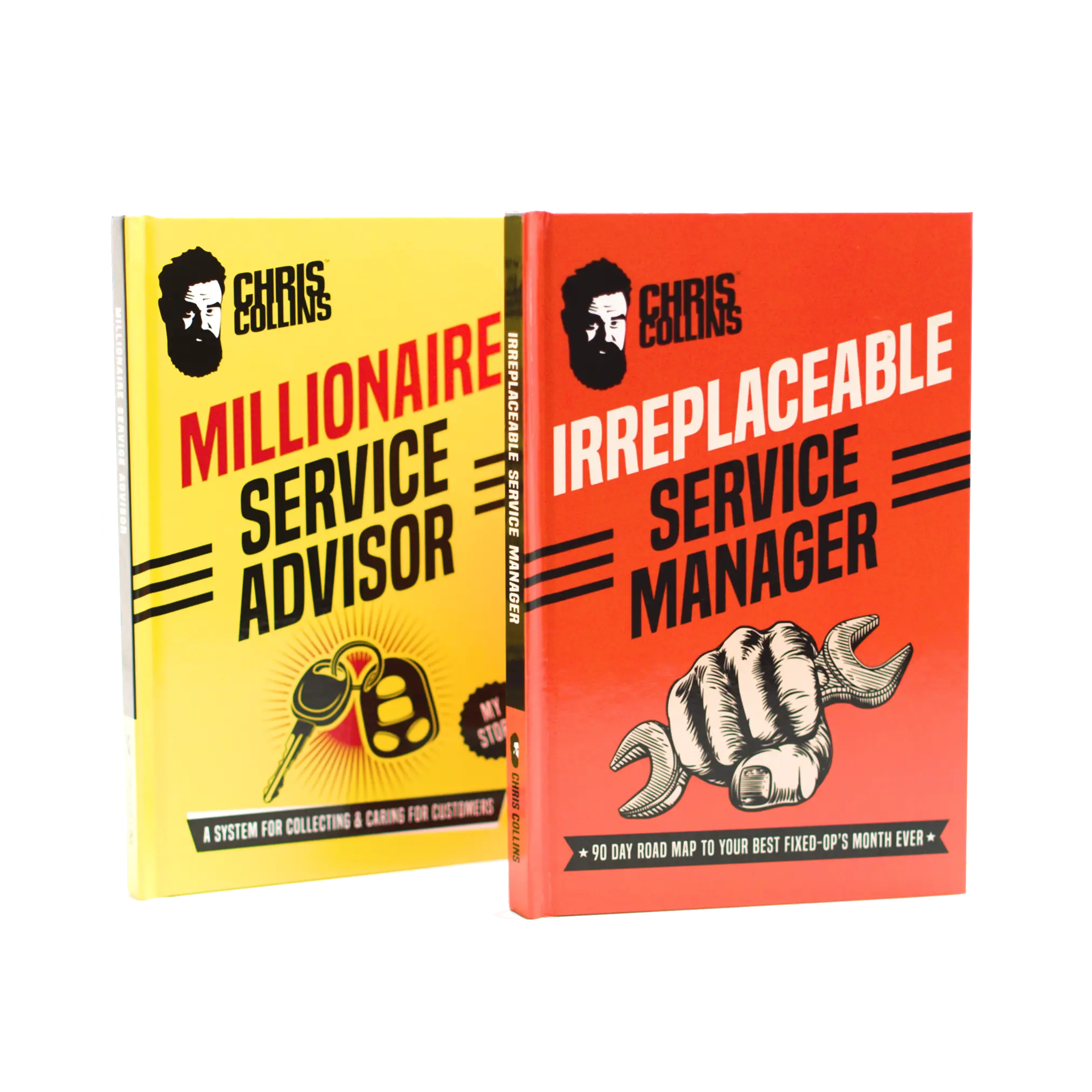
Thanks so much for watching this episode of Service Drive Revolution. We’re uploading new stuff every day, so make sure you subscribe and click the bell icon so you don’t miss out. If you have a question you’d like us to answer on the show, call 833-ASK-SDR, and we’ll answer your question on the show. That’s 833-ASK-SDR. For special deals on our books and training, head over to offers.chriscollinsinc.com. I’m Chris Collins, and I’ll see you in the next video.
🔗 Related Resources
- Top Fixed Ops Performers: What Car Dealership Service Managers and Advisors Do Differently
- 9 Reasons Why Service Managers Fail
- Service Department Roundtable: What’s Changed in Fixed Ops Leadership
Feel free to explore the linked articles above for deeper insights into each strategy. If you have any further questions or need additional resources, don’t hesitate to ask!
Achieving and exceeding your goals is possible when you have the right systems in place. With Service Drive Revolution OnDemand, you’ll gain access to the proven systems that have made thousands of SERVICE MANAGERS IRREPLACEABLE. Start transforming your department today!
Need help updating your playbook? Let us know how we can support your team’s growth.
Book a 15-minute strategy session with our team. We’ll explore how to unlock your dealership’s real value.