Service Drive Revolution — Episode #378
Official Full Transcript
Host: Chris Collins
Guests: Adam Krey and Chris Hogland
Published: October 5, 2026
Duration: 49:57
Listen on Apple | Listen on Spotify
Building on weeks of deep-diving into shop floor culture and productivity, Service Drive Revolution Episode #378 tackles one of the biggest career transitions in automotive retail: making the jump from SERVICE ADVISOR to SERVICE MANAGER. Host Chris Collins, alongside guests Adam Krey and Chris Hogland, breaks down the harsh realities of management, why top-performing advisors sometimes regret the move, and how shifting from individual output to leadership changes everything. This blog explores what the transition demands, the leadership traps to avoid, and how to evaluate whether moving into the management seat is right for your career.
Why Management Is Harder Than the Desk
As a SERVICE ADVISOR, your income and success are tied directly to your individual hustle. If you want to make more money or drive better numbers, you can put your head down and work harder.
Once you step into the SERVICE MANAGER role, that rule completely disappears:
- You Can Not Outwork a Broken Department: Managers are no longer judged by how many repair orders they write personally, but by the collective performance and production of their team.
- The Leadership Scale: Managing a team of advisors means trying to align multiple individuals with completely different upbringings, motivations, and skill levels toward a single standard.
- Carrying the Job Home: Advisors can usually clock out and leave the day’s stress behind; managers frequently lose sleep over shop numbers, missing parts, and unresolved customer escalations.
The Unexpected Human Element: Becoming the Therapist
One of the biggest shocks for newly promoted SERVICE MANAGERS is the amount of bandwidth consumed by personnel issues. On the service drive, advisors spend most of their time talking to customers about straightforward, lighthearted topics.
In contrast, the manager’s office often turns into an improvised HR department, high school counselor’s office, and personal therapist chair combined. You will find yourself navigating major personal conflicts, helping staff through life crises, and still trying to hold them accountable for performance metrics and shop efficiency.
Key Metrics and the Trap of Self-Execution
When new managers look at department dashboards, they are often overwhelmed by conflicting opinions on various metrics. To cut through the noise, successful managers keep their focus locked on two primary pillars: profitability and customer experience.
A common trap for new managers is trying to fix declining numbers by doing everything themselves. Because they spent years mastering the desk, they step in to rescue troubled repair orders instead of coaching their advisors on how to handle them. True leadership means understanding that every employee interaction is a daily training opportunity.

Frequently Asked Questions
Not necessarily. A high-performing SERVICE ADVISOR who builds a strong, loyal clientele and maximizes their commission structure can often outearn a manager, making financial motivation a poor sole reason for making the jump.
While numerous fixed operations metrics exist, the two most critical focal points are overall departmental profitability and the customer experience (CSI/NPS).
Transitioning from a peer on the service drive to the direct boss of your former colleagues creates an initial hurdle that requires intentional boundaries, clear communication, and consistent leadership.
Yes. Many dealerships see managers tap out and return to the desk or leave the store entirely when they realize the ecosystem or responsibilities do not fit their goals. Evaluating your “why” before making the transition helps prevent this friction.
Final Thoughts
Making the leap from SERVICE ADVISOR to SERVICE MANAGER is not a simple promotion; it is a complete reinvention of your professional identity. While the allure of the manager’s office and a change of pace is strong, success in fixed operations leadership requires letting go of individual hustle and learning to win through others. If you decide to make the transition, do it for the right reasons: a passion for coaching, system building, and developing people, rather than just chasing a higher paycheck or an escape from the drive.
Actionable Takeaways
- Audit your motivation: Before accepting a management role, evaluate whether you genuinely enjoy coaching and developing people, or if you are simply chasing a title bump or an escape from individual daily sales stress.
- Stop doing the work for them: If you are already a manager stepping in to fix troubled repair orders yourself, step back. Use those exact moments as daily training opportunities to coach your SERVICE ADVISORS on how to handle the situation independently.
- Focus on the core pillars: Cut through dashboard noise by keeping your daily operational focus locked strictly on overall department profitability and customer experience (CSI/NPS).
Ready to Strengthen Your Fixed Ops Systems?
Achieving and exceeding your goals is possible with the right systems in place. With Service Drive Revolution OnDemand, you’ll gain access to the proven systems that have made thousands of SERVICE MANAGERS IRREPLACEABLE. Start transforming your department today!
Need help updating your playbook? Let us know how we can support your team’s growth.
Book a 15-minute strategy session with our team. We’ll explore how to unlock your dealership’s real value.
Service Drive Revolution – Episode #378 Transcript
The Best Service Advisor Training Has… | SDR #378
Service Drive Revolution
Hosts: Chris Collins, Hogi, Adam Krey
In This Episode
- Why Amazon selling new cars online with flat-rate dealer delivery is disrupting traditional dealership models and why fixed ops needs to become the ultimate dealership focal point.
- The reality of service advisor training: why traditional training fails when it treats advisors like pushy salespeople instead of teaching them how to build trust, connect with customers, and create “key throwers”.
- How viewing the service advisor role as running a “business inside of a business” creates long-term equity, loyal clientele, and seamless vehicle trade cycles.
- The critical hurdles of making the jump from service advisor to service manager—including why management is harder, why you can’t just work harder yourself, and why leadership and systems matter more than ever.
- An inside look at Service Drive Revolution Academy’s latest desk process training, homework-driven breakthroughs, and the mindset shift needed to move away from shop pain.
Opening & Community Catch-Up
Introduction and Opening Banter
Chris Collins: Hey! Welcome everybody to Service Drive Revolution. We hope you’re having a great day. We have an incredible show for you today. We are going to talk about how you make the jump from service advisor to service manager and much, much more. We got a big list of things to go over here that we want to talk about, but please say hello to the Oklahoma Smoke Show, Hogi.
Hogi: Sup everybody. Chris Collins: And Adam, say hello, Adam.
Adam: Hello. I should start off by apologizing for us not being here last week. I had a little family thing that I had to do and, it’s so funny. Like I, I told, I told my parents, I’m like, uh, I’m going to have to move you guys down here to California. Cause every time something happens and somebody goes to the hospital or whatever it is, I have to fly to Washington. And I don’t know how many times in the last year I’ve had to do that, drop everything and go.
Adam: Um, but it’s, it’s, you know, it’s a lot, and also the healthcare in Washington isn’t that great compared to here. But what do you, what do you think my parents said about the idea of me moving them down here? You guys want to guess? No, not yet.
Hogi: Yeah. Not just yet. That’s a good one.
Chris Collins: Yeah. What, what, what else? What do you think the big, so for somebody who lives in the country, they’re worried about the crime, uh, not worried about the crime, worried about their ability to defend themselves against the crime.
Adam: Oh, okay. So most of what’s in the gut in the gun safe is not legal here. And that was a big topic of conversation, which I thought was pretty funny that that is the, that’s the holdup. That’s the holdup is, is the, you can’t bring all that down. How to ask you though, Chris, is, is your mom kind of like my mom where she like has a gun that’s like probably like a firearm, like a 40, like a 40 cal. That’s like just a little bit too big, probably for her to holders? It kind of like a little nine mill?
Chris Collins: Oh, there’s an arsenal. There’s, there’s pistols, but most of it is, is, uh, something you lean against your, your shoulder.
Adam: Okay. All right. And there’s a long, there’s a long tradition of that. Chris Collins: Oh, I love it. So funny. Get off my lawn. Like I can just picture it real quick.
Adam: Yeah. Cause you can have, uh, most of the pistols you can have here. It’s the, it’s the, the long range AR stuff that you can’t.
Chris Collins: Oh, we just got this video banned on YouTube by talking about this, but super funny. So I do apologize for that. It was completely on me and a very last minute thing. So, but we’re here today and have an exciting show and we’re going to have a lot of fun, also top dog. So top dog is coming up here in, uh, I don’t know, a couple of weeks, three weeks.
Top Dog Event Updates
Hogi: Yeah. And here in the office, nobody decided to cut it off. So we have more people coming than we have space. And so I would say to, to our clients and coaching every year, there’ll be a couple of people that show up that didn’t RSVP. It isn’t going to work out for you this year. You’re not going to be able to come in because we’re hoping some people don’t show up is what we’re hoping. Set up some monitors out in the, out in front of the building. They can watch from the outside.
Adam: Well, I mean, yesterday in our, in our meeting about it, we’re basically trying to figure out where to put our team. Like our coaches are going to have to go in a, in an annex somewhere. Cause of the room. I mean, this room can really only hold like a hundred and something people. It’s not. So I don’t know. We might need to be looking at a different, I love having it here, but yeah, we might, we might need to be moving it to, uh, somewhere else in the future.
Chris Collins: Pretty funny, but yeah, top dogs coming up. I’m really excited. I’m, I’ve been working on what I’m going to talk about and I’m really excited about some of the guests. I’m excited about what we’re doing with the elite group. It’s going to be good. It’s going to be fun to see one of our best. It’d be awesome.
Hogi: Yeah. I know every year it’s like, this is the best one, but I feel like this year is going to be one of those years where we’re like, wow, that, that’s a way to top it off. Chris Collins: Yeah. We’re good. We’re good at this. This throwing events like this is something that we do pretty good at. So excited about that.
Discussion on Amazon Selling New Cars & Industry Disruptions
Chris Collins: So the first thing I wanted to talk to you guys about, and I don’t know if you’re aware of this and you might want to short some of these public auto companies like lithium auto nation. Have you guys ever shorted a stock before?
Adam: Yeah. Bet against it. You have hogi?
Hogi: No, I have not.
Chris Collins: No, it’s risky, but Amazon is going to start selling new cars. I think they’re starting with the Kia and Hyundai. Maybe I have that right. But literally, so the comparison, if you’re watching any of the YouTubers or anybody talking about this is you’re going to be able to buy a car online. And then the dealers are just going to get a flat to deliver it. That’s it.
Adam: Crazy. Chris Collins: It is. It is crazy. I know eBay tried to do use cars for a while and that didn’t work. You use cars are a completely different game than new cars. Like them selling new cars cuts the dealer out completely. And it will be interesting to see what manufacturers love their dealers or what they do.
Hogi: Yeah. Yeah. How all of that unfolds.
Chris Collins: Yeah. Yeah. It’s going to be interesting. I think there’s going to be more and more of this. People are going to be copying the car vault. I don’t know. I forget what how many Stellantis stores car vault is up to. I know they got one in Phoenix. They got one in DFW.
Hogi: Oh, and as soon as they take over one, they instantly are number one in the country or two. Don’t they have one, two and three in the country and new volume?
Chris Collins: Yeah. Yeah. Yeah. And they, and they weren’t like, they were both stores doing a hundred, 200 cars, 200 new a month. And then, you know, within 60 days, one of them, the one in Dallas, Fort Worth. In the mid cities area, it was the very next month they sold like 900 something and then they’ve been doing it every, every month since.
Adam: Well, I just make it easy.
Chris Collins: Yeah. It’s it’s a wild, wild thing. And so yeah, talk about it changing more, more rapidly than it ever has before. Like some of those pressures are starting to be applied right now for sure. I mean, I’ve said for a long time, how many of these dealers that came up from the front end, they judge their success and, and just their existence on car sales are going to be okay running fixed ops because that’s what it will become at some point.
Chris Collins: And so the, the comparison that you keep seeing online in reference to Amazon selling is that it’s going to be as easy as buying a Tesla. Cause I mean, I’ve bought two Teslas and both times I never went into a dealer. You should see the comments on these videos, how hateful people are towards dealerships in reference to this subject. It hurts my feelings like, cause I, you know, I like, I want to defend it and public perception is public perception.
Hogi: Yeah. Brutal. It’s absolutely brutal. What people are, are saying, but that, you know, they’re saying that it’s going to be as easy as buying a Tesla, which for me was on an, on a browser. And then a couple of times like they will email you status. You have to send like proof of insurance, which is just a picture. And then you upload it. Trying to think what else you do. And then basically they scheduled a delivery. The kid shows up, he goes, open the app. He transfers the car to you in the app. And then he goes, you got any questions and takes off. And now you got a car. Like it’s the easiest thing to do. It’s like, let me, it’s harder to buy a TV. Like I bought a new TV for my living room in December at Best Buy. It was harder to get that delivered than it is to buy a Tesla. Chris Collins: And so just think if people don’t have to go to the dealership. Yeah, I don’t know. I guess maybe they have to go to the dealership to take delivery. And that’s why they’re going to pay dealers a flat. So I guess they’re still going into the dealership. It looks easy though. Like it’s really, I wonder how they’ll handle the trade. It’s four steps.
Adam: What are the four steps? You search, search and save cars near you. Choose finance, lease, or cash. Submit a credit application online. Test drive and wrap up at the dealership. So it sounds like you’re probably going to wrap everything up and pick it up at the dealer. Chris Collins: So they’re cutting the dealer out of the financing too. I mean, is there going to be an Amazon financial arm pretty soon? Like G cat, like they’ll do their own financing, right? They have the bandwidth to do that. When you have a trade in, it looks like they’ll just do the estimates. I, I,
Hogi: Yeah. Brutal. It’s absolutely brutal. What people are, are saying, but that, you know, they’re saying that it’s going to be as easy as buying a Tesla, which for me was on an, on a browser. And then a couple of times like they will email you status. You have to send like proof of insurance, which is just a picture. And then you upload it. Trying to think what else you do. And then basically they scheduled a delivery. The kid shows up, he goes, open the app. He transfers the car to you in the app. And then he goes, you got any questions and takes off. And now you got a car. Like it’s the easiest thing to do. It’s like, let me, it’s harder to buy a TV. Like I bought a new TV for my living room in December at Best Buy. It was harder to get that delivered than it is to buy a Tesla. Chris Collins: And so just think if people don’t have to go to the dealership. Yeah, I don’t know. I guess maybe they have to go to the dealership to take delivery. And that’s why they’re going to pay dealers a flat. So I guess they’re still going into the dealership. It looks easy though. Like it’s really, I wonder how they’ll handle the trade. It’s four steps.
: That’s one of the most profitable parts of the whole thing is the financing. The interesting thing though, at the top is that they have like for trusted dealers, it’s like they’ve hand selected trusted dealers to be a part of their ecosystem of the entire, entire deal. So maybe not every dealer can just sign up. So that could be a gateway to that too. Chris Collins: Yeah. We’re just more and more with the consolidation of the industry and these public companies and then these sort of things. We’re losing the loyalty to the dealership. The dealership isn’t a part of the community. It’s, it’s not a reference point or something that people look at in a positive way. We need to go back to the old school, you know, old Joe who owns the Ford dealership downtown, kids go to the school and he’s part of the chamber of commerce. Like we just don’t have that anymore. I mean, we have clients that are like that, but they’re, they’re, uh, it’s hard to keep that up. They’re rare.
Hogi: Yeah. Yeah. I think a lot of that’s done on the, on the back end of the house there too.
Chris Collins: That what do you mean? He just brought up.
Hogi: Well, I think like the typical adage is about, um, vehicle sales, new vehicle sales. They sell the sales, sells the first vehicle. And then service and parts, you know, the fixed ops side sells the second or the third or whatever. So like in order to have that solidification within the community, you really need to focus still on that fixed ops piece. You can’t only focus on the new vehicle sales. So if you’re not doing it from all angles, it’s going to continue to not only in consolidation, but even for the ones that are being consolidated, you still have to be a focal point in the community and not lose touch with that. That’s very hard.
Chris Collins: Yeah. But yeah, you got to live in the community. You got to be a part of it. Like you got to care about it.
Hogi: Really want to see the community succeed. It’s a, it’s a whole nother level. Mm hmm.
Chris Collins: Interesting. I didn’t know that Amazon was doing that. What brands are on there?
Adam: So it’s key and Hyundai first, right?
Chris Collins: Yeah. Yeah. Kia Hyundai Subaru Mazda Chevy, GMC, Caddy Jeep Dodge Ram. And then Ford is doing it only for their blue advantage CPO program. Not for new Ford inventory.
Adam: Man. That’s not the GM’s doing it. It is wild, but, but you can see the conditions. Chris Collins: Yeah. Sorry.
Adam: Oh, that’s okay. Well, I’m just, you know, the thing about all these conversations is, um, whether you’re talking about Carvana or whoever, um, even Carvana, even though Carvana is physically buying the dealerships, um, one thing that’s clear to everybody involved in their customer base is, uh, they’re not interested in service. They are just selling those cars and slinging them all over the United States. But, uh, you know, the, there’s still a huge advantage, um, at being good in service and I think too, like, uh, when you buy a car, there’s always things you want to get, and if there’s not support for it, it could be something that some of these things, they, they buy it this way one time and there may be a chance if we’re really good in service, uh, you know, to win them back. Chris Collins: Yeah. But service has to be the focus. Like you have to be good at it in the customer experience has to be something that people want to want to come back. And I think a lot of people are looking at how to solve this problem on the variable side and I think you solve it on the fixed side and it’s not, uh, doesn’t really have a seat at the table at the moment, which is interesting.
Hogi: No, I think they’ll figure it out. Just the majority of people that own car dealerships don’t have a seat at the don’t see fixed ops as being something that excites them. You got to mirror the two. Chris Collins: Yeah. Cause it’s, it’s becoming more and more that fixed ops is going to be the focal point of a dealership. The direct to consumer thing has been coming for a long time at Amazon, you know, Tesla, I, I said this forever and it’s true, like the thing about Tesla going direct to consumer is that, you know, 10% of market share that they’re getting is, is a big deal when you start taking it away from other manufacturers. And that seems to be picking up and now you, you now you’re going to direct to consumer through Amazon. And if it’s really easy, you’re just the value of the dealership in the marketplace becomes less and less of a foothold. Chris Collins: I mean, it’s just crazy that, uh, that there isn’t a more unified dealer body and anybody kind of leading this. It was crazy when it happened to Tesla. I said that about, you know, NADA and the lobbying and, and really having somebody running those sort of things that is thinking about the dealers. But at the same time, the dealers have to get better. Like you have to pay attention to what the consumers want, but the dealers aren’t inventing ways for people to buy cars in an easier way, right? Like the dealers could have come up with a portal. You could have a national portal where customers can buy cars direct, but nobody will do that. They can’t get their header. Chris Collins: It’s like blockbuster video. Nobody, nobody can think, well, no, what the late fees and you know, we’re, that’s how we’re thinking when it comes to selling cars and the trade. This and that. And we don’t understand that Netflix is just going to have it all right there at the push of a button. Nobody’s going to drive to a blockbuster to rent a movie when they can just click it and it’s the same sort of thing.
Politics, Passports, and AI Discussions
Adam: Did you, did you guys see a Marco Rubio’s thing yesterday with a passport?
Chris Collins: No. What do you say with that?
Adam: I would encourage everybody to watch that just in the sense of, uh, I absolutely love how patriotic Marco Rubio is. I’m, I’m, I’m a huge Marco Rubio fan. I he’s just common sense. I like him, but basically they’ve, uh, you know, they’ve had all these tech guys come into the government and be like, these websites don’t work. And he’s showing like what, what it was to get a passport before and how many steps and how confusing, and they’re going to, uh, make it really easy to get a passport, but also it’s going to be on your phone, like, you don’t know. Adam: He’s showing, he’s showing the, uh, the envelope that your passport comes in. And he’s, he’s basically like, this is us. Like, this is how we send out millions of these a year is in this like broken up envelope that gets thrown on the ground in front of your house. Like, and, uh, it just doesn’t, you know, it doesn’t match what, what we want to be as a, as a country and how we should think about ourselves. And so they’ve redesigned it at all. Adam: And he goes through it. It’s like, I don’t know, it’s 10 minutes, but it’s just very patriotic and cool that this stuff should have been done 20 years ago, but we’re starting to do it. Cause other countries have had their driver’s license and passports on their phone for a while and we’re still caring, you know?
Chris Collins: Oh yeah, you can transfer it, but you gotta take a photo of it. It’s not an actual legit electronic copy, right?
Adam: Yeah. So this is legit and you would scan it and the whole, the whole thing. But the, the part of it that I, that I’m, uh, most excited about is just the patriotism and, and the, you know, we have all this technology and other countries adapt our technology before we do, which is so odd. Mm-hmm. Adam: And it’s a really great presentation. The way it was designed and that you can tell they’re putting in a lot of work and a lot of thought into how they’re, you know, how they’re presenting it. I thought it was pretty cool. I’d recommend everybody to watch it.
Chris Collins: Yeah. Let’s check it out. I don’t know what event they’re having. It was some event like, Hmm.
Adam: Well, they were, uh, they got all the tech CEOs together to talk about AI.
Chris Collins: Yeah. To try to create. No, it’s not called AI anymore. It’s called a SI. Like SI or something. What’s SI stand for?
Adam: Uh, can’t tell you. She super, super intelligence or something like that.
Chris Collins: Yeah. Something like that.
Adam: Yeah. Well, I’m not, I’m not interested in, in that. I saw that, but I don’t know. I don’t care about that. I think everybody’s too excited about AI and half the time I try to do something in AI it’s wrong. It’s, it’s certainly not.
Chris Collins: I thought about making a video because, because these guys that, um, are trying to scare everybody into forcing the government to regulate AI. The reason why they’re doing that is because if you force the government to regulate it, then nobody else can come in and compete because the regulation is, is so crazy. And then they’ll get a seat at the table. Right. So chat, GPT, perplexity or whatever. They, they all want, they don’t want competition, but that’s the worst thing for us as consumers.
Chris Collins: And so they do these things where they’re like, Oh, we had, we had an AI that escaped and did this and all this stuff. And I want to make a video of me neutralizing AI, which is basically just unplugging it from the wall. Like your rogue AI, I will just unplug it. And then it does like, we control the electricity. How, how is it that we think that AI can become smarter and more powerful than us when all you gotta do is unplug it? It’s like saying my toaster is going to hijack. It doesn’t make any sense to me.
Hogi: Right. And burn your toast, man. It doesn’t want you to eat this morning. So it’s going to burn it.
Chris Collins: Yeah. So that’s why whenever I see people talking about AI, I just kind of get bored with the, this whole like fear mongering and it’s not there yet. It’s not, it’s not human. It doesn’t have common sense. It’s wrong. A lot of the time it’s very, you know, the AI that we’re using as consumers is, is just trying, it’s like, uh, trying to fill in things really, really quick, but it’s not doing a deep, if you ask it a deep question or, you know, want it to really do research, it’s not, it’s not that good at that. And then the information it has, isn’t that, you know, great that it’s pulling from.
Chris Collins: So I think it’s funny that there’s all that to do about nothing, but I do like that the administration is not letting them regulate it like that. They’re making them put controls in place and self police, which to me is, is the American way.
Hogi: Yeah. Cause you know, a lot, a lot of these industries, like, uh, the internet that happened, uh, broadband, like a lot of those. Kind of all controlled by a handful of companies in the consumers. You know, I look at what I pay for, for cable TV, like what? You know, it doesn’t make any sense, but there’s no competition because there’s just one pipe in and it’s three people sitting around the table going, well, let’s, you know, nobody go below this price sort of a thing. Let’s go up.
Chris Collins: Yeah. And Hulu just went up. I just got the email today. Is it Hulu Disney?
Hogi: Oh yeah. I think I get free Hulu at Disney. Do you not have Disney kids?
Chris Collins: No, I, I had, it’s all one package with ESPN and now they just went up like another 10 bucks and I’m like, man, I don’t think we need to watch the new toy story kids.
Hogi: No, it’s the best babysitter you have. That’s funny.
The Truth About Service Advisor Training
Chris Collins: Okay. Um, I’ve been doing, uh, a lot of strategy sessions with potential coaching clients. And one of the things that keeps coming up is service advisor training. And I keep hearing, Hey, we, we had this company come in. There’s kind of three companies out there doing service advisor training. I think, is that right?
Hogi: Okay. Yeah. Yeah.
Chris Collins: And so they they’ll say like, I had them come in and do advisor training, but it didn’t, it didn’t work. And so I just want to talk about what the best service advisor training is out there. And I think our service advisor training is the best, but I’m biased. It’s okay.
Chris Collins: But the best service advisor training out there does what? And I think it comes in a, in a bunch of different ways. One is it’s in person, right? Just doing online training, isn’t going to have the same effect as doing it in. But reinforcing it with some sort of online component is really important. But I think where a lot of advisor training gets off is this notion that service advisors are salespeople. That in a, in a world that was a very disruptive idea that made people stop and think, and especially when most. People running car dealerships come from sales. It like sounds nice.
Chris Collins: But the truth of the matter is, is, is service advisors aren’t so much selling as they, they are building trust and making friends. That’s the most important part. Cause if somebody needs breaks, you don’t have to sell them breaks. Like they need breaks. If they, if they’re not doing the breaks with you, they’re going somewhere else. And even like nobody’s taking breaks to go somewhere else, even to save a hundred dollars, probably. Like it’s just such a hassle.
Hogi: That’s true when it’s already there. Yeah. Time is the most important commodity to anybody. And so, you know, the, the best service advisor training is talking more about the psychology of how to connect with customers, how to build trust and create what we call in our training, key throwers, customers to just throw us the keys and say, Hey, Chris, do, do whatever it needs. Right. And that, you know, that’s something that I learned when I was a service advisor.
Chris Collins: It feels like to me, most of the advisor training out there is written by sales trainers that have never written service a day in their life, because what you don’t want in your service advisor training is how to overcome objections, how to ask five times for the sale. Like that ends up being very, very, um, adversarial. If, if you’re a good advisor, like you’re not, you, I can’t think of a situation where you would ask a customer five times to purchase something they had declined in service. Can you guys know?
Hogi: Not even, I mean, twice as a stretch. I was going to say, I don’t even think you would get it to the second one. If you get to the second one, you’re definitely not going to get a third.
Chris Collins: No, I think, uh, I think also you have to train to get an outcome and get a result. I think that’s a big difference also. And then, uh, you know, common feedback. I’ll hear from advisors over and over and over again is, uh, like you, when you guys are talking about doing things, we know it’s going to work because you’ve already done it and it’s not the idealized version of things.
Hogi: Like, I can’t tell you how many of these training things I’ve sat through over the years, whether it’s manufacturer or some of the others. And, uh, like you’re saying, Chris, you know, the person up there hasn’t written a RO a day in their life. You can, you can just tell. And, and, uh, some of the stuff they’ll be saying, it’ll just be like, you know, some of that stuff sounds good, but come back to my drive tomorrow and write 18 tickets and let’s see how much of that stuff you do and see how effective it is.
Hogi: Um, so it’s a, it’s a lot of, I kind of idealized version of things. And, uh, when you are, are training to get a different outcome, uh, it just creates a straight path and you realize it’s about connecting with people. It’s about consistency. It’s about having a system. Um, and, and, uh, and, and some of those things. And it just, um, yeah, we get, we get a caught in a lot of overcoming objections and, and making your advisors become good salespeople. And when you train to get an outcome, you start realizing very quickly. That’s just a bunch of noise.
Chris Collins: Yeah. The, you hear that one a lot, right? The, we, we need to teach our advisors how to overcome objections and you’re like, Oh, you don’t, uh, you don’t understand. Like, yeah, no, it doesn’t work. It’s why, why people hate car dealerships.
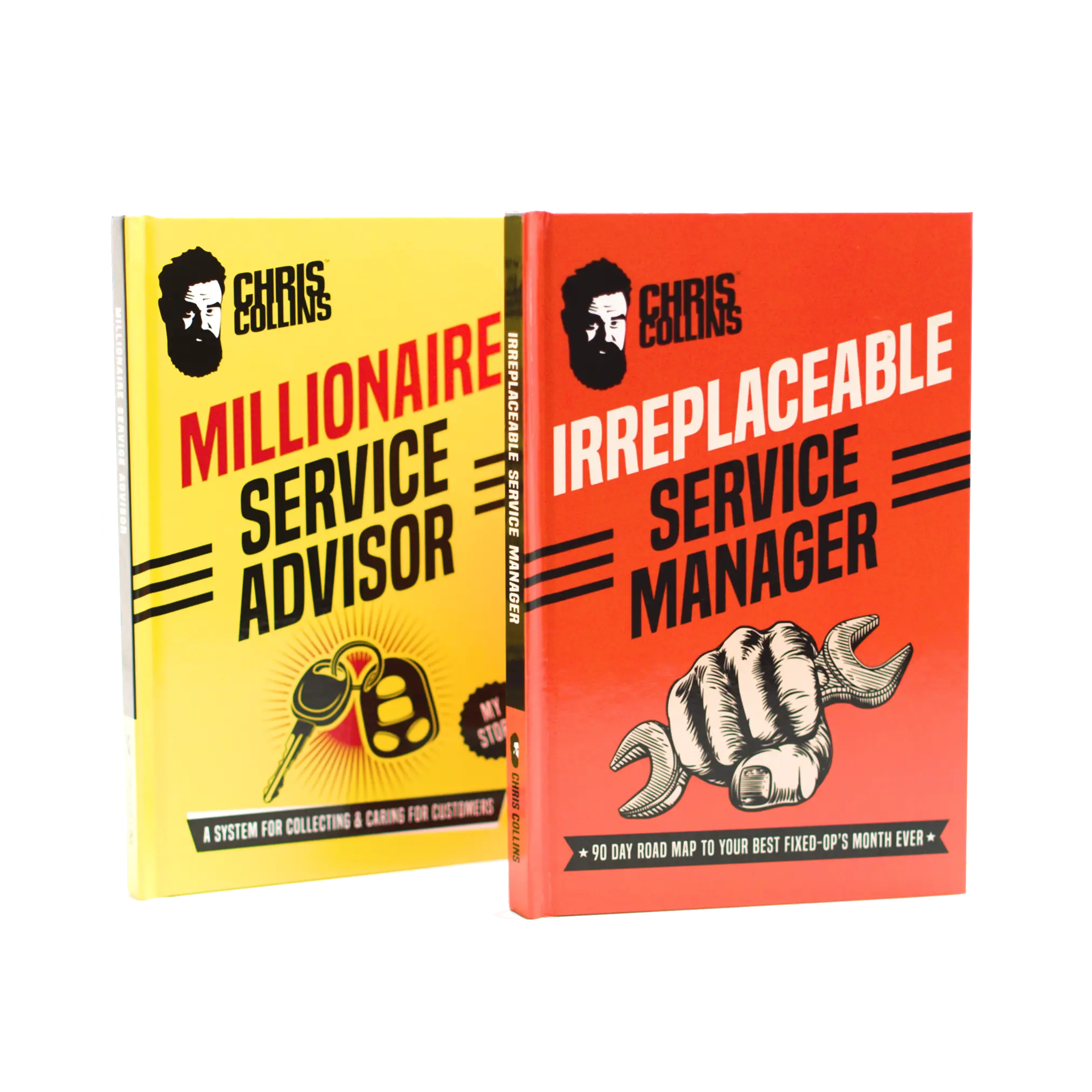
Hogi: Yeah. It’s, if you’re not connecting with them and then you’re trying to overcome an objection, like it’s just a salt and open wound, right? The other thing I think that’s important about advisor training. And I, uh, I set this up in the, in the book, I wrote the millionaire service advisor is that when you’re a service advisor, you are running a business inside of a business.
Chris Collins: You want to stay in one place for a long time and you want to collect customers. You want to collect key throwers. And so if you connect with two or three customers on a deeper level every day, what does that do for you in five years? When five years you have this clientele that does two things. One is they throw you the keys and they’re like, do whatever it takes, Chris. But the other one is their next vehicle purchase is ran through you.
Chris Collins: Like when I was an advisor, I had clients that would not buy another car without talking to me first. What do you think about the new Subaru? What do you think about the new Jetta? You know, they, they wanted to know and it rightfully so. I’m touching them every day. I know what, you know, I know their driving habits and what they need. And then I know what’s, what’s good and what people are happy with and what I see breaking down and that sort of thing.
Chris Collins: But you, you’re running your own business. You’re building a clientele inside of a business. And that is, is a much better strategy than trying to learn how to be a great salesperson connecting and building a clientele over the long run makes you way more money and makes the dealership more money. Cause it’s the, what we call the circle of life where sales sells a vehicle, hands it to us in service. And then we take care of that customer. And then when their trade cycle comes up, we hand them back to sales and then they hand them back to us and that’s the circle of life.
Chris Collins: So thinking as an advisor of building your own business inside of a business is a really positive way to, to approach it. The, you know, thinking long-term, like, let me connect with, with a handful of customers every day and really take care of them. And in the long run, I’m going to have all this equity. I’m going to have all these friends. Like we say it all the time. You can’t have enough friends. Like it isn’t, it isn’t, it is important to just sell somebody something as it is to understand them and be, and be a friend, be, be a trusted person and not sell them something when they don’t need it is just as valuable, right?
Chris Collins: All of those times when a customer comes in and they’re not due for anything. You’re, you know, that’s the best way to build trust is not selling them something and then when they genuinely do, of course they’re going to do it because there’s been all these times where you took really good care of them and they didn’t need something. So, you know, building a business inside of the business is an important characteristic of advisor training in what I, you know, what I’ve seen and what I learned when I was an advisor and then how to interact with the technicians.
Chris Collins: I don’t think advisor training really talks about the reality of the consistency you need to show to the techs, how you sell work from the inspection sheet and communicate with the techs. All of that is a big part of being an advisor. The technicians control your income more than anything else. Like if you, they, they’re the driver of everything. So that relationship, I don’t, I don’t hear that talked about a lot in advisor training, but it’s a, it’s a really important part of, of the, the dynamic and the active delivery and how you end things with the customer.
Chris Collins: Cause there’s probably the two most important parts of it is how we start and how we end and how we start is how we’ll end usually they go, they go hand in hand. So that same care at the beginning is the same care at the end that we need to show to build trust and have those key throwers.
Chris Collins: So the best service advisor training out there is ours. I would say though, as a qualifier is our advisor training is built to train the advisors inside of a system that is designed for advisors. Where in a lot of stores, the advisors are overwhelmed. It’s, it’s really hard for them to do the things that they need to do because the process doesn’t support them.
Chris Collins: And so how many they’re writing every day, how the workflows, where they meet the customer, all of those efficiencies have to be built into the system in order to train the advisor. So what we see over and over again is that, you know, dealers are hiring service advisor training without any adjustment to the system without any change in the output. So you increase your sales, but you can’t get the work done and then it implodes. And so it’s a delicate balance on all sides. You don’t, you don’t want to sell more in the drive if you don’t have more capacity in the shop, right?
Hogi: Yeah. Yeah. But I I’m seeing that over and over again, that people are having bad experiences with advisor training. It isn’t fixing anything, but they’re doing it just to do it. It’s good.
Making the Jump from Advisor to Manager (The Hotline Question)
Chris Collins: Okay. Let’s, let’s talk about the moving from making the jump from service advisor to service manager. So we had a call and we still have this hotline. We don’t talk about it that much, but it’s 8333 ask SDR that will answer your question. So that’s 8333 ask SDR. And if you call into that and it’s a good question, we’ll play it on the show. We had a question about how to make the jump from service advisor to service manager. And if we can play that question and then we will, we will give our advice on how to make that jump.
Chris Collins: Oh, I think the boys cut it off because he said something there at the end. But yeah, isn’t it funny that he sounds like he’s been a tech his whole life, just like bumping his knuckles up against a cold engine block. And he’s like, I’m done. I’m ready for this. Is it? You gotta, you gotta hang me up.
Hogi: Yeah. When he said at the end, I didn’t know. He’s like on my back. I can’t bend over a hood anymore. This is it. This is it. I want to guess what brand and what market he’s in. Like Cadillac Cadillac in Florida. Can’t do it anymore. So funny.
Chris Collins: Okay. What advice would you guys give him for, for making the jump from being a service advisor to being a manager? And we should probably start off by saying it isn’t easier being a manager. It’s harder.
Hogi: Yeah. Yeah. If you haven’t done it yet, you’re more likely to ride off into the sunset on a easier, you, you know, on an easier note at the desk than you are in the manager seat. So yeah, considering that, that part of his question, that’s, I was kind of thinking the same thing. It’s not, you0 know, that made it sound like he was looking for it to be easier. So definitely not easier.
Chris Collins: If you are doing it, I think the, the, the main thing for managers is as you start to learn it, you’re going to get a lot of different metrics. People are going to have a lot of opinions of the different metrics. And the, the most important thing is to understand that the two most important metrics are profitability and customer experience. And if you’re chasing those two numbers, a lot of things come in to come into focus for you. If you’re focused on driving customer experience, you realize that you, you know, kind of like we were talking about when with service advisor training, it’s about having a system that gets an outcome.
Chris Collins: And surrounding that subject, I think where a lot of managers get it wrong is when you come from whatever position you were in before, like a service advisor, if you wanted to do a better job, you only have to worry about yourself. You can just work harder and, and show increases and, and gain ground that way. As a manager, it’s that you can’t do that. If you, if you try to approach it that way, which most people fall into that trap of they, they’re the manager now, they know they need to grow the business. They know they need to grow the numbers, the customer experience, all of those things. So they just try to work harder.
Chris Collins: And one of the biggest traps people fall into in making that jump is not paying most attention to, to profitability and customer experience, and then right behind it, trying to do it themselves. Like you’re, you’re, you’re going to be judged on the, on your people, the outcomes of your people, every customer interaction, every technician’s production in the shop. You’re more judged on those things than, than how hard you work. And that’s a common, you know, that’s a common trap a lot of people fall into. Hoagie: Would you say that it resides a lot on their leadership abilities, Hoagie?
Hogi: Yeah. I think it’s a, I think it’s kind of a focusing on that. Like I don’t know why more service manager training, just kind of like we were talking, when we were talking about advisor training, we’d be in a way better place if all industry chain training for advisors started with the psychology of the customer. I think when you start talking about the psychology of management, you’re talking about leadership and that’s a big concept. And while more, why more manager training doesn’t start with leadership training, I also don’t know it’s a failure of the industry for sure.
Adam: I have, I have probably more questions and like answers for them. Cause I just want to know like what triggered to, Hey, I want to go directly into management? Cause I, what I’ve seen, or I think we’ve seen it is that it’s kind of that natural progression after you’ve done one thing at one set, then you just kind of naturally progress in going up and that’s not naturally doesn’t have to be that way. And not everyone is made out for that leadership management position. So I’ve got way more questions and I’d probably like have answers, but I like what, what you provided is a kind of the, you know, the stepping stone of things to think about before making that leap probably.
Adam: And just kind of understanding that it it’s harder. So you kind of want to hear in his voice that he’s excited to learn something new and figure it out versus, Oh, I’m tired of this thing. So I’m going to go try this thing. Cause it’s, it’s, it’s way different. It’s more responsibility.
Chris Collins: There’s a great comment here on YouTube where Josh Davis says the number one priority as a manager is training every day. Every employee interaction is a training opportunity. And he’s so right because like, I re I remember this for me in a, in a couple of steps in my career is like hoagie was saying, when you’re an advisor and you want to make more money, you can just work harder. But when you’re a manager, you got, you got five advisors, you got to train and inspire those five advisors to be better, which is like hurting special needs. Like it’s really hard to, to do that across a bunch of people that have a different upbringing than you have a different motivation than you, if motivation at all, that have a different, you know, sensibility and education.
Chris Collins: And you’re, you’re trying to get them to, you know, perform at a, at a level that is acceptable. It’s, it’s hard to scale across a group of people. Leadership is, is a completely different game in that way. So yeah, it’s, it’s hard. And then just take into consideration texts and hiring and all of that that goes into it and then understanding the numbers. And if things are going wrong or the markets down or whatever it is, it’s on you. Chris Collins: Like you have way more responsibility as the manager than you ever do is just being an advisor as an advisor, your responsibility is just yourself. And you’re responsible for intangibles that one, when you’re new, you don’t know, but you’re still responsible for it. And then two, there’s just market conditions or things that happen that you got to develop a toolbox for and understand how to, you know, how to overcome them. So it’s, it’s hard. I, I don’t hear it in his voice that that’s the move. I would stay as an advisor.
Hogi: And kind of to that point, uh, welcome back to the chat. Mick Roller pick glad to sell that one.
Chris Collins: Yeah. Do we know who roller pigs?
Hogi: No, no, I don’t know who he is.
Chris Collins: Um, uh, I’m sure it’s good insight though.
Hogi: Yeah. Yeah. Yeah. It’s a maybe he’s a fellow, uh, Hoagland and that’s just a, uh, play on the play on our last name or something. Uh, but Mick roller pig says, uh, I’d be curious how many advisors that wish for the jump to management, uh, get there and then regret it. Hoagie: Yeah. It’s a good. That’s a good one. That’s a bad, you know, I’ve definitely seen a few that tap out and, uh, and, and go back and, you know, that’s a bigger conversation. Cause I’ve seen some people, uh, get into the job in, in, uh, in an ecosystem or, or just a system in general, that’s, that’s not a great one. And, and they’re just, you know, kind of given a, uh, a pretty tough, uh, task. But yeah, I definitely think that happens quite a bit.
Chris Collins: Also to like, you can take a step back financially. The manager doesn’t always make more than the advisors. A really high performing advisor can do pretty well.
Hogi: Yeah. Yeah. That’s true.
Chris Collins: Yeah. It’s good.
Hogi: Yeah. So I don’t know. Do you think, do you guys think we gave him good advice? Basically telling him not to do it. Really think about it. I need some enthusiasm in that voice. Think about the why, think about the why you want to do it. I guess it’d be my biggest thing.
Chris Collins: I mean, the thing about being an advisor that I loved is, is my customers. Like you get to talk to people. And that could be perception too. Right?
Hogi: Yeah. And you also like the other part is when you leave, you leave the job there. I mean, I know some advisors right now listening are going, well, I forgot a night drop or whatever it is. But when you’re a manager, like you, you’re, uh, you’re losing sleep over things, not going, right. That sort of thing. You take the job home with you when you’re an advisor, you, you can clock out and go home.
Hogi: Yeah. Yeah. Well, like you said, like after you get a customer base, like it’s, it’s fun, uh, dealing with the majority of your customers, right. And, uh, I think the thing too, that they don’t, they don’t prepare you before, before you take your first manager job and people talk about it, but you never really get it until you’re in the seat is, uh, when you, when you flip over to the manager thing, it’s also one, it’s hard, uh, where you, you, uh, when you’re, you’re, who was your peers. Now you’re their boss. That there’s always a weird thing with that to work through that you got to learn.
Hogi: And then, um, yeah, like when you get there, they don’t warn you that you’re on that service drive and all of your advisors are going to have major league personal problems. Like you become the therapist, the, the, high school counselor, the HR manager. Like, uh, it’s just all this.
Chris Collins: Yeah. And, uh, where with customers, you’re just talking to them, you know, about fun stuff, um, about the lighthearted parts of life. Like you’re not trying to help someone through their first divorce and, uh, hold them accountable for performing at work and stuff like that. And, uh, that part of it never gets talked about and it ends up, you know, taking a big part of your bandwidth.
Academy Updates and Closing Remarks
Chris Collins: It’s fun. Well, this is a, this has been a fun episode. We are going to move over to the academy side of things. So today in the academy, we’re finishing up the second half of what happens at the desk. We talked about service drive judo in the process in the drive. Now we’re talking about the most effective things that we need to do and hit at the desk and the nuances and how it works. So that’s what’s going on in academy today. Chris Collins: If you’re not in academy, you can go to
Chris Collins, inc.com and sign up for it. But it’s going to be fun. The team in a, in academy had homework. I’m really excited to see their homework because, uh, the homework that you assign them, hoagie is going to upset them.
Hogi: Yeah. And that’s the best part of that is that they’re going to be very upset, but you know, by what they found from, from the homework. So that’ll be exciting. I’m, I can’t wait to see the disappointment on everybody’s face. But from that disappointment comes opportunity to get better.
Chris Collins: There you go.
Hogi: Yeah. But it starts with the pain that then makes you want to not be in pain anymore.
Chris Collins: Yeah. We’re moving away from pain, but you got to establish the pain. And so I’m, I’m excited about that. And did you, in some of the homework that was sent to you hoagie, was it pretty painful?
Hogi: Yeah. Oh yeah. For sure. Of course. I mean, it’s designed for that exercise. It’s just my, uh, it’s my all time favorite for illustrating why, why service is so great, like without, without doing anything, without making any adjustments, without doing anything else, you can go take 20 CPR. And look at the tremendous amount of dollars just laying all over these tickets. It’s nuts.
Chris Collins: Yeah. You don’t have to cheat. You don’t have to do any, like you don’t have to be smart. Like, I can be easy. Probably have a booger hanging out of my nose and ask for it and get a pretty good clip of it.
Adam: Well, I had a really good visual on that one hoagie. Thank you. Thanks everybody for hanging out with us for the Oklahoma smoke show hoagie and Adam, I, I am very grateful. I will say we got through this whole thing without Adam talking about the bears. Which is great.
Hogi: Close. Clay. You can see it. How about white socks?
Adam: Yeah, there you go. Bring that one in.
Hogi: Yeah. Yeah. I’ve wondered how Adam worked in something about the Cubs yesterday. I thought it was so funny.
Adam: No, not Cubs white socks. No, you said something about that’s a Cubs fan mentality or something.
Hoagie: Oh, okay.
Adam: Yeah. Yeah. You don’t even remember.
Hoagie: I do. I will. Just want to, you can now packers. You can’t say I’m a Packers fan or a Cubs fan. That’s literally. These are all sports. I love that. I can relate.
Wrap-Up
Chris Collins: Well, thanks everybody. In the team in the Academy, we’ll see here in just a couple minutes and have a great, have a great week. Bye.
About Service Drive Revolution Academy
I know from experience that a lot of dealer owners won’t invest in training for fixed ops — but eight SERVICE MANAGERS in our coaching group have been promoted to general managers. That doesn’t happen enough in our industry. It’s proof that when you’re given the right tools and the right mentorship, you can do amazing things.
I’d like to personally invite you to something that should exist already, but unfortunately doesn’t: a live Fixed Ops Academy — a mentorship, a community. It’s a Service Drive Revolution Academy. Anybody can afford it; anybody who wants to invest in themselves can join. We teach what we know about running a healthy fixed-ops service business. Our average coaching client performs well above the industry average, and a handful are in a league completely their own — if I told you their numbers, you wouldn’t believe it.
🔗 Related Resources
- Master the role: Service Manager Leadership Strategies for Automotive Success.
- Fix underlying issues: How to Fix a Broken Service Department
- Understand the core responsibilities: What Does a Service Advisor Actually Do (A Complete Guide)
Feel free to explore the linked articles above for deeper insights into each strategy. If you have any further questions or need additional resources, don’t hesitate to ask!