Road accidents, clogged traffic, and inefficiency are challenges we face every day. Cars don’t talk to each other, road infrastructure doesn’t communicate like it should, and pedestrians often remain invisible to drivers until it’s too late. These gaps in coordination put lives at risk, waste time, and harm the environment.
V2X communication technology is changing that. Through sharing data among vehicles, road infrastructure, and even with pedestrians, V2X is paving the way for an innovative driving experience. It can warn drivers about accidents on the road, streamline traffic, and even prevent the risk of pedestrian collisions. Amazing, isn’t it?
So, if you’re curious about how this technology works and the challenges it faces, this blog covers all the key details. Let’s break down V2X and what it means for the future of transportation.
What is V2X?
Yes, we know. It seems like science fiction at first glance. But the technology to make a smarter city is already here. It’s called Vehicle-to-Everything (V2X).
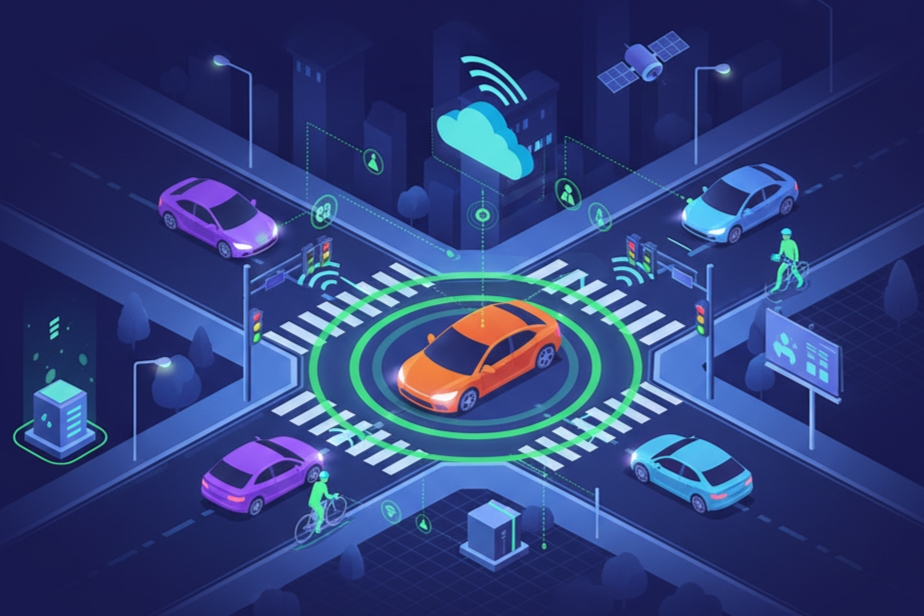
Your car already “talks” to you in simple ways, like when the gas light comes on or a chime reminds you to buckle up. But V2X is different. It is an entire communication network that enables your car to engage in a two-way live conversation with all things and people that surround it.
This is no minor improvement, but rather a “foundation technology for autonomous driving”. Many of the world’s top automakers, including BMW, Mercedes, and Renault, believe this connectivity is the key to truly advancing self-driving vehicles. The goal is to create a seamless, connected network that makes our roads dramatically safer and more efficient.
The potential is so massive that the V2X market is expected to grow from USD 0.5 billion in 2023 to USD 9.5 billion by 2030. Now that’s a multi-billion-dollar investment right there, just to make this smart infrastructure a reality.
How V2X Works
A. The Technology Behind V2X
So, how does your car start talking to a traffic light? The system works by combining two types of technology. First, it relies on sensors and devices already installed on the car (cameras, radar, and LiDAR) to gain insight into what is going on around. Second, and this is the critical part, it uses wireless connectivity (like 5G, LTE, and WiFi) to share this information and receive data from others.
Think of V2X as creating a “mesh network” on the road. Each vehicle, smart traffic signal, or even a pedestrian’s smartphone can act as a “node” on this network. Such nodes are always sending, receiving, and relaying messages. This creates a dense, reliable web of information right where it’s needed most: in and around traffic. In this system, continuous, reliable connectivity is the holy grail.
B. Types of V2X Communication
“Everything” is a big word. V2X technology is divided into a few main components that interact with each other.
1. Vehicle-to-Vehicle (V2V): A direct line of communication between cars. Vehicles wirelessly exchange data on their speed, location, and direction. That enables it to do much more than the modern blind-spot detectors. It is capable of alerting a driver about a possible crash or inform him or her that a car ahead has suddenly slowed down.
2. Vehicle-to-Infrastructure (V2I): Connects the car to the “smart” road itself. Vehicles share information with infrastructure like smart traffic lights, road signs, and sensors. Such a communication is able to optimize traffic or alert the driver of an imminent construction or a blind corner hazard.
3. Vehicle-to-Pedestrian (V2P): Aimed at saving the lives of the most vulnerable road users. The car will be able to detect and communicate with other pedestrians, cyclists, and people in wheelchairs around it. This usually functions through connection to mobile devices. Such technology is vital, especially when considering the World Health Organization reports that nearly 1.19 million people die each year as a result of road traffic crashes.
4. Vehicle-to-Network (V2N): Vehicle-to-Network (V2N): This links the vehicle to a larger network, such as the cloud, via cellular technology such as 4G and 5G. V2N is applied to services that need a longer range connection, like real-time data about traffic to navigate, locate the available parking, or the nearest EV charging station.
V2X vs ADAS Systems
A. Limitations of ADAS Technology
Many new cars already have Advanced Driver-Assistance Systems (ADAS). It basically includes features like lane-keeping assist, adaptive cruise control, and automatic emergency braking. ADAS is fantastic, indeed. But it has one major limitation—reliance on “line-of-sight” sensors.
ADAS is based on cameras, radar and LiDAR to perceive the surrounding world. When a sensor is not able to see an object, the system does not know it exists. These systems cannot see around a sharp corner, through a dense fog bank, or over the crest of a hill.
B. V2X as a Complementary Technology
V2X is the solution to this problem. It doesn’t replace ADAS. It complements it by acting as an additional sensor. V2X creates what experts call a “non-line-of-sight” capability.
Your car no longer needs to physically see the danger. It can be told about it. V2X will be able to provide a warning to your ADAS that a vehicle in the road is at the blind corner, or that some pedestrian has just stepped into the crosswalk behind that big truck. It provides data from 360 degrees and works in all weather/light conditions that can often confuse optical sensors.
Also Read: Maximizing Efficiency with Auto Insights 2025
Debate: DSRC vs C-V2X
Before V2X can be everywhere, the world needs to agree on a single “language” for it. Right now, there is a major technology debate between two competing standards: DSRC and C-V2X.
A. What Are DSRC and C-V2X?
DSRC (Dedicated Short-Range Communication) is the older, more established technology. It operates on a dedicated frequency band of 5.9GHz on a Wi-Fi-based standard (IEEE 802.11p).
➜ PROS: It is a mature, reliable standard with very low latency (under 100ms), making it ideal for instant safety-critical applications.
➜ CONS: It has only a short range (300-1,000 meters) and may fail in the city with numerous buildings. It also involves high costs of installation of new roadside units.
On the other hand, C-V2X (Cellular-V2X) is the newer standard based on 3GPP cellular technology (LTE and 5G). It has two modes: a direct (PC5) mode for short-range safety alerts (like DSRC) and a long-range (Uu) mode that uses the existing cellular network.
➜ PROS: C-V2X can leverage existing cellular infrastructure, providing a wide range and coverage. It is very scalable, works better under non-line-of-sight situations and is said to be future-proof due to its straightforward upgrade with 5G.
➜ CONS: Its long-range operations depend on the availability of cellular networks, which may be weak in rural areas.
B. Current Trends
This technology “format war” has slowed down global adoption. Different regions have picked different sides. China has gone all-in on C-V2X. Japan chose DSRC (though on a different frequency). Europe and some automakers like Toyota initially backed DSRC, while others like Volkswagen backed C-V2X.
The tide seems to be turning in favor of C-V2X. In the United States, the Federal Communications Commission (FCC) reclaimed a large portion of the 5.9GHz spectrum that was originally set aside for DSRC, dealing it a significant blow. One judge, in his opinion, bluntly stated that DSRC was a technology that “has always been promised but never actually delivered”. As 5G networks continue to expand, most experts believe C-V2X is likely to become the dominant V2X technology.
MORE ON AUTOMOTIVE INNOVATION
How AI Infotainment Is Enhancing Driver Experiences
Benefits of V2X Technology
A. Enhanced Safety
This is the number one reason for V2X. The statistics are sobering. In 2021 alone, the National Highway Traffic Safety Administration (NHTSA) estimates that nearly 43,000 people died in car accidents in the United States. A direct solution to this is V2X technology. V2X will eliminate accidents by giving early alerts on any possible accidents, like sudden braking or hazardous road conditions. The NHTSA itself estimated that adopting just two V2X safety features could save 1,000 lives and prevent half a million crashes per year.
B. Energy Efficiency
V2X is not only safer, it is smarter. It is able to enhance fuel and energy efficiency radically. When your car knows about traffic jams and the timing of stop lights miles ahead, it can translate that data into a route that avoids unnecessary stopping. This smooths out your drive and saves fuel. For electric vehicles, V2X can connect to the grid to find nearby charging stations and confirm if they are available or in use.
C. Smarter Mobility
When you combine enhanced safety and efficiency, you get smarter, faster, and cheaper transportation. V2X is the key to unlocking “smart city” mobility. It enables “platooning,” a method where trucks or cars drive closely together in a digitally-connected convoy, drafting off one another to save fuel. It also allows for advanced traffic management. V2X use cases prove it when Audi has tested a Green Light Optimized Speed Advisory (GLOSA) system that shows the driver the exact speed to travel to “catch the green wave” and avoid stopping at red lights.
The Future is Coming, But What About Today?
The future of V2X is bright. But, it highlights a trend that is already here—vehicles are more complex than ever.
Cars are lasting longer, and they are incredibly well-designed. While this is great for drivers, it often means dealerships are selling fewer new cars. So, where is the real, sustainable opportunity for dealerships?
It’s in Fixed Operations—the Service Drive.
As V2X and ADAS systems become standard, the “repair” part of the dealership becomes the most critical. Cars always need to be fixed, and these complex systems require expert service. Many dealers focus on new car sales, but the truth is that boosting the revenue of your Fixed Ops will exponentially increase the total value of your dealership.
That is exactly what Chris Collins Inc. does! We specialize in transforming dealership Service Drives into money-making machines. It’s just not about training here. Rather, we provide leadership and accountability coaching to optimize your processes, increase customer satisfaction, boost retention, and skyrocket your profits.
If you’re focusing on the future of automotive, don’t forget the most profitable part of your business today.
Conclusion
Fixed Operations in dealerships are the driving force behind consistent profitability, customer loyalty, and long-term success in a rapidly evolving automotive industry. Through service optimization, investing in the latest technology, as well as creating high-performing teams, dealerships can access a reliable source of revenue and have meaningful interactions with customers.
Ready to revolutionize your dealership’s approach and stay ahead in this competitive field? Share this article with your peers and let us continue delivering valuable insights to keep your business thriving!
Achieving and exceeding your goals is possible when you have the right systems in place. With Service Drive Revolution OnDemand, you’ll gain access to the proven systems that have made thousands of SERVICE MANAGERS IRREPLACEABLE. Start transforming your department today!
Need help updating your playbook? Let us know how we can support your team’s growth.
Book a 15-minute strategy session with our team. We’ll explore how to unlock your dealership’s real value.