Quick Answer
An automotive shop foreman serves as the hands-on supervisor connecting service management with floor mechanics. They manage daily workflow, assist with complex diagnostic repairs, and perform quality control inspections. Unlike administrative service managers who focus on business strategy, foremen directly ensure shop-floor productivity and mentor technicians.
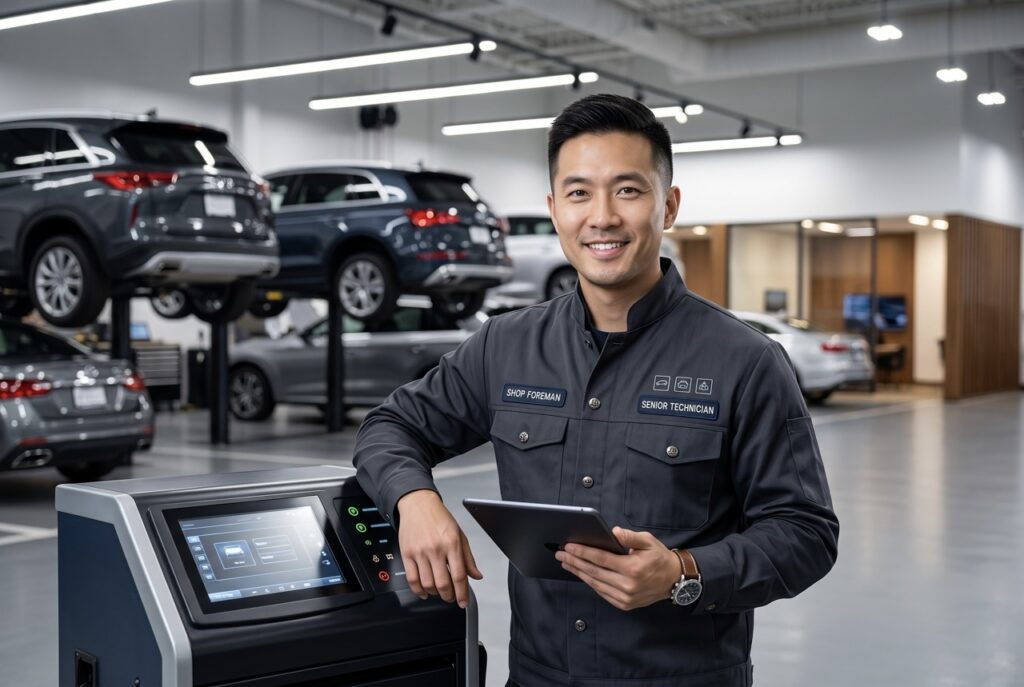
Your service department is where genuine customer relationships are built, and where a huge chunk of profit opportunities lie. However, consistently maintaining peak efficiency, ensuring every repair meets quality standards, and keeping your technicians productive can undoubtedly be challenging. When the flow of work falters and complex jobs turn into bottlenecks, both customer satisfaction and your dealership’s profitability are bound to feel the impact.
That is why a dedicated automotive shop foreman is undeniably important. This expert supervises technician teams, coordinates workflows for maximum output, and implements rigorous quality control to guarantee that repairs are done right the first time. They also provide crucial dispatch support, deliver technician training, monitor productivity, and facilitate clear communication with service managers, making certain every repair remains accurate and efficient. Keep reading to understand the full scope of what an automotive shop foreman does, and how this position can empower your service operation for consistent success.
Key Takeaways
- Shop foremen act as front-line leaders, bridging the gap between service management and mechanics.
- Daily duties involve dispatching workflow, supervising technicians, ensuring quality control, and mentoring junior staff.
- Unlike administrative service managers, foremen work directly on the shop floor, guiding technical repairs.
- The role requires a blend of advanced diagnostic expertise, strong leadership, and clear communication.
- Average annual salaries range from $65,000 to $70,000, often combining base pay with performance bonuses.
What Does an Automotive Shop Foreman Do?
An automotive shop foreman wears many hats, acting as a crucial central figure in your service center. And that’s for so many reasons, as they are the…
● Front-Line Leader
The shop foreman serves as the primary hands-on supervisor within a dealership. This individual acts as a direct link, connecting shop management and the mechanics on the service bay floor. They provide immediate guidance and support, making sure that directives from above are understood and executed by the team. Zippia data shows there are over 15,043 shop foremen currently employed in the United States.
● Operational Supporter
Overseeing daily repair activities is a core responsibility. The foreman’s objective is to ensure all tasks run smoothly, safely, and efficiently, preventing unnecessary delays. This involves monitoring workflow, allocating resources, and addressing minor roadblocks as they arise to keep the service department productive.
● Technical Expert
When complex diagnostics or challenging repair issues surface, the shop foreman consistently steps in to assist mechanics. That’s why deep technical knowledge is a must here as they help resolve difficult problems, allowing work to move forward without prolonged holdups. Their expertise is invaluable for troubleshooting and guiding technicians through intricate repairs.
What Are the Duties of a Dealership Shop Foreman?
The daily duties of a dealership shop foreman are pretty diverse, covering everything from team management to quality assurance. The tasks below are vital for maintaining high standards and a productive work environment.
● Technician Supervision & Support
A foreman assigns work fairly among the technicians, leveraging each individual’s strengths. They guide team members through difficult diagnostic procedures and intricate repairs. The Bureau of Labor Statistics projects about 70,000 openings each year for automotive technicians. Thus, guiding the new mechanics becomes a large part of the foreman’s day. The foreman is also responsible for monitoring performance, ensuring technicians consistently meet their daily goals for efficiency and quality.
● Workflow Coordination & Dispatching
Organizing technician schedules and managing the flow of work is a major part of the role. A foreman often performs pre-dispatch road tests to accurately verify repair needs before a job begins. Furthermore, they help direct incoming repair orders, guaranteeing each vehicle is routed to the most qualified specialist.
● Quality Control & Inspections
Maintaining high repair standards is so important. This involves conducting spot checks on ongoing work and performing post-repair road tests on repaired vehicles. The foreman also manages return repairs, often called “comebacks,” identifying root causes and preventing recurrences to secure high customer satisfaction.
● Productivity Monitoring
A big aspect of the foreman’s job includes developing the team. So what does that mean? Well basically, they teach younger mechanics new techniques, sharing practical insights and methods. Moreover, the foreman organizes and facilitates ongoing factory safety and technical training. That ensures the entire team elevates and updates their skills and knowledge.
● Training & Mentoring
Tracking daily performance records provides crucial insights into shop efficiency. On a regular basis, a shop foreman checks repair order accuracy. It’s their responsibility to make sure that all work is correctly documented and billed.
What Is the Difference Between a Shop Foreman and Service Manager?
While both roles are critical to a service department, the shop foreman and service manager operate with distinct focuses and responsibilities. Understanding this separation will give you clarity about their unique contributions.
● Primary Focus
The shop foreman primarily handles hands-on technical guidance, technician training, and the physical quality of repairs directly on the shop floor. In contrast, the service manager addresses broader business decisions, financial planning for the department, and overarching strategic initiatives. The foreman guarantees the work gets done correctly, while the manager shapes the department’s direction.
● Daily Responsibilities
Foremen manage the daily upkeep of tools and equipment, conduct road testing, and actively participate in mechanic problem-solving. Service managers, conversely, are responsible for major hiring decisions, budget control, establishing overall department policies, and optimizing broad financial outcomes. One handles efficient daily execution while the other oversees strategic departmental health.
● Work Environment
The shop foreman spends the majority of the workday directly in the service bay, closely interacting with mechanics and working on vehicles. On the other hand, service managers largely operate from an administrative office, focusing on paperwork, meetings, and higher-level planning. Can you see now the difference? Even their physical locations reflect their distinct operational priorities.
What Skills Does an Automotive Shop Foreman Need?
A successful automotive shop foreman requires a blend of technical prowess and strong interpersonal abilities. These skills will equip them to lead a team effectively and maintain high operational standards.
● Advanced Technical Expertise
In-depth diagnostic capabilities are essential for identifying complex vehicle issues. A foreman must master various vehicle systems and be familiar with manufacturer-specific procedures and special tools. Such a deep technical foundation allows them to guide and support their team through challenging repairs.
● Strong Leadership & Coaching
The ability to motivate technicians is crucial for maintaining a high-performing team. A foreman must resolve interpersonal conflicts fairly, mentor apprentice mechanics, and consistently foster strong team morale. Effective leadership creates a cohesive, productive work environment.
● Clear Communication
Skill in explaining complex mechanical issues concisely is vital. A foreman must articulate problems clearly to service advisors, customers, and upper management, translating technical jargon into easily understandable terms. This level of clarity helps manage expectations and build trust across all interactions.
● Organization & Problem Solving
Strong time-management skills are necessary to efficiently schedule shifts and allocate tasks. A foreman must evaluate the root causes of recurring repair errors and strategically eliminate workflow bottlenecks, making sure that operations remain smooth and productive.
Salary Trends & Earning Potential
For those contemplating or currently in this crucial role, understanding the compensation landscape for automotive shop foremen offers valuable insight. It reflects the blend of technical skill and leadership responsibilities.
● National Pay Averages
Annual base pay for a shop foreman typically ranges from $50,000 to $80,000. National averages generally hover around $65,000 to $70,000 annually. In major metropolitan or high-cost-of-living areas, top earners can reach upwards of $93,000 to $103,000 or more per year, reflecting regional demand and experience.
● Earning Structure
Compensation packages for foremen often combine a stable base salary with performance-based bonuses. These bonuses are commonly tied directly to key metrics such as net shop profits, overall efficiency ratings, and technician output. Through that structure, strong leadership and operational excellence are being incentivized.
● Industry Progression
Advancing from an entry-level technician position to a lead technician or shop foreman represents a significant career progression and typically brings a substantial boost in pay. Opportunities for increased earnings grow alongside accumulated leadership experience, specialized certifications (such as ASE certifications), and the mastery of advanced diagnostic skills. This underscores the value placed on comprehensive abilities within the automotive industry, making it an attractive career path for skilled technicians aiming for leadership.
Ready to Strengthen Your Fixed Ops Systems?
Achieving and exceeding your goals is possible when you have the right systems in place. Whether you’re improving technician efficiency, streamlining shop dispatching, or building more consistent dealership processes, Service Drive Revolution OnDemand gives you access to the proven systems that have made thousands of Service Managers and shop leaders irreplaceable.
Start transforming your department today!
Need some help updating your playbook? Let us know how we can support your team’s growth potential.
Book a 15-minute strategy session with our team. We’ll explore how to unlock your dealership’s real value.
Frequently Asked Questions (FAQs)
A supervisor holds a higher position in the organizational hierarchy than a foreman. While a foreman manages daily tasks on the floor, the supervisor oversees broader operations, administrative duties, and long-term planning.
A shop foreman boosts productivity by assigning jobs based on skill level and streamlining workflow through immediate technical guidance. They also minimize downtime by ensuring tools, parts, and safety protocols are ready before repairs begin.
A shop foreman focuses on hands-on technical work, quality control, and directing shop floor staff. Conversely, a supervisor handles higher-level management tasks like budgeting, HR policy enforcement, and department performance metrics.
Foremen sometimes struggle to balance hands-on technical responsibilities with personnel management. On top of that, they must also manage strict production deadlines while keeping worker safety high and team stress low.
Bottom Line
Indeed, a skilled automotive shop foreman serves as the backbone of a successful service department, bridging the gap between complex workshop logistics and high-level service management to keep your workflow moving without hitches. And so, prioritizing this role within your dealership will give you tighter quality control and a significant boost in customer trust. Have you found these insights useful? If so, be sure to share it with your industry peers so we can keep the conversation going. Follow us to stay updated on our newest uploads!
Achieving and exceeding your goals is possible when you have the right systems in place. With Service Drive Revolution OnDemand, you’ll gain access to the proven systems that have made thousands of SERVICE MANAGERS IRREPLACEABLE. Start transforming your department today!
Need help updating your playbook? Let us know how we can support your team’s growth.
Book a 15-minute strategy session with our team. We’ll explore how to unlock your dealership’s real value.