Service Drive Revolution — Episode #376
Official Full Transcript
Host: Chris Collins
Guests: Adam Krey and Chris Hogland
Published: September 15, 2026
Duration: 54:32
Listen on Apple | Listen on Spotify
Following up on the massive conversations sparked by last week’s episode regarding technician pushback and changing shop floor dynamics, Service Drive Revolution – Episode #376 dives deep into how fixed operations leaders can strategically keep their businesses firmly on the capitalist side of the coin. Host Chris Collins and guests Adam Krey and Chris Hogland examine shop floor accountability, advisor performance traps, recruitment pipelines, and why modern dealerships must evolve to survive.
Key Takeaways & Highlights
- Guaranteed Opportunity, Not Pay: Technicians aren’t just fighting over flat-rate versus hourly systems; they want proof that they have a clear path to high earnings and shop leadership.
- The 80/20 Warranty Trap: Low customer-pay hours combined with heavy warranty volume mask poor multi-point inspection habits, which ultimately hurts advisor and technician earnings alike.
- The Danger of Vanity Metrics: Dealership managers often chase high closing percentages on low-dollar recommendations rather than focusing on building real, profitable repair orders.
- The Vocational School Gap: With traditional trade school enrollment dropping, progressive dealerships are bypassing the middleman, going directly into high schools, and building custom apprentice programs.
Navigating Shop Floor Dynamics and Capitalist Success
Building a high-performing service drive requires fixed ops leaders to look past surface-level complaints and address the core operational habits that either reward high performance or breed stagnation.
1. Moving Beyond Guaranteed Pay to Guaranteed Growth
When shop floors face friction over compensation models, the underlying issue is rarely just about hourly versus flat-rate pay. Technicians want transparency. When leadership builds a culture based on clear career progression and fair opportunity, the desire for artificial wage guarantees naturally fades. Top-tier technical talent wants to control their earning potential, but they need management to provide the tools, training, and workflow consistency to make it happen.
2. Escaping the Warranty and Inspection Trap
Relying too heavily on manufacturer warranty work while neglecting customer-pay hours creates a false sense of security. When multi-point inspections drop off, advisors stop uncovering vital maintenance recommendations. This not only hurts effective labor rates (ELR) but also caps technician hours. Dealerships must treat inspections as a non-negotiable daily habit to protect shop profitability.
3. Solving the Recruitment Pipeline at the Source
Relying solely on external job boards to find master technicians is a losing battle. Dealerships that successfully scale their technical workforce are taking matters into their own hands by building direct relationships with local high schools and technical programs. By introducing structured internal apprenticeships, shops can mentor fresh talent from day one and mold them into productive, loyal team members.

Financial Impact of Modernizing Shop Floor Systems
Optimizing service drive operations delivers measurable performance returns across key dealership metrics:
| Performance Area | Operational & Financial Outcome |
| Technician Retention | Stabilizes when clear career paths and objective shop workflows replace favoritism. |
| Multi-Point Inspections | Increases significantly, driving higher customer-pay hours and parts sales. |
| Effective Labor Rate (ELR) | Climbs as advisors effectively communicate value across maintenance and repair buckets. |
| Fixed Absorption | Strengthens above 100%, securing overall dealership profitability. |
Frequently Asked Questions
Technicians are looking for clear career paths, fair job distribution, and proof that hard work translates directly into financial growth rather than getting stuck in legacy management traps.
Relying too heavily on warranty work without balancing customer-pay hours can depress effective labor rates and disguise poor multi-point inspection habits across the team.
Traditional trade school pipelines produce far fewer graduates than the market demands, requiring progressive dealerships to build direct high school outreach and custom internal apprenticeship programs.
Final Thoughts
Keeping your dealership grounded in high-performance capitalism requires more than just managing repair orders; it demands absolute transparency, strong shop floor accountability, and structured career paths for emerging talent. By fixing broken dispatch habits, aligning pay with skill, and eliminating vanity metrics, fixed operations leaders can build resilient, thriving teams.
Actionable Takeaway: Evaluate your current warranty versus customer-pay mix today to ensure your multi-point inspection process is actively protecting both technician and advisor earnings.
Ready to Strengthen Your Fixed Ops Systems?
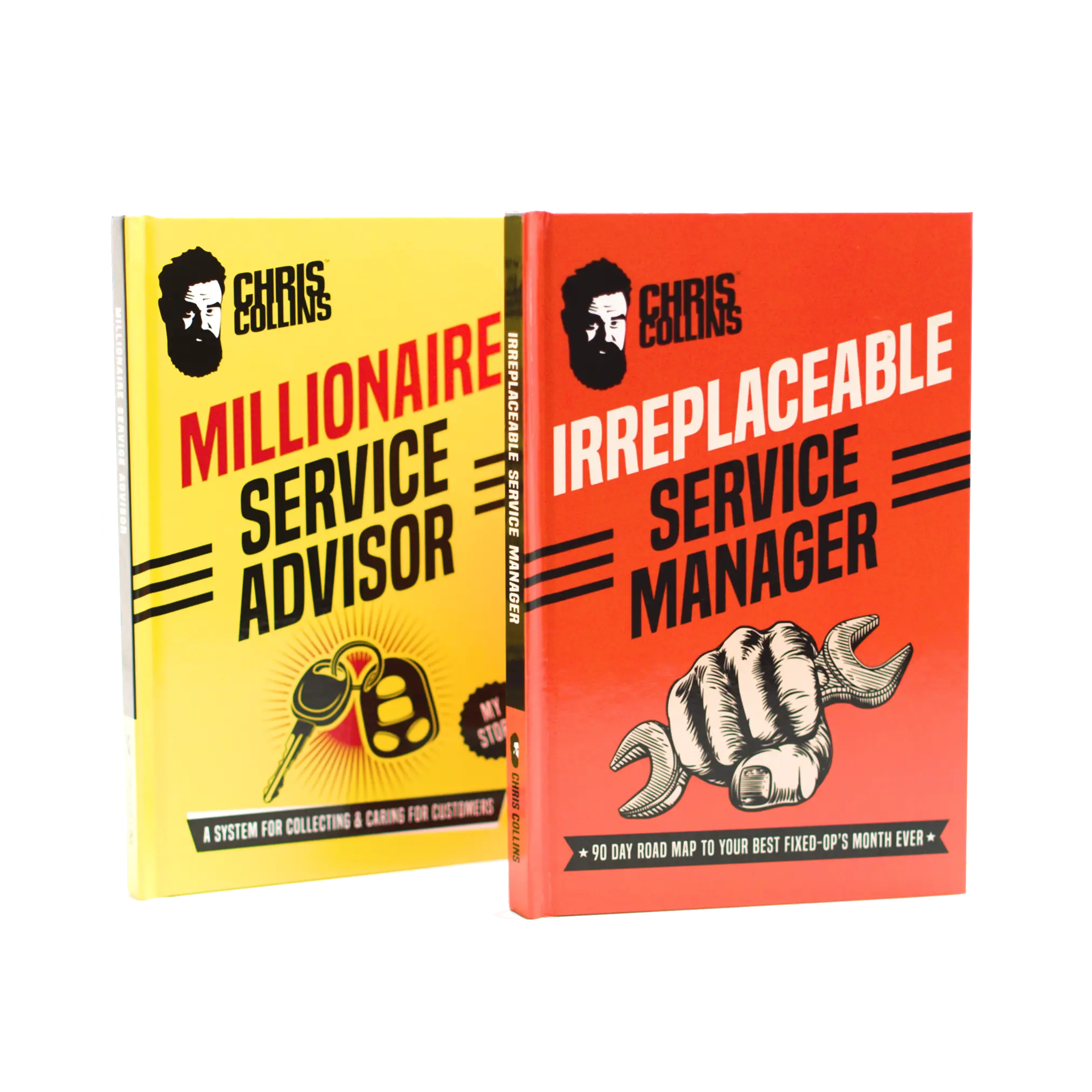
Achieving and exceeding your goals is possible when you have the right systems in place. With Service Drive Revolution OnDemand, you’ll gain access to the proven systems that have made thousands of SERVICE MANAGERS IRREPLACEABLE. Start transforming your department today!
Need help updating your playbook? Let us know how we can support your team’s growth.
Book a 15-minute strategy session with our team. We’ll explore how to unlock your dealership’s real value.
Service Drive Revolution – Episode #376 Transcript
How To Avoid Socialism In The Service Drive
Service Drive Revolution
Hosts: Chris Collins, Hogi, Adam Krey
In This Episode
- Why banning digital e-readers (Kindles) and owning physical books protects intellectual history from corporate edits
- Adam’s transition into the Apple ecosystem and why tech platforms engineer walled gardens
- Exploring Rust Belt and southern Illinois towns, forgotten manufacturing hubs, and the Bentonville economic revival model
- How mayoral leadership and a “retail-first, apartments-second” redevelopment playbook revitalizes local communities
- Marketing secrets: Why going young with your brand and target audience drives higher sales across all age demographics
- Tackling technician minimum standards, simplifying advisor pay plans, and eliminating the mediocrity trap
- The hidden dangers of high ASR closing percentages paired with low hours per RO and garbage multi-point inspections
- Why the push for hourly pay and socialism is colliding with an automotive market where top technicians can name their price
Opening & Community Catch-Up
Chris Collins: Welcome everybody to the big show! Welcome to Service Drive Revolution. We’re gonna teach you how to start a revolution in your service drive—at least that’s the intention, that’s the goal. Hogi is here, and Adam is here in the office. Usually once a month, we’re all together here in beautiful Los Angeles, California. It is hot and as humid as Florida right now.
We are live on a bunch of different platforms and we have the ability to read your comments, so we’re gonna do a Q&A here like we did last week. What we’re talking about today though is how to avoid socialism in your service drive. The episode we did last week was pretty popular and started some good conversations, so we want to talk about how do you avoid that? If socialism is coming, how do we avoid it strategically, and what things can we do to keep our business on the capitalist side of the coin?
Why We Banned Kindles (You Don’t Actually Own the Book)
Chris Collins: Adam has a Kindle notebook, and as we were getting ready to do this, Josh looked at it and asked, “Is that a Kindle?”
Adam Krey: How have I—I tried to warn you.
Chris Collins: We are literally making a piece for the office—a fish aquarium that we’re going to fill with oil that looks like water, and we’re going to put Kindles in it. We are officially collecting Kindles.
If you look around this room, what is predominantly going on? Books—physical books, not electronics. What can never happen to physical books? Barring being destroyed, they can never be changed, and history can’t be rewritten on them. With digital books, unapologetically, Amazon has changed books to be politically correct or to change history and change the narrative. When you get a book on a Kindle, you don’t own the book; they can change it and you have no control whatsoever. So, item one in eliminating socialism from your service drive is ban Kindles—or use them strictly as a notebook.
Adam Finally Joins the Apple Ecosystem
Chris Collins: How does it feel to be in the Apple ecosystem, Adam? For anybody that doesn’t know, Adam was fighting that for the longest time and was Android forever. Then something happened. What happened?
Adam Krey: You can’t connect with everybody in order to know what’s going on, so it messes up a bunch of group messages. Things just don’t work seamlessly.
Chris Collins: See, that was the largest insight for me—when you go to an iPhone, everyone makes a big deal about you finally being blue instead of green.
Adam Krey: It’s an odd thing how impactful Apple’s made that, and they say they fixed the group messaging thing, but no, they didn’t—it’s not in their interest. But things do work a little bit more seamlessly, just like printing and how everything talks to one another. I’ve been converted a little bit.
Forgotten Towns: Cairo, Illinois and the Rust Belt
Chris Collins: Let’s talk about Southern Illinois and the Rust Belt. There’s this YouTube channel called Rocka News that goes to old mining towns and forgotten parts of the US to see what’s going on. One of them featured Southern Illinois and Cairo.
Adam Krey: When you travel through those areas, like Metropolis or the Shawnee National Forest, it’s a beautiful part of the state, but you look at the people and try to understand what happened. At one point in time, those river cities especially were thriving in industry. Cairo was considered the middle or “Egypt” where two rivers come together, and they were all industrial spots.
Chris Collins: Most of those places had economies fed by coal. People that work in coal mines work really, really hard under tough conditions. If you’re building a factory where you need workers who will work hard, don’t complain about conditions, and work for a fair wage, why aren’t we putting factories in those places strategically? Instead, factories tend to go right by major cities because you can’t attract talent or build housing if you aren’t next to a city.
The Bentonville Blueprint for Reviving a Town
Chris Collins: Have you seen what Walmart did with the city they’re based in—Bentonville, Arkansas? It’s crazy! They invested tons of money. You got the town square, mountain biking, theaters, restaurants, and art galleries. Northwest Arkansas grew really fast because of that investment.
When you look at redevelopment, I’ve been in on these meetings with mayors, city planners, real estate developers, and business owners. They have formulas where they incentivize businesses—like giving a grocery store owner free rent for the first couple of years—and then they start building apartments on top of retail. You gotta put the retail and grocery in first before you build the residential buildings, which seems counterintuitive, but by year five, you have 2,000 tenants who have to come to you. The quarterback in this situation is an active mayor working hand-in-hand with developers, tax incentives, and building an arts and music scene to attract young people.
Marketing Lesson: Go Young to Sell the Older Buyer
Chris Collins: I learned about going young when I took over Cravier BMW. Ownership wanted to market exclusively to 7-Series buyers on ESPN and the Golf Channel so they could brag at the country club. Nobody graded commercials on car sales; it was just branding.
I said no, I want to track my advertising investment, so I went young—Howard Stern, Kiss FM—and started pushing the 3-Series. What I learned is we sold twice as many 7-Series when we were selling twice as many 3-Series! It didn’t work the other way around. You can get entry-level buyers into a BMW 3-Series for $399 a month—cheaper than a Honda Accord because of maintenance—and chip away at Honda and Toyota. When you build a young core with art, music, and energy, it attracts everyone else.
Q&A: Technician Minimum Standards and Advisor Pay Plans
Chris Collins: Let’s take a question from Richard Devo (born in 1956): “How should we approach technician minimum standards if we have too many technicians, too few appointments, and advisors with average wild card sales?”
First, you have to guarantee opportunity, not pay. You have to start upfront by setting advisors up for success with systems that ensure every customer is offered proper vehicle maintenance every time. Most service advisor pay plans are hodgepodge structures that reward mediocrity. When I see this question, I almost always find low hours per RO and an 80% warranty / 20% customer pay split.
If advisors are just making a living off warranty writing without offering customer-pay maintenance, it becomes hard to hold technicians accountable. If you have too many technicians, you may lose a couple, and maybe that’s what needs to happen, or you have to aggressively drive marketing and customer-pay traffic.
Why Techs Want Hourly and the Realities of Flat-Rate
Chris Collins: There is an undercurrent happening right now where technicians are talking about moving away from flat-rate and going to hourly wages. What technicians really want is to know they have the opportunity to make a decent paycheck and that the system is fair.
It doesn’t make sense when a recall comes out paying 1.1 hours, and six months later it drops to 0.3 hours. That happens over and over, and the industry absorbs it. Both sides are right and both sides are wrong, which makes this line hard to navigate. But high-performing advisors take care of their techs, which is why when you interview top advisors, the best interview question to ask is: “How many techs will follow you?” The answer is always at least two or three because great advisors protect their technicians’ hours and pay.
The ASR Closing Percentage Trap & Chasing Metrics
Chris Collins: Another trap going around right now is obsessing over ASR (Automated Service Request) closing percentages off multi-point inspections. You’ll see high closing percentages paired with low hours per RO. When you check the multi-points, they are either garbage, non-existent, or pencil-whipped—like an all-green inspection on a car with 95,000 miles.
If a technician doesn’t do a multi-point inspection, or only flags the sure bets, the advisor easily closes 100% of a $300 recommendation. Managers get caught chasing shiny reports to look good on paper rather than telling the truth, looking bad on a report, and actually making more money. I’d much rather have an advisor with a 50% closing percentage on $1,500 than a 100% closing percentage on $300.
Hiring Disciplined: Look for Assassins, Not Resumes
Chris Collins: To avoid cultural drift and operational decay, you have to be more disciplined in your hiring. Don’t take chances on a technician just because you like them in an interview or they have brand certification. Look for “assassins”—technicians with a proven track record of flagging hours who can be dropped into any stall and figure out how to produce.
It’s ironic that talk of socialism and unionization is happening in a market where top automotive technicians can name their price and make $100 an hour. The tools are literally on wheels for a reason.
The Vocational School Gap & High School Recruiting
Chris Collins: We also don’t have enough young, fresh faces coming into the trade because kids are trapped with $100,000 in student loans for political science degrees, when they’d be much better off working on cars, trucks, or heavy equipment. For decades, trade schools went into high schools and falsely promised kids that fixing cars is just like playing video games on a tablet. Then the student gets to technical school, faces complex electrical diagnostics, and struggles.
Successful dealerships and groups are bypassing traditional technical schools entirely, going straight into local high schools, creating their own pipeline programs, and showing students a clear career path. Dealerships need to double down on being the fabric of their local communities.
Wrap-Up
Chris Collins: The consumer population has changed, but our industry has stayed the same—and it has to evolve. Car dealerships can no longer survive by ignoring people, lacking business acumen, and running poor systems. Public dealer groups are already showing signs of dumping stores, which brings us right back to local operators buying dealerships, building good roots, and embedding themselves in the community.
Thanks everybody for hanging out with us today! We will see you right now inside the SDR Academy. Have a great week!
About Service Drive Revolution Academy
I know from experience that a lot of dealer owners won’t invest in training for fixed ops — but eight SERVICE MANAGERS in our coaching group have been promoted to general managers. That doesn’t happen enough in our industry. It’s proof that when you’re given the right tools and the right mentorship, you can do amazing things.
I’d like to personally invite you to something that should exist already, but unfortunately doesn’t: a live Fixed Ops Academy — a mentorship, a community. It’s a Service Drive Revolution Academy. Anybody can afford it; anybody who wants to invest in themselves can join. We teach what we know about running a healthy fixed-ops service business. Our average coaching client performs well above the industry average, and a handful are in a league completely their own — if I told you their numbers, you wouldn’t believe it.
🔗 Related Resources
- Is “Socialism” Coming to Your Service Drive?
- Hourly vs. Flat Rate Automotive Technician Pay Plans
- How Does Flat Rate Pay Work for Auto Mechanics
Feel free to explore the linked articles above for deeper insights into each strategy. If you have any further questions or need additional resources, don’t hesitate to ask!