Book A 30-Min. Discovery Call with our team Today+1 (800) 230-5165 Book a Call

High Performing Service Advisors: 7 Traits That Drive Results

What separates average advisors from high performing SERVICE ADVISORS?

Success in Fixed Ops is not luck.
It is not traffic.
And it is never just the location.

In Service Drive Revolution #349, the conversation focuses on the seven core traits that consistently show up in top SERVICE ADVISOR performance across hundreds of dealerships.

If you are a SERVICE ADVISOR, this is your blueprint.

If you are a SERVICE MANAGER, this is what you must coach, inspect, and enforce.

Because the difference between average and elite performance is behavioral — not circumstantial.


1. High Performing SERVICE ADVISORS Are Intentional

The first trait is intentionality.

High performing SERVICE ADVISORS do not “see what the day brings.” They walk in with goals:

  • Hours per RO targets
  • Effective labor rate expectations
  • Bonus objectives
  • CSI benchmarks

They know what they want to produce each month. More importantly, they reverse-engineer their daily behavior to hit those numbers.

Average advisors react to traffic.
Top advisors create outcomes.

For SERVICE MANAGERS, this means performance conversations must center around measurable targets — not vague encouragement.

Intentionality is coached.


2. They Are Investigators — Not Order Takers

One of the most powerful SERVICE ADVISOR traits discussed in the episode is the investigative mindset.

Average advisors write what the customer asks for.

High performing service advisors ask questions.

They investigate:

  • Service history
  • Driving habits
  • Future ownership plans
  • Prior maintenance records
  • Patterns in repairs

They do not sell randomly, they build a maintenance strategy.

This builds credibility and trust. It also increases average RO naturally — without pressure tactics.

SERVICE MANAGERS should coach advisors to slow down during write-up and gather better information. Better discovery leads to better recommendations.

how to fix shop culture

3. They Are Insatiable Learners

Top SERVICE ADVISOR performance requires continuous growth.

High performing SERVICE ADVISORS:

  • Ask to speak with top performers
  • Request coaching
  • Read and study
  • Learn how technicians diagnose issues
  • Seek feedback

They do not justify underperformance. They look for improvement.

In many stores, when performance data is shared, average advisors look for excuses. Elite advisors ask:

“Can I talk to the top performer?”

That mindset alone separates them.

If you want to strengthen leadership standards around growth and performance expectations, you may also find value in our related article on 9 Reasons Service Managers Fail in Fixed Ops (And How to Avoid Them). Leadership standards influence advisor behavior more than most managers realize.


4. They Control the Experience

High performing SERVICE ADVISORS control the service visit from start to finish.

They:

  • Frame expectations early
  • Explain the multi-point inspection upfront
  • Set update timelines
  • Call before customers call them
  • Remove decision fatigue

They do not wait for customers to chase them for updates, they guide the experience.

Customers feel safe when there is structure. Structure increases trust. Trust increases approvals.

SERVICE MANAGERS must train framing language — not just selling language.

Framing is where performance begins.


5. They Build Trust (Not Objection Scripts)

Many dealerships focus on objection handling and product knowledge training.

However, high performing SERVICE ADVISORS understand something deeper:

Trust eliminates objections.

They do not sell brake fluid by discussing viscosity.
They sell brake fluid because the customer trusts them.

Trust is built through:

  • Consistency
  • Transparency
  • Follow-through
  • Calm confidence
  • Relationship building

Overcoming objections is usually a symptom of missing trust.

If your advisors constantly “fight” for approvals, the real issue may be relational — not technical.


6. They Understand the Business

Top SERVICE ADVISOR performance requires business awareness.

High performing service advisors understand:

  • Hours per RO
  • Technician productivity
  • Gross profit
  • Pricing structure
  • Maintenance intervals

High-performing advisors understand how the department makes money.

Because of that, recommendations are never presented blindly.
Every suggestion is backed by a clear reason.

This business awareness increases confidence. Confidence increases credibility.

For SERVICE MANAGERS, this means teaching advisors how the department works financially — not just how to write tickets.

If you want to see how systems directly impact performance metrics, review our related post on Why Fixed Ops Systems Matter More Than People in Dealership Service. Strong systems create the environment where advisors can win.


7. They Have Emotional Resilience and Ownership

Service advising is demanding.

Customers arrive stressed. Vehicles break unexpectedly. Surveys sometimes feel unfair.

High performing SERVICE ADVISORS demonstrate emotional resilience.

They:

  • Stay steady
  • Reset between customers
  • Avoid emotional swings
  • Take ownership of outcomes
  • Focus only on what they can control

They do not blame traffic.
Nor do they blame the car wash.
And they certainly do not blame the technician.

They own the experience.

Ownership creates control.
Control creates consistency.
Consistency creates results.


What SERVICE MANAGERS Must Enforce

If you lead a service department, this episode is a coaching blueprint.

You must:

  • Set clear production expectations
  • Inspect daily performance
  • Reinforce investigative behavior
  • Coach framing language
  • Reward intentionality
  • Address emotional volatility

High performing SERVICE ADVISORS do not appear by accident.

They are developed through:

  • Clear standards
  • Daily inspection
  • Consistent coaching
  • Measured accountability

When managers tolerate mediocrity, advisors stay average.

When managers enforce standards, performance rises.


Final Thoughts

High performing SERVICE ADVISORS are not pushy.
They operate with intention.

Instead of being aggressive, they investigate.
Instead of reading scripts, they focus on building trust.

Great advisors control the customer experience.
They understand the business behind every repair order.
Most importantly, they take ownership of their outcomes.

For advisors, this mindset becomes a roadmap to elite performance.

For SERVICE MANAGERS, it becomes the filter for hiring, training, and coaching the right people.

Because in Fixed Ops, the SERVICE ADVISOR is truly the small hinge that swings very big doors.


FULL VIDEO TRANSCRIPT

Rob Riggle and the American Airlines Saga

Welcome to the big show. Today we’re going to talk about the seven core traits of the highest performing service advisors. The people that maybe create the most gross in the dealership and touch the most customers every day. What are those characteristics? What do the top performers have that the other ones don’t? I’m Chris. Hogi’s here. Adam’s here. And we talk about that. And then we talk about a conversation I recently had with Rob Riggle and much much more coming up right now on Service Drive Evolution.

Life is a journey, not a destination. Do you guys remember our conversation about American Airlines a couple weeks ago?. I feel like it’s ongoing, but you can always refresh us. Well, it’s just something really funny happened to me that was totally random and not expected, but we were recording an episode of Books That Changed My Life and we had Rob Riggle on, the actor and comedian, and he went into a whole story on the show about how bad American Airlines is. He told it like we were talking about how the employees have learned helplessness basically. He then told me a story about how one of the stewardesses was yelling at the guy in front of him. I told him we’re starting a podcast about how bad American Airlines is and does he want to be a co-host with us? And he was down.

The Psychology of Shared Frustration

I don’t think it’s just us. I think that there’s a lot of people out there that when you bring it up, there’s like this little glimmer that comes into people’s eyes. There’s a body language thing that I picked up on when we did a lot of that Chase Hughes training. Do you guys know what it means when someone has compressed lips? They’re sitting at a table in conversation and their lips are compressed. It means that they have something to say, but they’re not wanting to say it. When you bring up American Airlines, they get this glimmer in their eye and they’re waiting for you to finish their story and they’re nodding along because they have their own.

I can’t even imagine what Rob Riggle banter would be like about American Airlines because I could only imagine his delivery on all of it. There’s just so much passion listening to people. It was funny too because I was trying to figure out how he ended up on American Airlines because I think he was flying to New York or somewhere like that and I was like, “Try Delta.” He’s like, “Yeah, no, that’s my new thing. I fixed that. Nobody’s booking me on that.” I’m sure it was just some assistant that booked him.

Logistics and Pilot Perks

I’m all United. I tried the American thing. I was 1k for all the travel for United and actually what I was appreciative with American is they’ll match your status as you just hit those segments. So I was like, “Alright, I’ll try and do that.” That did not work out. We talked about it before getting caught up in that whole Dallas storm of just hell. But now it’s like the gift that keeps on giving to everybody. American Airlines, keep at it. You know, the CEO is getting hated on by the employees. Not only are the employees unhappy up, then they’re unhappy down to the customers.

The Human Touch in Travel

Somewhere there’s an American Airlines waiting for the crew to show up because that’s happened to me a bunch of times. They’re waiting for the crew to show up because they’re on another plane in Hawaii. The logistics is crazy. On United or Delta, I get it that they need to go back to a certain place, but customers are paying for those seats just to move them out. One of the coolest, smallest little things as a customer is when we were flying to see the Chicago Bears overseas in London.

On our way back, the pilot saw that I was a certain status and he wrote on a card. He actually had his own physical card and wrote, “Mr. Cray, thank you so much for all of the time that you’ve traveled with us. We really appreciate your loyalty to United”. It was just a handwritten little note. I actually saved that card for several months. It was just really cool that they gave a crap about the time it takes to travel for business and be away from your family. For an airline to actually connect with me and say thank you, it means a lot. American Airlines is so far away from any of that sort of stuff.

Culture vs. Marketing

Everybody has a story about an interaction with an employee at American Airlines. Like we were talking about the other day, it’s a culture thing. When the CEO talks about redefining American Airlines and making a comeback, he’s talking about new lounges. Nobody’s going to care about the new lounges if the person on the other side of the counter is bumping them and moving them to the back. You just have to fly them for a few flights and then fly Delta or United and you can just feel the difference.

What if we took Jerry Jones and switched him with Robert Isom, the CEO of American Airlines? What if Isom ran the Dallas Cowboys and Jerry Jones ran American Airlines?. Nothing would happen exactly. We either got to do that or make them change their name. It shouldn’t be American Airlines. The pilots Jerry Jones would hire would have a rap sheet. I’ve got money on the fact that Isom won’t fix it because he’s just talking about the lounge, not the culture.

Trait 1: Intentionality

Let’s talk about the seven core traits of the highest performing service advisors. The top advisors just stick out. You can just tell. Certain celebrities have a charisma and an energy about them that’s different than everybody else. Rob Riggle and I were talking about that because he said he’d met every president from Nixon forward and I asked who was the most charismatic. He said Clinton by far. It’s the same thing with top performing advisors; there’s just something about them.

Number one on our list is that they’re intentional. They’re figuring out what they’re tracking to make. They have a goal for how much they want to write every month, their bonuses, and their CSI. They’re there to create an outcome and that drives what they do, they’re not indifferent or just trying to get through the day to see what happens. They’re trying to make something out of the day and looking for opportunity.

The “Waiting for a Tow-In” Strategy

I remember one time I was a general manager in a meeting with two advisors and the service manager about performance. The two advisors said the problem was they needed more traffic. I stepped out of the meeting and our number one advisor was walking towards me. Our drive manager comes up and says, “Gary, that tow-in you were waiting for is here”. Gary leaves and says, “Oh, I always tell him I’m waiting for a tow-in”. Those other two clowns are in there talking about needing more traffic while Gary is out there making his own traffic. They’re intentional, they have a plan, and they’re building everything around that.

Trait 2: Investigators, Not Order Takers

Number two is they’re investigators. They’re not order takers, they’re really looking for the opportunity in every vehicle they’re writing up. They’re trying to understand the customer’s story and the story of the vehicle. When I was an advisor and a customer came in for the first time, I would ask if I could go through their receipts in the glove box or call the place where they’d been servicing to see what was done before I recommended something. I wanted to come up with a plan for the customer. You’re checking history, what is due, the customer’s intentions, and their driving habits. You look at the whole thing as a bigger grand strategy.

Great service advisors ask a lot of questions and they’re just open in general. There’s no preconceived notion about what’s going to happen. One of my mentors told me years back that the first thing you need to know is that people are either open or they’re closed. If you fall into the trap where a customer says the wrong thing and you think, “Oh, you’re one of those customers,” you’re just working against yourself. They’re open, asking questions, and trying to get to the outcome. There’s a different level of intentionality and trust when an advisor asks to go through service records to get the history on the car.

Trait 3: Insatiable Learners

Number three is they’re an insatiable learner. They want to be coached and they want to get better. They’re looking for how other advisors do it. In our advisor competition, they want to talk to the other advisors that are doing well and learn. They’re looking for tools and ideas to be more effective and connect more with customers. They don’t think that they’ve arrived; they’re always evolving, reading books, and watching videos.

When advisors are introduced to the competition, some are indifferent, some want to justify why top performers are doing better, and the third group wants to know how the guy at four hours per RO does it and if they can talk to him


I would take a vacation day to go watch some of these advisors because once you see it, it’s just different, I remember when I first became a general manager, a guy in our 20 group was beating us in new car sales, I asked if I could come watch, I wasn’t even there two days before I saw that his system made sense and we were leaving ours to chance


. People justify underperformance by making up stories, but the reality is top performers just hold themselves to a higher expectation.

Trait 4: Controlling the Experience

Number four is that they control the experience. They’re controlling the customer’s perception, when they’re communicating, and figuring out the customer’s availability so the customer can plan. They call the customer before the customer calls them. They take away decision fatigue. A customer gets frustrated when they have to wait to figure out who’s going to write them up or wait for an update. Being proactive and framing what to expect relieves the pressure. Customers feel safe and trust us when we have a plan and show up when we say we will.

Framing is the correct psychological term for setting expectations. Customers don’t know our processes and are often uncomfortable, like going to the dentist. Controlling the experience means being a good host and guide, always telling them what’s next. For example, at write-up, you tell the customer your goal is to keep them in a safe vehicle and ask if it’s okay to share the results of the inspection later. They’re setting themselves up for success early in the visit. Controlling the entire customer experience is what leads to improved NPS and CSI scores. When I was an advisor, I thought I should be able to charge more because customers were in better hands with me.

Trait 5: Building Trust

Number five is they build trust. When people say we need to train advisors on overcoming objections or product knowledge, they’re missing that they don’t have trust. I never sold maintenance by talking about the viscosity of brake fluid. I would build trust and then tell the customer they were due for brake fluid and an alignment. They would usually say yes because they trusted me, even though I knew nothing about the viscosity of brake fluid. The key is trust.

They make customers feel safe because the process makes them feel safe. Overcoming objections is often just harassment. If you ask a customer to buy an alignment five times, they’re never coming back. You’ve never written service a day in your life if you think it follows normal sales training. In service, if you’re asking five times, they’re gone. Overcoming objections is treating the symptom, not the cause. The cause is they don’t trust us. Good advisors get customers to trust them through control and making the experience better.

Trait 6: Business-Mindedness

Number six is they are business-minded. They know what hours per RO are and understand pricing and gross. They’re very confident and always learning. When I was an advisor and didn’t understand something, I’d ask the tech to show me so I could present it. I wouldn’t try to sell something I didn’t understand.

When a tech told me a valve cover gasket was leaking, I asked him to show me what that was. He showed me how the oil runs down and creates a burning smell. So when I called the customer, I asked if they smelled a burning smell when they parked the car. I wanted to believe in what I was selling and understand the value to the customer so I could honestly tell them if it could wait or if they really should do it.

Trait 7: Emotional Resilience and Ownership

Number seven is emotional resilience and ownership. Top performing advisors are often a little introverted and they manage to the middle. Nothing gets them too excited or too depressed; they’re steady Eddie. They have a system and they’re just doing their thing. Resilience is crucial because customers coming in are typically upset because something is wrong with their car.

Being resilient means not getting upset with the last client and starting with a reset button for the next one to ensure they have the best experience. Some say being a service advisor is a thankless job, but if you have emotional resilience and ownership, it’s a very thankful job. For the right people, the relationship with customers is the best part of the whole thing.

The Service Advisor as a Hinge

A service advisor is a little hinge that swings big doors. So much filters through that one person between departments, techs, and customers. For the right person, that’s a satisfying challenge. You can’t stay emotionally resilient if you’re not taking ownership. There are a million reasons why you might get a bad survey and most aren’t your fault, but you have to look for what you can control


People ask if the customer is always right. The customer is wrong all the time, but the saying should be “the customer is always right because that’s what you’re left to deal with”. We want the customer to always win, so we allow them to be right even when they’re wrong because they’re the customer. When you accept that and focus on what you can control, you already know how you’re going to react to situations. New advisors think the most important thing is learning the business system or warranty history, but it’s really the psychology of the customer, taking ownership, and making the connection

Closing Thoughts on Culture

Advisors aren’t really salespeople; they’re facilitators of sales and it’s much more about the long-term relationship. The best advisors are just a little different. They want to learn, they’re intentional, and they build trust. I don’t feel sorry for American Airlines. Leadership there can’t find their way out of a wet paper bag because they don’t understand culture. They think marketing can fix culture, but it can’t.

They’re worried about the stock and switching to different banking systems instead of thinking about the customers. The employees there are just going through the day. They aren’t intentional about making it a great experience. Even when they mess up, it’s just “take it or leave it”. It would be nice if they were just nice.

We hope everybody has a great week, and we’ll see you next time on Service Drive Revolution.

Final Outro

Thanks so much for watching this episode of Service Drive Revolution. We’re uploading new stuff every day, so make sure you subscribe and click the bell icon so you don’t miss out. If you have a question you’d like us to answer on the show, call 833-ASK-SDR, and we’ll answer your question on the show. That’s 833-ASK-SDR. For special deals on our books and training, head over to offers.chriscollinsinc.com. I’m Chris Collins, and I’ll see you in the next video.


Feel free to explore the linked articles above for deeper insights into each strategy. If you have any further questions or need additional resources, don’t hesitate to ask!


Achieving and exceeding your goals is possible when you have the right systems in place. With Service Drive Revolution OnDemand, you’ll gain access to the proven systems that have made thousands of SERVICE MANAGERS IRREPLACEABLE. Start transforming your department today!

Need help updating your playbook? Let us know how we can support your team’s growth.

Book a 15-minute strategy session with our team. We’ll explore how to unlock your dealership’s real value.  
Recommended Posts

AUTOMOTIVE CONSULTANTS AT WORK

Automotive consultants are employed by dealerships and other car companies to help in developing their businesses and, in turn, increase profits. They also might work

MY TOP 17 MUST READ BUSINESS BOOKS OF ALL TIME

[et_pb_section bb_built=”1″][et_pb_row][et_pb_column type=”4_4″][et_pb_text] “I FIND TELEVISION TO BE VERY EDUCATING. EVERY TIME SOMEBODY TURNS ON THE SET, I GO IN THE OTHER ROOM AND READ A

LIMITED TIME EVENT

Days
Hours
Minutes
Seconds
Join me as I tell the stories from my best-selling book.

1: Contact Information

2. Payment Information

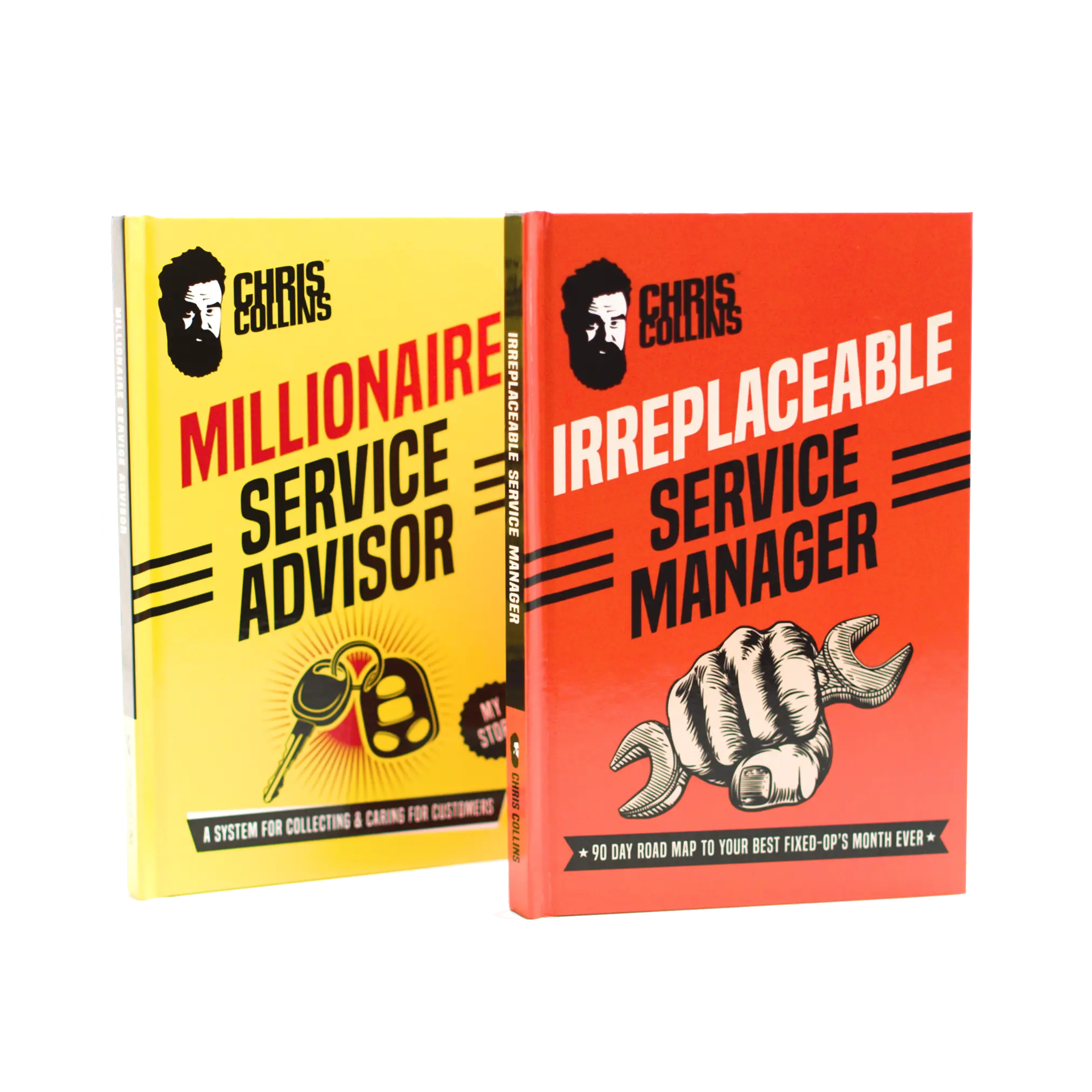
Millionaire Service Advisor and Irreplaceable Service Manager books by Chris Collins

Claim Yours Before We
Run Out Of Stock!

$74.95 $39.95

This Step By Step Guide Will Teach You How To…

  • Create a workplace you and your employees love!
  • Drive traffic and increase your RO count!
  • Significantly increase your CSI count!
  • Create lifetime customer loyalty!
  • And so much more!
 

Get Free Access to Our M.O.R.E Technician Recruiting Workbook!

First enter your best email address below so we know where to send it!
 
Automotive leadership and service manager training banner promoting Chris Collins Inc. programs for car dealership growth and performance.
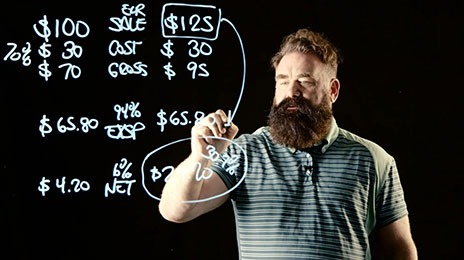
Man writing profit and cost calculations on a transparent board
 

We respect your privacy. Your email will never be shared