Customers trust your service department to get repairs right the first time. Still, comebacks happen, often leaving your team scrambling and customers frustrated. The thing is, repeat repairs aren’t just about fixing a missed problem. They hit customer satisfaction, technician efficiency, and your bottom line all at once. Shocking, isn’t it?
That’s where digital vehicle inspections start to make sense. This technology gives your team a simple, transparent way to document vehicle conditions and communicate repair needs with customers. Even though it sounds pretty simple, those clear visuals and easy-to-understand reports can help everyone stay on the same page. Even more so, such an extra layer of accountability helps reduce mistakes and build real confidence.
Stick with us as we get into the key reasons for service comebacks and share straightforward steps to make digital vehicle inspections work for you. Let’s begin!
Key Takeaways
- Digital platforms replace paper forms, giving customers photographic evidence of necessary vehicle repairs.
- Sharing visual proof builds customer trust, calms repair anxiety, and allows pressure-free decision-making.
- Cloud-based software speeds up daily workflows, eliminates lost paperwork, and streamlines team communication.
- Standardized checklists force inspection consistency, catching small mechanical problems early to protect drivers.
- Providing clear photo evidence increases repair approval rates and raises average invoice values.
- Mobile reporting and online payment options offer seamless convenience, securing long-term customer loyalty.
Why Auto Repair Shops Shift From Paper to Digital
The transition from traditional clipboards to modern software platforms marks a fundamental change in how automotive service providers operate.
● Replacing the Clipboard
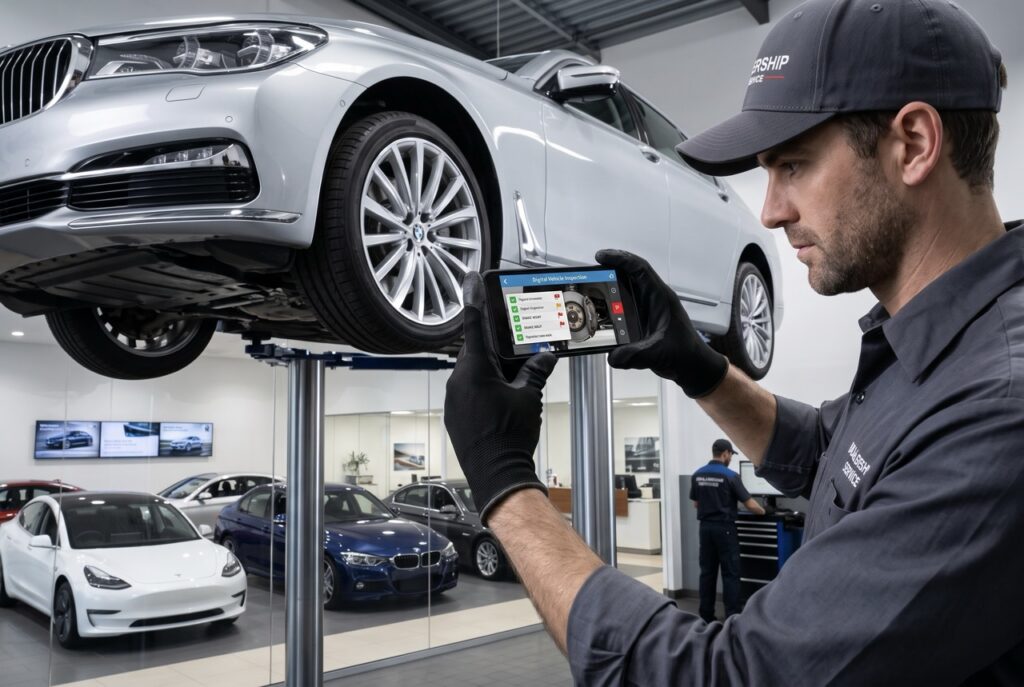
Technicians are now swapping out old paper forms and messy handwriting for smartphones or tablets to complete vehicle checks. This elimination of manual paperwork guarantees that service records are clear, instantly legible, and permanently saved in cloud-based storage.
● Visual Proof
Instead of just getting a call about a broken part, customers receive a digital report complete with clear photos and videos of the issues. Mechanics can use text markup to highlight exact problem areas, giving car owners an undeniable look at what is happening under the hood.
● No Guesswork
High-resolution images remove confusion, showing car owners exactly why a repair is necessary. Seeing a rusted exhaust clamp, a worn belt, or a leaking component on their smartphone completely removes ambiguity.
How Digital Inspections Create Customer Trust
Transparency is the foundation of a reliable automotive service relationship, and electronic vehicle reports make honesty instantly visible.
● Combating Repair Anxiety
Car owners often worry about being overcharged, paying for fixes they do not need, or receiving low-quality work. Vague verbal descriptions over the phone frequently intensify these worries, making drivers feel defensive.
● Window Into the Garage
Seeing real photographic proof of worn brake pads or leaking fluids shifts the focus from an unexpected cost to a clear solution. When car owners see the actual measurements and physical condition of a part, they realize the shop is simply doing an honest, thorough job.
● Time to Think
Sending reports via text or email removes the pressure of on-the-spot phone decisions, letting customers review the details and chat with family members first. Such an open approach gives them space to evaluate options without feeling rushed by a service advisor.
● Long-Term Connections
Showing honest data rather than just talking about money convinces drivers that the shop cares about their safety, creating lifelong customers. Drivers return predictably because they know the workshop prioritizes technical expertise and open communication over a quick sale.
Boosting Efficiency and Shop Productivity
Upgrading to an electronic tracking system optimizes daily operations by removing administrative friction and connecting the entire garage team.
● Faster Workflows
Digital checklists allow mechanics to enter vehicle data quickly, helping them complete more inspections in less time. A quick 360-degree walkaround lets a technician systematically evaluate every point using a mobile device.
● Eliminating Lost Paperwork
Storing everything in a cloud-based software platform reduces administrative tasks and prevents physical forms from piling up. Service advisors no longer waste precious minutes deciphering bad handwriting or filing physical sheets.
● Better Team Communication
Software integrations help mechanics and service advisors share data instantly, creating uniform and highly accurate repair estimates. That level of instant internal data sharing prevents communication delays, meaning vehicles spend less time sitting idle in service bays.
● Smarter Shop Management
Syncing inspection tools with the core business system allows managers to track active jobs and sales, helping them plan future staffing and parts inventory. Owners gain a crystal-clear understanding of business volume for specific date ranges, helping keep the workflow smooth.
Automotive fixed operations consulting expert Chris “Bulldog” Collins points out that optimizing the service drive through efficiency measures directly impacts a dealership’s overall health. His consulting firm trains service managers and advisors to build consistent processes, establishing the fixed operations department as a reliable profit center. Implementing digital tools also aligns with his approach of prioritizing repair revenue rather than relying solely on new-car sales.
Improving Road Safety and Dropping Human Error
Standardizing the evaluation process protects drivers by establishing an unyielding safety net that catches small mechanical issues before they turn dangerous.
● Consistency Every Time
Standardized digital checklists force technicians to follow a strict structure so they never overlook hidden issues like suspension wear or tiny tire punctures. Mechanics follow the exact same inspection framework for every car, guaranteeing a reliably comprehensive review.
● Beating Mechanic Fatigue
Manual inspections done quickly or at the end of a long, exhausting day lead to errors. But not in software, as it maintains a high evaluation standard. Automated prompts ensure that busy or tired employees never skip a step or miscalculate component wear.
● Preventing Serious Failures
Catching deteriorating components early keeps broken vehicles off the streets and actively reduces accidents caused by mechanical failure. Research published by the National Highway Traffic Safety Administration (NHTSA) emphasizes that critical component failures, such as degraded brakes and worn tires, directly compromise vehicle control and elevate crash risks on public roads.
● Clear Maintenance Logs
Digital history tracking tells drivers exactly when past work was performed, making it easier to schedule the next safety check. These organized health records eliminate ambiguity in factory maintenance intervals.
Financial Growth and Better Business Performance
Modernizing the inspection sequence drives substantial revenue gains by accurately documenting actual repair needs and building strong consumer confidence.
● Truth Over Upselling
Digital inspections are not meant to trick drivers into buying random parts. Rather, they ensure genuine safety issues are discovered and clearly shown. The primary goal is complete thoroughness, ensuring that vehicle owners see genuine evidence rather than feel pressured.
● Higher Approval Rates
Customers are 20% to 30% more likely to authorize repairs when they see photo evidence of a problem rather than just hearing about it over the phone. Clear, visual confirmation replaces skepticism with immediate understanding.
● Increased Invoice Values
Dealers see average invoice values rise by 15% to 25% simply because mechanics stop missing legitimate repair needs. Standardized checklists make sure technicians do not rely on memory, exposing necessary fixes that would otherwise go unnoticed.
● Tracking Postponed Work
When a driver declines a non-urgent fix, the system automatically logs it, allowing the shop to follow up at the next annual visit to secure future revenue. This builds an automated pipeline of future service appointments.
Elevating the Modern Customer Experience
Providing effortless, high-speed interactions meets the needs of busy vehicle owners who value clear communication and ultimate convenience.
● Speed Today’s Drivers Demand
Modern customers value speed. And so, sending instant digital estimates prevents frustrating games of phone tag. Drivers appreciate knowing that their time is valued, allowing them to review information immediately without disrupting their workday.
● Ultimate Convenience
Car owners can review reports, communicate with the shop, and authorize work directly from their mobile devices wherever they are. Such flexibility lets people manage their vehicle service while at the office or at home.
● Remote Payment Options
Integrating third-party digital payment tools allows customers to pay online instantly and pick up their keys without hassle. This provides a seamless, touchless service experience that eliminates long waits at the front counter.
● Securing Customer Loyalty
Over 80% of drivers will switch to a competitor after a few bad experiences, and 15% will leave after just one. Statistics compiled by the Automobile Association of America (AAA) indicate that tens of millions of drivers still lack a repair facility they fully trust, giving forward-thinking garages a massive opportunity to win permanent loyalty through digital transparency.
Frequently Asked Questions (FAQs)
Digital vehicle inspections are highly worth the investment because they increase average repair order values by building immediate trust with customers. Sharing clear photos and videos of required repairs helps car owners see exactly why the recommendations are necessary.
Service advisors use these digital reports to text color-coded updates directly to customers for quick, transparent reviews. They then follow up with a brief phone call to answer questions and secure fast repair approvals without lengthy explanations.
Dealerships see a significant boost in technician productivity and parts revenue by streamlining the entire multi-point inspection workflow. The digital format also creates a permanent visual record that protects the shop against future liability and tracking disputes.
Bottom Line
In today’s competitive market, building lasting trust and reducing service comebacks means taking a smarter approach to transparency and communication. Digital vehicle inspections (DVI) give both technicians and customers a clear understanding of every repair, minimizing confusion and setting the stage for higher-quality work. It’s a win-win situation for both parties if you think about itf it. When customers see exactly what needs attention, confidence rises. Thus, DVI truly opens the door for honest conversations and creates a solid foundation for customer loyalty. If you found these insights helpful, share this on your favorite social media platform. Stay tuned for more!
Achieving and exceeding your goals is possible when you have the right systems in place. With Service Drive Revolution OnDemand, you’ll gain access to the proven systems that have made thousands of SERVICE MANAGERS IRREPLACEABLE. Start transforming your department today!
Need help updating your playbook? Let us know how we can support your team’s growth.
Book a 15-minute strategy session with our team. We’ll explore how to unlock your dealership’s real value.