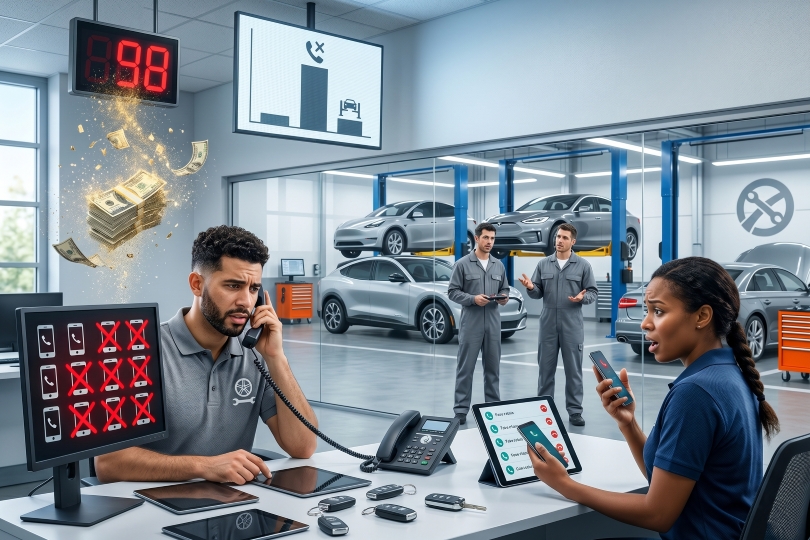
Missed calls are one of the most overlooked problems for service departments. When a customer calls to book a service, ask about a repair, or check a price, and no one answers, it’s more than just a missed conversation. Over time, these missed calls can lead to lost appointments, lower customer retention, and lost revenue. It can be frustrating to see strong numbers on reports, only to realize that missed calls are quietly holding your dealership back.
But you can still do something about it. You only need a structured approach to handling incoming calls to close these gaps and recover lost revenue. Just by prioritizing service calls, you can already generate more appointments and help build long-term customer relationships. Yes, that’s how powerful it is! Want to see real impact in your service department’s bottom line? Keep reading for top-tier strategies that will surely put you back in control of missed calls revenue.
Key Takeaways
- Dealerships risk losing almost a million dollars annually from unanswered service appointment calls.
- True missed calls include hold abandonments, unreturned voicemails, and dead-end phone transfers.
- Call volumes usually peak on Monday and Tuesday mornings, when staff are under the most strain.
- Unanswered phones push customers to independent repair shops, which in turn lower long-term retention rates.
- Managers fix connection rates through rapid phone audits, smarter staffing, and AI voice automation.
Economic Weight of the Unanswered Ring
Missed calls in service departments directly translate into substantial revenue leaks. Data from hundreds of dealerships shows that the average service department misses approximately 158 appointment-related calls each month. High-volume stores, or those in the 75th percentile for missed calls, often see that number climb to 216 monthly misses.
When evaluating the financial impact, the cost per repair order (RO) serves as the primary multiplier. National averages indicate a customer repair order value of approximately $466, which rose to $470 in the first half of 2025. Using these industry baselines, the annual revenue at risk for an average performer is staggering:
158 calls x $466 x 12 months = $883,536
For stores with higher miss rates, the annual loss exceeds seven figures:
$216 calls x $466 x 12 months = $1,207,872
Even when applying a more conservative industry estimate of $450 per RO, dealerships remain sitting on $850,000 to $1.17 million per year in revenue at risk from missed appointment calls alone. These figures represent high-intent opportunities where the customer has already chosen to contact a specific dealership, only to be met with silence or a hold queue.
Defining the “Missed” Call
A common management error is undercounting missed calls because phone systems often hide the full extent of the problem. If a store only counts calls that ring forever without an answer, they overlook roughly half of the total issues. A call is “missed” whenever a customer fails to complete the task they phoned to have done.
But what are the real hidden failures in call handling? Take a look at this list:
- Hold Time Abandonment: Customers who hang up while waiting for an advisor. Industry analysis shows that 31.8% of unconnected calls are customers hanging up while on hold. In fact, poor phone management ranks high among the 10 reasons service advisors fail, creating instant customer frustration.
- Voicemail Dead Ends: Callers who reach a mailbox and never receive a same-day resolution.
- Transfer Gaps: Callers sent to lines that do not pick up or end in a “dead end”.
- Slow Response: Customers who leave messages but do not receive a fast enough response to book the slot.
- Empty Promises: Callers told they will receive a callback that never happens or fails to convert into a booked appointment.
The average hold time currently sits at 3 minutes and 5 seconds. While three minutes might seem brief to a busy service advisor, it serves as a conversion funnel in which customers actively choose to try a competitor instead.
Peak Demand Windows
Missed calls do not occur randomly. The truth is, they cluster during predictable periods when staff are most stretched. Data confirms that Monday is the busiest day of the week, with Tuesday following closely. By the end of Tuesday, over 52% of the weekly service calls have already occurred.
The most active time block falls between 8 a.m. and 11:30 a.m. During hours when service teams handle walk-ins and check-ins, the phones remain vulnerable. When staffing remains even throughout the week, the morning rush on Monday and Tuesday becomes the primary point of failure for capturing revenue. That said, service departments must consider how service advisors can strike a balance between volume and quality during rush hours to prevent overwhelming staff on the floor while handling phones.
Why Missed Calls Drive Customers to Competitors
A missed call is more than a single lost visit. It’s actually a forced experiment that pushes customers to try independent repair shops. Customer loyalty is fragile, and the inability to reach a service department directly reduces retention. Take a look at these retention trends we have gathered across available sources:
- Market Loss: Service departments have lost 12% of visits to competitors since 2018.
- New Car Decline: In 2023, 72% of owners with vehicles two years old or newer returned to the dealer for service. By 2025, that number dropped to 54%.
- Race to Respond: Roughly 70% of customers who reach a voicemail call a competitor within 30 minutes.
When customers encounter friction while booking simple tasks like oil changes, they are less likely to return for major repairs or trade in their vehicles at that location in the future. Approximately 58% of customers who experience a dropped call never return to that store again.
Strategies for Improving Call Conversion
Identifying the specific “leaks” in a dealership requires an honest assessment of current processes. A 15-minute audit can reveal whether a store is prepared for demand surges.
- Peak Hour Testing: Call the main line and service line on a Monday between 10:00 a.m. and noon. Measure the time to reach a human and the time required to actually book an appointment.
- After-Hours Evaluation: Call when the store is closed to see if the system leads to a dead voicemail, an outsourced taker, or an automated scheduling tool.
- Voicemail Inspection: Check if mailboxes across the store are full or checked regularly.
- Log Categorization: Review the previous day’s inbound logs. Sort them into “Answered and Resolved,” “Put on Hold/Transferred,” “Went to Voicemail,” and “Abandoned”.
The goal of this audit is to move past the answer rate reported by phone systems and focus on the connection rate—whether the caller actually completed their intended task.
Strategies for Improving Call Conversion
Dealerships can address missed calls through a combination of process discipline, staffing adjustments, and technology.
● Process Improvements
Immediate impact can be achieved by banning “blind holds”. Instead of placing a caller on hold indefinitely, staff should offer a choice: stay on the line or receive a callback within five minutes. Every person answering the phone should have the authority and tools to book an appointment at the first touch, eliminating transfer bottlenecks. Firms such as Chris Collins Inc. offer automotive service department training that teaches specific communication protocols to reduce hold times and increase booking rates. Furthermore, dealerships should enforce a strict callback service-level agreement (SLA) aiming for a window measured in minutes (ideally under 10) rather than hours.
● Staffing Adjustments
Coverage should mirror real-world call peaks. It may involve shifting personnel out of service lanes during morning rush windows or creating a “phone quarterback” role. This individual’s sole responsibility during peak periods is to catch, triage, and book incoming calls to make sure that high-intent leads do not fall through the cracks.
● Automation and AI Solutions
Because human staffing cannot always scale to sudden spikes or after-hours demand, modern dealerships are increasingly adopting AI-driven communication tools.
AI voice agents can answer every call simultaneously, providing consistent responses to pricing and service questions. Unlike traditional voicemail, these systems focus on resolution, allowing customers to book appointments in under 2 minutes or cancel them in under 30 seconds. Studies show that 84% of digital-heavy buyers who engaged with AI assistants were highly satisfied with the buying process, reporting greater trust and a faster experience.
Impact of Affordability and Incentives on Call Volume
When vehicle affordability improves due to price drops or incentives, inbound demand jumps quickly. This urgency translates to both sales and service, as buyers move faster and expect immediate answers regarding inventory or maintenance.
| Call Driver | Customer Expectation | Risk of Failure |
| Price Relief | Immediate answers on incentives | High-intent buyers call competitors if put on hold |
| Demand Spikes | Always-on communication | Staffing gaps exposed during simultaneous spikes |
| Incentives | Quick, confident details | Vague responses or voicemails erode trust quickly |
Stores that modernize their response systems to handle these spikes see higher lead conversion and improved customer satisfaction scores. The ability to scale communication as demand shifts guarantees that temporary price relief translates into permanent revenue rather than lost opportunities.
Frequently Asked Questions (FAQs)
Modern call-tracking software logs every incoming number and flags unanswered calls in real time. Now, managers can just review automated daily reports to identify exact time blocks where staff members fail to pick up.
Frustrated callers usually hang up and contact a competing business within minutes of a failed connection. Silence from the dealership costs potential revenue and encourages people to leave negative public reviews.
Service advisors secure more bookings by offering defined appointment windows rather than asking open-ended questions. Also, sales teams can increase success rates by following a consistent follow-up schedule for every inquiry that enters the database.
Bottom Line
Without a doubt, the impact of missed calls revenue extends beyond a single lost conversation. We have seen it in numbers and hard facts. It indeed shapes customer relationships, service retention, and your bottom line. In a fast-paced dealership environment, every call is an opportunity to secure business and build loyalty. Thus, prioritizing service calls will surely help prevent lost opportunities and keep revenue in your store. If you like what has been discussed today, please share the insights with your team or colleagues. Stay tuned for more updates!
Achieving and exceeding your goals is possible when you have the right systems in place. With Service Drive Revolution OnDemand, you’ll gain access to the proven systems that have made thousands of SERVICE MANAGERS IRREPLACEABLE. Start transforming your department today!
Need help updating your playbook? Let us know how we can support your team’s growth.
Book a 15-minute strategy session with our team. We’ll explore how to unlock your dealership’s real value.