
It’s tough to get everything right when designing and building cars. Small mistakes can lead to big problems—unexpected failures, costly recalls, or production delays. To top all that, it is difficult to come up with ways to make cars safer, smarter, and more efficient without slowing down development.
Digital twins in automotive offer a smarter way forward. They act as virtual copies of real vehicles, systems, or even entire assembly lines, allowing automakers to test, track, and improve without wasting time or resources. This technology is transforming the game in terms of early detection of potential problems and development of enhanced designs in a shorter period of time.
Want to see how digital twins are changing the industry and why it’s becoming a must-have? Read on to know more.
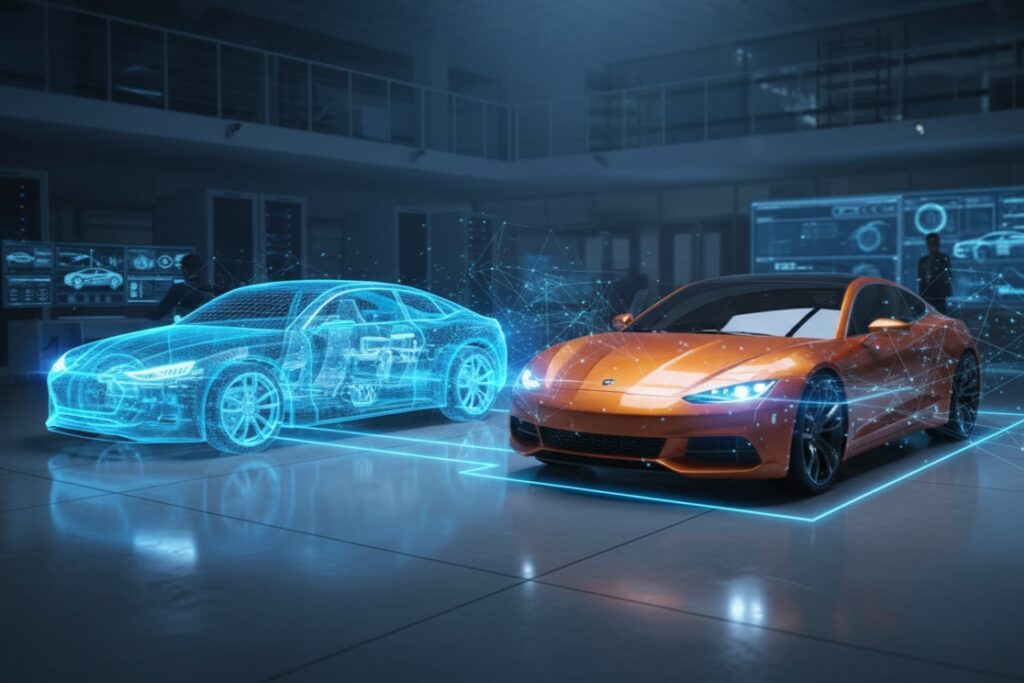
What is Digital Twin Technology?
At its core, a digital twin is a virtual replica of a physical object, system, or process. It establishes a connection between the real and the virtual worlds. However, this is not just a static 3D model sitting in a computer folder.
The magic lies in the connection. Digital twins make use of real-life data sets and apply digital methods, including simulation and machine learning. In contrast to the conventional simulations, digital twins are always in touch with their physical counterparts. They facilitate real-time information exchange, analysis, and feedback loops.
Think of a simple tire. A digital twin of a tire starts with a 3D model of its shape and dimensions. But an advanced twin goes further. It contains data on weight, tread compound, and how it flexes at different inflation pressures. When you combine enough of these twins, you create a virtual doppelganger of a complete car.
Pretty amazing, isn’t it?
This concept actually originated at NASA for space mission simulations and was formally articulated by Dr. Michael Grieves in 2002. Today, thanks to advancements in the Internet of Things (IoT) and artificial intelligence (AI), these systems have evolved from simple replicas to sophisticated tools that can predict the future of the machines they mirror.
MORE ON AUTOMOTIVE INNOVATION
V2X Communication Technology for Connected Roads
Why the Automotive Industry Needs Digital Twins
The automotive sector is currently navigating a perfect storm of challenges. As we approach 2026, the industry faces significant supply chain disruptions and volatile material costs. Furthermore, the mandated transition to electric vehicles (EVs) has accelerated, with many regions setting deadlines to phase out internal combustion engines between 2030 and 2035.
That very same change requires radical redesigns of vehicle structures. To top it all, there is still an ongoing shortage of semiconductors, which is impacting a wide range of products such as infotainment systems and driver assistance technologies.
Also Read: Chip Shortage 2025: Auto Industry’s Response and Recovery
To survive and thrive, implementing Industry 4.0—which integrates cyber-physical systems and cloud computing—has become necessary. The digital twin model serves as a cornerstone of this transformation. It enables manufacturers to view, scan and streamline operations without interfering with the real factory floor. When testing is moved to the virtual space, companies can not only avoid these complexities but also develop resiliency against future shocks.
Applications of Digital Twins in Car Development
The application of this technology isn’t limited to just one department. It actually spans the entire lifecycle of a vehicle.
A. Vehicle Design and Prototyping
In the past, designing a car required building expensive physical prototypes. Today, digital twins allow engineers to simulate crash scenarios, aerodynamic performance, and thermal management before a physical part is ever manufactured.
For example, General Motors utilizes digital twins to simulate manufacturing processes like Gas Metal Arc Welding (GMAW) to predict issues like weld distortion during the design phase. This reduces the need for physical prototypes and improves quality. Likewise, Ford develops the virtual prototypes to perfect the aerodynamics and structural integrity even before the real model has been developed.
Such capability allows for rapid iteration. BMW’s digital twins simulate entire vehicle assemblies and optimize thermal flows in electric vehicle batteries without requiring physical test benches at early stages. Thus, resulting in accelerated authentication of intricate subsystems such as powertrains.
B. Production Optimization
Digital twins are also transforming the factory floor. They monitor assembly lines in real-time, predicting equipment failures and reducing costly downtime.
Suppliers are getting involved, too. A transmission supplier can create a digital twin of its production line to virtually identify bottlenecks. In one of the most notable cases, BMW uses a digital twin of its Regensburg plant based on NVIDIA Omniverse. This enables them to model the assembly line setups and ergonomics to streamline production sequences prior to actual physical setups.
Supply chains also benefit enormously. Toyota creates virtual replicas of its European manufacturing plants to simulate production changes without disrupting operations. Such real-time visibility enables them to analyze inventory and transport routes and results in more agile decision-making.
C. Maintenance and Monitoring
Vehicle maintenance is another area where digital twins can be beneficial beyond the manufacturing industry. Manufacturers can forecast possible breakdowns in advance by relying on real-time data provided by vehicle sensors. It, therefore, increases safety and customer trust.
Moreover, service technicians even use these twins for training. If a mechanic needs to repair a specific pump for the first time, they can simulate the process on a digital twin before touching the real engine.
For advice on using predictive technologies to develop a successful service strategy, watch How To Sell More Service WITHOUT Annoying Customers. Gain some insights on how smart diagnostic tools can elevate service quality and profitability.
Benefits of Digital Twin Automotive Technology
The adoption of this technology offers measurable, high-impact benefits for manufacturers and consumers alike.
A. Speed Up Innovation
In the automobile business, time is money. By shifting validation to the virtual domain, companies can significantly reduce development time. A McKinsey study showed that senior R&D leaders have cut total development times by 20 to 50% for some users.
A digital twin for automotive manufacturers can reduce product design time by 1 year or even 1 quarter in certain cases. Such a rapid pace is essential for keeping up with the aggressive timeline for electric vehicle adoption.
B. Optimize Costs
Reducing dependence on physical prototypes lowers costs drastically. It also reduces the amount of rework on the production floor as it pre-validates manufacturing steps.
The financial impact is massive. According to a study, the market value of digital twins in the automotive industry is predicted to reach $73.5 billion by 2027. This growth is driven by the ability to identify defects and inefficiencies virtually before they become expensive real-world problems.
C. Improve Safety
In the car industry, safety comes first. Digital twins allow manufacturers to simulate safety-critical systems under various scenarios. For autonomous vehicles, for example, rigorous virtual testing ensures software reliability under complex road conditions before deployment.
Furthermore, minimizing accidents caused by vehicle malfunctions helps reinforce customer trust. Want to know why trust matters? Check out this video: Dealership Tech Fail: Why Old School Still Wins.
D. Enhance Sustainability
Digital twins encourage sustainable vehicular engineering solutions through efficient energy consumption and material choice. They assist manufacturers in achieving regulatory objectives with minimal effects on the environment.
For instance, Jaguar Land Rover’s transformation of its Halewood plant supports its strategy to target net-zero carbon emissions by 2039. By using digital twins to optimize battery pack assembly, manufacturers can balance cell performance and thermal management, ensuring minimal waste.
Also Read: Efuels Debate: Understanding E-Fuels vs EVs for Clean Travel
Challenges and Future Outlook
Despite the utopian vision of seamless digital-physical integration, there are hurdles to overcome.
A. Near-Term Challenges
Cybersecurity is the most burning issue. Since digital twins are based on live data streams, they are targets of attackers. Breaching a digital twin can lead to the theft of proprietary models and sensitive operational insights. There is also the risk of data injection attacks, where malicious commands deceive the system.
Integration is another hurdle. Connecting new digital twin technology to legacy systems that are decades old is often the hardest step. Additionally, running complex simulations requires substantial computing power and robust infrastructure to handle high-quality data in real-time.
B. Future Goals and Opportunities
Looking ahead, the global market for digital twins is expanding fast. It is projected to reach USD 155,839.4 million by 2030.
The future will see tighter integration of AI, IoT, and Augmented Reality. 3D Deep Learning will enhance the spatial understanding of complex components, improving defect detection. We will likely see the rise of autonomous fleets and smart cities running on data from interconnected digital twins, managing traffic and resources dynamically.
With the development of AI models, digital twins are not merely reactive but will become a proactive platform to make decisions. The automotive industry is not just building cars anymore. They are building intelligent, living data systems that will drive us safely into the future.
The Human Element in a Digital World
As vehicles and factories become more complex, the service side of the automotive business becomes more critical. Cars are lasting longer, and the “Fixed Ops” department (Service and Parts) is becoming the financial backbone of the dealership.
However, advanced technology requires advanced leadership. You cannot run a 21st-century service department with outdated management tactics. But worry no more! Chris Collins Inc. is here for you! We specialize in helping dealerships optimize their fixed operations, streamline processes, and train staff to handle the complexities of modern automotive service.
If your service drive is struggling to keep up with the changing landscape, or if you just want to maximize your profitability, it is time to get serious about training.
Book a 15-minute opportunity analysis today!
Bottom Line
To wrap up, digital twins are reshaping the automotive world by making cars smarter, safer, and more innovative from concept to the road. Be it streamlining design, predicting maintenance, or improving vehicle performance, the potential is already here. If you found this look into digital twins automotive interesting, share it with friends or colleagues who want to stay ahead of the curve. Let’s keep the conversation rolling!
Achieving and exceeding your goals is possible when you have the right systems in place. With Service Drive Revolution OnDemand, you’ll gain access to the proven systems that have made thousands of SERVICE MANAGERS IRREPLACEABLE. Start transforming your department today!
Need help updating your playbook? Let us know how we can support your team’s growth.
Book a 15-minute strategy session with our team. We’ll explore how to unlock your dealership’s real value.