That’s an excellent place to reinforce your keyword! Placing the focus keyword, service manager retention strategies, near the start of the content boosts its perceived relevance to search engines.
Here is the revised opening paragraph with the keyword integrated naturally:
✍️ Revised Blog Introduction
If you’ve ever lost a great technician or ADVISOR and thought, “I wish I knew before they left,” you’re not alone. Most SERVICE MANAGERS and Fixed Ops leaders find out too late—during the exit interview. This is where effective service manager retention strategies become crucial.
But what if you could prevent turnover before it happened?
In this episode of Service Drive Revolution, Chris Collins and Christian sit down with Clint Pulver—author of I Love It Here and the “Undercover Millennial.” After interviewing over 11,000 employees undercover, Clint discovered what truly makes people stay…and what pushes them out the door.
And here’s the kicker: it’s not just about pay.
Why People Quit (and Why They Stay)
Clint’s research revealed a powerful truth:
- When people hate their job, they blame the manager.
- When people love their job, they credit the mentor.
That’s the difference. Leaders who show up as mentors—not just bosses—create departments people never want to leave.
💡 SERVICE MANAGER Tip: Don’t just manage tasks—mentor your people. The difference between “I have to work here” and “I love it here” comes down to leadership.
👉 Related: The 9 Reasons Why Service Managers Fail (And How to Avoid Them)
The “Status Interview” Every MANAGER Should Run
Most leaders wait until the exit interview to ask employees what went wrong. By then, it’s too late.
Instead, Clint recommends running status interviews with your best people:
- What can I do to keep you here?
- What’s getting in the way of your success?
- How can I help you get where you want to go?
📌 Fixed Ops Reality Check: If you’re losing good techs and ADVISORS, it’s probably not about pay—it’s about how supported they feel. Regular status interviews uncover problems before they turn into resignations.
Why Culture Beats Compensation
Employees want more than a paycheck. They want:
- Recognition for their performance
- Growth opportunities through training and mentorship
- A supportive team environment
Great SERVICE MANAGERS understand that a healthy shop culture makes techs and ADVISORS want to stay—even when another store offers a little more money.
💡 SERVICE MANAGER Tip: Culture is your ultimate retention tool. Money gets employees in the door, but leadership and recognition are what make them stay.
👉 Curious how culture drives profitability too? Read Boosting Service Drive Revenue: Proven Strategies for Service Advisors and Managers

The Leadership Shift That Stops Turnover
Here’s the bottom line: technicians and ADVISORS don’t quit jobs—they quit managers.
If you want to stop losing people to the store down the street, shift from being a boss to being a mentor.
- Ask better questions.
- Run status interviews.
- Recognize great work.
- Build a culture that people are proud to be part of.
Because when your team feels valued and supported, they won’t just stay—they’ll thrive.
The Takeaway
Leadership—not pay plans—is the #1 retention tool in Fixed Ops.
If you want to keep your best techs and ADVISORS:
- Run status interviews before exit interviews.
- Invest in training and growth opportunities.
- Build a culture where people say, “I love it here.”
That’s how great SERVICE MANAGERS lead—and why their departments consistently outperform the rest.
Full Video Transcript
Today on the big show, we are talking to a guest, Clint Pulver, from Drums to Data and also the author of his book, I Love It Here. He’s going to be a speaker at Top Dog. So, we have a fun conversation with him, and then we talk about Christian’s anger problems. And that’s just the beginning of what happens in this edition of Service Drive Revolution.
If you guys have been to the office here in the library, you know that Christian’s office has a glass door and then on the other side there’s a glass wall. And so he also has this funny—I’m going to guess who put these things on everybody’s door—I took it off of my door. Yeah, I know. I know. But there’s this piece of wood that on one side says basically leave me alone, and on the other side it says come on in. But if you wanted to come on in, wouldn’t you just open the door? To me, if the door is closed, that tells you you don’t need the sign. So, I always love to go by Christian’s and flip the sign to come on in when he has it on. Do not come in. The look on your face because in order for him to flip the sign, he has to make eye contact with me. No matter what call I’m on, he has to make the eye contact first, and then I… So, today I forget. I’m going in that front room for something. One of the guests on Books That Changed My Life sent me a book. And so I want to return the favor and send her a book. And so I went in that front room because it was a photography book. And I’m coming out of the side door, and out of the corner of my eye, Christian’s in a fistfight. He’s fighting something. He’s literally swinging. And then I stopped to look, and he’s standing over his computer, like I don’t know, pissed about something. And so I asked him later—I even tried to wave at you, and you wouldn’t even look at me. You were so into it. And I go, “Who are you talking to?” He goes, “It was a prospect.” It was a prospect. You don’t talk to clients that way. How are you ever going to make friends with somebody? But also you’re way over the computer. It had to look like you were a Tyrannosaurus Rex or whatever coming up on this. “Well, was it a female or a male?” “It was a group of people. So it was non-discriminant. No, we were talking about how the state of the industry is that the customer’s expectations when they come in for service is that it just doesn’t suck. That’s how below the bar is.” And sometimes I get a little passionate about that particular topic. I feel like you were reenacting a Steven Seagal scene from one of his movies. The other thing that, now that you mentioned that, I have to think about is it’s funny when I meet with people now—and I’m sure this was happening to you when you were doing strategy sessions—is that I’m not on a computer for them anymore. They put me on a TV. So I’m on a big screen TV, and I was trying to T-Rex them, and it might have been a bit much. So I’m really sorry about the passion there. Whoever that was, I should call them. You should apologize. But I do like when you change my style. I like to speak with your hands. I do. You know who I got that from? Jimmy Swaggart. Yeah, that’s a you thing a little bit. No, I took it a little too far, but I started, I never did this before I met you. I caught a fish this big. You caught a fish this big. And another criticism for those listening: putting your two hands up. Yep. And then you do this. I do. Yeah. But do I look mad? No, you look happy. I meant to look happy, but apparently I was. You know what my mom used to do when I was a kid is she used to hold my hands and then make me talk, and I couldn’t. She thought it was bad. I don’t think it’s bad to speak with your hands. I don’t like it. Very physical. There was something too when you do this—I don’t know if that’s an open your mind kind of thing subconsciously there or whatever. There’s probably a term for that, but you love to do this, and it’s when you’re talking about expanding your mind or being creative. It almost always happens during this moment. And then sometimes you catch the fish. The catch the fish is funny. Yeah. So funny, man. I would have sworn you were talking to your kid or something, like, “You got detention one more time!” No, I did have a conversation like that with him the other day because he’s not doing well in his honors algebra. Not doing well in his honors algebra. First of all, the fact that he’s in honors algebra is better than most. Yeah, but he’s in there for a reason, and he’s not doing well, which is only once. How many times have you used algebra in your career? Regularly. It’s just filling in blanks. What we do is algebra. What we do is simple math. No, it’s algebra. How is it algebra? Algebra is always filling in a hole. Now, if you told me that wasn’t the kind of algebra—if you told me about calculus or quantum physics, no, I’m not using that every day. But basic algebraic equations we do all the time. I don’t even think we’re using pre-algebra. We are, the way that you can, the way that you can find out ELR if you know total sales and hours. It’s more than that. The formula, what is it? Labor sales divided by labor hours sold. That is basic math. But if you have a hole and you don’t know the hours, but you have ELR and you have the total dollars, you can figure out the hours. You’re filling in a hole. Can we get a math teacher validation on this? Do you think there’s a lot of math teachers listening? Yeah. Three. Oh my goodness. So fun. Okay. Well, now we’re going to talk to one of our speakers from Top Dog, October 23rd and 24th. He’s the reason why a lot of you are getting drumsticks in the mail. You’re probably wondering, there’s a QR code on there. So, once you hit that, there’s a video of him talking about it. But we’re excited to introduce you to one of our speakers, the opening speaker for Top Dog this year. We are really excited today. Today’s guest is Clint Pulver. He will be joining us on the opening night of this year’s Top Dog event, which is going to be very exciting: October 23rd and 24th here in Los Angeles. Clint is an Emmy Award winner, pro drummer, and bestselling author of I Love It Here: How Great Leaders Create Organizations Their People Will Never Want to Leave. Everybody’s going to be getting this book at the event. Known as the Undercover Millennial, he’s helped organizations like Microsoft, NASA, and the NBA build cultures people never want to leave. Clint, thank you for joining us today, and we’re really looking forward to having you at Top Dog 2025. Tell us about how you became the expert that you are and what the audience should be prepared to experience when you take the stage next month.
“Yeah, first of all, thanks for having me on. It’s an honor to be here. For the last six and a half years, I’ve traveled the world as the Undercover Millennial. It’s kind of like Undercover Boss without the makeup. So, I would go undercover into organizations as a young person looking for a job. And I would just walk up to the first employee that I saw and I’d say, ‘Hey, I’m just thinking about applying. What’s it like to work here?’ And the employees always get kind of quiet. They look around. It feels like an illegal drug exchange. And then they would tell me everything. They tell me the good. They would tell me the bad, what they loved, what they didn’t love. And man, the magic of what we were able to find through that research was not so much when people were dissatisfied with the job. The magic was found when I would ask, ‘What’s it like to work here?’ And employees would say, ‘I love it here. I love it here.’ And that began the revolution of the Undercover Millennial program. We’ve now worked with 697 different organizations, and as of this year, I’ve interviewed over 11,000 employees undercover. And yeah, it’s a wild adventure, but it’s been super cool to find the hidden truth behind what makes people stay and what makes people head for the exit doors when it comes to employee retention.”
“So, what’s the one commonality that you see over and over again when you’re doing that?”
“Yeah. When people leave their jobs, when they hate their jobs, when they’re dissatisfied with their jobs, they always talk about the manager. When people love their jobs, they always talk about the mentor, the mentor in the story. How does that manager, how does that leader, how does that dealer, how does that CEO become the mentor in the story? If you do that, you win in the game of retention.”
“That’s great. So, I was a drummer. Well, I guess you could say I still am a drummer. I just don’t play that much. But growing up, I was pretty serious about it. The one thing that most people don’t know about drummers is that they get all the chicks. Yeah, there you go. It’s not the singer. People think it’s the singer. It’s not the singer. It’s the drummer. Every singer will tell you that, too. But how do you go from drums to writing books and speaking in front of large audiences?”
“So, as a little kid, I always struggled to sit still. You could maybe relate to this as a fellow drummer. For sure, and I would just tap. I would constantly move. Everybody saw the issue. They saw this annoyance. I got called the twitcher in school. I got called the tapper because I just couldn’t sit still, and it happened again and again. I was constantly in trouble until one day there was a teacher. His name was Mr. Jensen. He told me to stay after class. Everybody left. It’s a completely empty room. I’m thinking I’m getting kicked out of school as a 10-year-old. He sits me down. He goes, ‘Listen,’ He said, ‘Clint, you’re kind of the kid that’s on the list. You’re constantly tapping. You’re constantly moving.’ He said, ‘I’ve watched you, though.’ And he’s like, ‘It’s crazy. You take a pen, and you work on an assignment. You write with your right hand, and then you tap with your left hand. And then in the middle of the assignment, you switch the pen, and you start writing with your left hand, and you tap with your right hand.’ And he’s like, ‘Listen, I think you’re ambidextrous.’ And I was like, ‘No, I’m Presbyterian.’ He’s like, ‘No, not what it means.’ And he said, ‘Can you tap your head and rub your belly at the same time?’ And I could do it. And he said, ‘Can you switch that?’ And I just had this independence, and he looked at me and he said, ‘Listen, I don’t think you’re a problem. I just think you’re a drummer.’ And I will never forget, I’m somebody, Chris, I believe in the power of moments. I think if you look at your life, that’s what makes it a great story. We don’t remember days in our lives. We remember the moments. And in this moment, Mr. Jensen, he leans back in his desk, and he opened up the top drawer, and he took out my very first pair of drumsticks. And he put them in my hands, and he said, ‘Listen, kid. Just keep the sticks in your hands, and let’s see what happens.’ And that was over 28 years ago, and it was a moment that changed my life. And for 28 years, I’ve had the opportunity to tour and record all over the world as a professional drummer. I played with Blue Man Group, Tim McGraw, Carrie Underwood. My whole college education was paid for through music scholarships. And I don’t say that to go, ‘Oh, wow. Good for you, Clint.’ It’s because of one moment where an educator created a moment where he saw an opportunity, not a problem, and it transformed everything in my life. So, that is how the drumming story began.”
“Yeah, it’s crazy. And I know you talk about this, that one person believing in you can completely change how you see the world and your trajectory, right? That’s incredible.”
“It’s like that power of someone seeing the picture when you’re in the frame. Sometimes it’s hard to see our potential and our worth at times. And in my life, so much of that has come from other people seeing further than I ever could on my own. People recognizing some things that I just didn’t see. And in doing so, because of the moments that they created of advocacy, the moments of support, the moments of belief where I said, ‘Okay, maybe this is it. Maybe they are right.’ And it just allowed me to write a better story. That concept in the world of retention is key. How do you become that Mr. Jensen, that person that when people are with you, they go, ‘I like myself best.'”
“Yeah, that’s beautiful. Do you play traditional or left-handed?”
“Which side high-hat?”
“Yeah, I play both. So, I play traditional grip like you do when you march. So, I coached and did drumline. So, we’d hold that stick a little weird with the left hand, and then I would hold matched stick. But I’m right hand dominant, and so that high-hat is on my left side, but I can play open-handed as well. There’s a little bit of the obviously ambidextrous side, but right hand lead is my preference.”
“That’s—so I’m left-handed, but I started playing in church, and they wouldn’t let me switch it. I had that same thing going for me where I was left-handed, but I learned traditional, but it made me better than most because I could kind of switch in a sense.”
“You were forced to move that over because they’re not switching the high-hat. So, that’s cool.”
“It was great. Okay, tell me about your book, I Love It Here. It’s an incredible quote here from Maxwell that says ‘one-of-a-kind perspective that will transform leadership for years to come.’ ‘This is the book your employees want you to read.’ I thought that was amazing. There was a couple of really good endorsements in there. So, tell me about the book.”
“Yeah, so the book is cool because it’s not another leadership book written by a self-proclaimed leadership guru. This is a book at the time that was written by 10,000 employees who knew what good leadership looked like to them. And I think that’s the difference with this book: the perception of leadership versus the reality of an employee’s experience. Usually there’s a gap, right? Because there’s no incentive for an employee, especially when things aren’t going well, to walk up to a boss and really tell them what they think. Could you imagine if an employee walks up and is like, ‘Hey, listen, Doug. I think this could help you. Every time we lose as a team, you blame everybody else. And every time we win as a team, you take all the credit. Happy Tuesday, Doug.’ They’re not going to tell you that. There’s no incentive for an employee to tell you that. So instead, what do they do? They just leave or worse, they mentally check out, and then they stay. And how we did this, how we wrote the book—six years of research—going in and capturing that perspective that most managers never hear, right? Most leaders don’t get to hear, and when things aren’t going well, it’s easy to point fingers. I hear all the time the manager saying, ‘Nobody wants to work. Nobody wants to work anymore.’ But the question is, do they want to work for you? And that was the magic of what happened when a leader became that person that people chose.”
“I love that you picked the name Doug. That was it. It just kind of came out. So, Clint, many leaders today are facing high turnover, burnout. What’s the biggest blind spot you see leaders struggling with right now when it comes to employee retention?”
“I think the biggest thing is understanding that every employee is a unique individual and a human. The moment we start looking at this employee base as a generation or you look at them as a stereotype, it’s the moment that you lose. People are people, and people are very dynamic. I’ve met many millennials that are young, entitled, that want it now. They don’t want to work for it. They’re lazy. Maybe some of the stereotypes that you would hear. And then I’ve met many millennials that are incredibly hardworking, dedicated, willing to put in the time. It’s the same thing with Gen Z. And I think sometimes as leaders, we look for those, ‘Here’s the five things you need to do from a Forbes article to tell us on how to retain our people.’ And the reality is there’s no generational hack. Every employee has what’s called a status. I worked in the medical field for a little while, and the doctor would always call out and he would ask for, ‘I need a status update.’ What the doctor was asking for is, ‘Tell me what the heart rate, respiratory rate, body temperature, blood pressure is of that patient.’ We would then check the status of the patient, and the status would determine treatment. We would then treat the patient, and then we would recheck the status. That same formula, I think, in the realm of employee retention we have seen great leaders do, and it creates the most significant results when they understand the actual status of the people that they’re leading. So, we recommend what’s called a status interview. It’s very simple, and I think this is a cool actionable thing that anyone that’s listening to this podcast could do tomorrow with your people, and it would make a difference. If you’re the mentor in the story, the status interview gives you the opportunity to understand what’s really taking place. You would take an employee, one of your rock stars, one of your best people. You create a moment with them where you offer a little bit of vocal praise. You let them know why you need them. You let them know why they matter. And then I would challenge every leader right now to ask them three questions. The first question is, as your employer, as your boss, what can I do to keep you here? What do you need? Is it more time off? Is it a little better pay? Is it more flexibility? Is it the product? Is it the environment? What can I do to keep you here? I need you. What can I do? The second thing is, what is getting in the way of your success at work? Is it a coworker? Is it another employee? Is it the schedule? What’s getting in the way of you being able to perform at your best? And then the third question is, as your manager, what can I do to help you get there? What can I do to help you get to where you need to go? Very simple questions, but those three questions most employees are never asked, unless it’s in the exit interview, when the employee’s already decided, ‘I’m out. I found a better opportunity. This is not where it’s at.’ And then the manager, when they get the two weeks’ notice, if they even hand us that, they’re like, ‘Oh, come on. Steve, what else can I do to keep you here? What can we do better?’ And then it dawns on you in that moment, ‘I should have asked these questions six months ago.'”
“Communication to collaborate is key, and having that status interview is important. And sometimes they’re going to tell you things that you can’t do, right? You can say, ‘What can I do to keep you here?’ And they’re like, ‘Yeah, pay me 20% more. Give me a big corner office with big windows and ski passes, then I’ll stay.’ And you’re like, ‘I can’t do that.’ What the status interview does, though, is it gives you the opportunity as a leader to look for variables. How can we create collaboration? How can we create partnership in this where I’m not here to pull you. I’m not here to push you. I’m here to walk with you. And at the end of the day, if there’s no resolve that can be obtained, my goodness, at least you asked. That’s our job as the leader is to get to the part about them. And the status interview is a beautiful way to start doing that better.”
“That’s great. I love that. I think that’s probably one of the most profound things is by the time someone gives their notice—I always think about this, in the times where I’ve had somebody give their notice to me—how long did they think about it before they come in? It’s so far done by the time they actually hand you the piece of paper or they let you know they’re giving the two weeks. I don’t know if there’s a better lesson than status updates. Look at your exit interview and ask those questions in month three, month six, month nine, because they don’t matter at the end.”
“Correct. 100%. And that’s usually when we ask them, which is so ironic. Yeah. It’s good. So, when you sign up for Top Dog, and quite a few people have already, you get these drumsticks from Clint in the mail with some other stuff, but it’s going to be fun. I’ll tell you, Clint, you’re going to have a blast with our group. They’re super talented and really fun, and I love that you’re starting off the whole event that evening, because it’s going to set the tone. I’m really excited about that part of it. I think it’s great.”
“I took the drumsticks to a Chinese buffet, and they got mad at me.”
“Right. They’re too big. I will tell you this: it will not be a death by PowerPoint experience. This will be off the charts, engaging, full throttle. It will set the tone. That is for sure. There it is. There it is.”
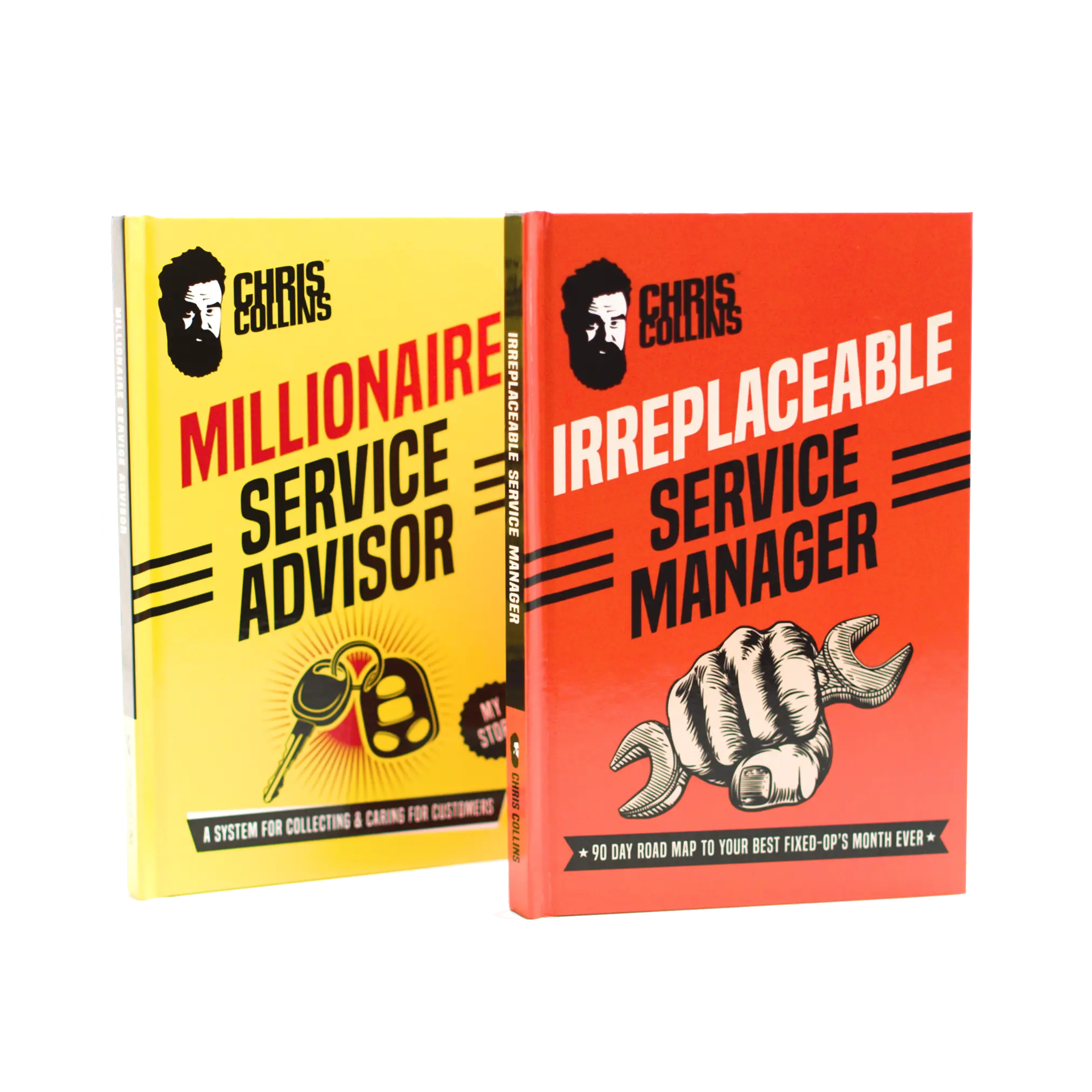
“So great. Well, I can’t wait, and I promise you, you’re going to have a great time. We look forward to it. We appreciate you doing this, and we will have Clint’s book for you, but if you’re not coming to Top Dog, I would encourage you to pick it up on Amazon or your local bookstore. And it’s pretty great stuff. So, thank you, Clint, and we’ll see you real soon. Thanks so much for watching this edition of Service Drive Revolution. We’re uploading new stuff every day, so make sure you subscribe and click the bell icon so you don’t miss out. If you have a question you’d like us to answer on the show, call 833-3-ASK-SDR, and we’ll answer your question on the show. That’s 833-3-ASK-SDR. For special deals on our books and training, head over to chriscollinsinc.com/services. That’s chriscollinsinc.com/services. I’m Chris Collins, and I’ll see you in the next video.
🔗 Related Resources:
- The 9 Reasons Why Service Managers Fail (And How to Avoid Them)
- Boosting Service Drive Revenue: Proven Strategies for Service Advisors and Managers
- Top Fixed Ops Performers: What Car Dealership Service Managers and Advisors Do Differently
- Are You Ruining Your New Service Advisors?
- Are You Really Paying Your Technicians Enough? (Hint: It’s Not Just About Money)
Feel free to explore the linked articles above for deeper insights into each strategy. If you have any further questions or need additional resources, don’t hesitate to ask!
Achieving and exceeding your goals is possible when you have the right systems in place. With Service Drive Revolution OnDemand, you’ll gain access to the proven systems that have made thousands of SERVICE MANAGERS IRREPLACEABLE. Start transforming your department today!
Need help updating your playbook? Let us know how we can support your team’s growth.
Book a 15-minute strategy session with our team. We’ll explore how to unlock your dealership’s real value.