Ever wonder why your dealership’s numbers swing wildly one quarter and remain steady the next? The answer comes down to the core functions driving your business—fixed vs variable ops. Confusion around these two segments can lead to missed revenue, wasted marketing spend, and lost customers. When sales can rise or fall without warning and service lanes aren’t running at full potential, overall performance suffers.
And so you really need to understand the difference between fixed vs variable ops if you want to gain consistent growth and profitability. Strong variable ops bring in new customers through sales, while fixed ops keep them coming back through reliable service and parts. When these areas work together, dealerships build greater customer loyalty, steady cash flow, and a foundation for long-term success.
Keep reading for practical insights and real-world tips that can help you strike the right balance. We will walk you through the main differences, the impact on your bottom line, and how you can maximize both sides of your dealership for lasting results.
Key Takeaways
- Dealerships rely on two engines: variable operations (vehicle sales) and fixed operations (service, parts, and collision).
- Variable ops drive massive revenue but suffer from thin margins, volatile demand, and surging inventory interest costs.
- Fixed ops yield reliable 45% to 50% profit margins, generating half of total gross profits from small transactions.
- High service absorption rates allow fixed ops to cover store overhead, turning vehicle sales into pure profit.
- Service departments face heavy tech costs, technician shortages, uneven daily demand, and high customer defection rates.
- Dealerships counter revenue leaks by digitizing the service journey with online booking, mobile payments, and text updates.
- Video inspections and instant digital estimates build consumer trust and accelerate repair approvals.
- Leaders must track weekly metrics like technician efficiency, effective labor rate, and parts inventory supply to sustain growth.
Fixed Ops vs. Variable Ops
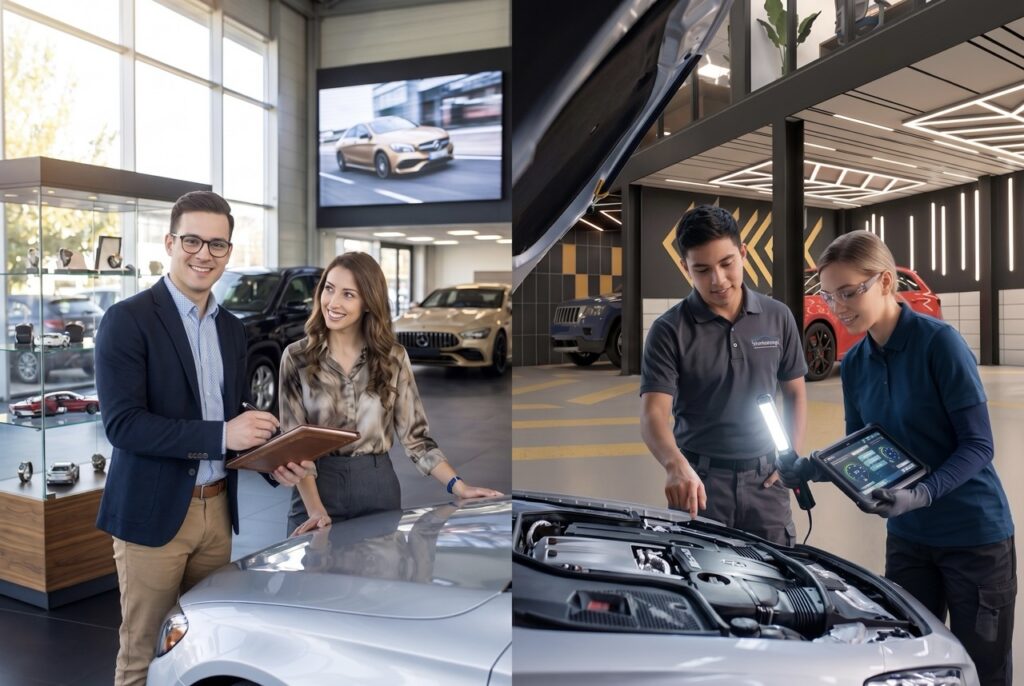
Car dealerships run on two distinct operational engines: variable operations and fixed operations. Balancing both departments is what keeps a dealership profitable and successful over the long term.
● Variable Operations (Front-End)
- What it is: This department represents the sales floor, which includes new and used vehicle sales, marketing, and the finance and insurance office.
- The Goal: The main objective is customer acquisition through fast, exciting, and transaction-driven vehicle sales.
- Financial Profile: Variable ops generates massive revenue per transaction, but operates on incredibly thin profit margins, usually in the single-digit percentages. According to Presidio-NCM, new-vehicle gross profit dropped 33% in 2024 to an average of $2,247 per unit. Floor-plan interest expenses also heavily burden this side of the business. Monthly floor-plan interest costs hit roughly $70,000 per dealership in 2024, marking an 800% increase from pre-pandemic levels based on data from Wards Auto. Financing costs accumulate constantly, costing dealers an estimated holding fee of $44.63 per unit each day, according to NextGear Capital.
- Market Sensitivity: This side of the business is highly unstable and exposed to constant fluctuations. Sales volume and expenses swing wildly based on consumer confidence, changing economic conditions, interest rates, seasons, holidays, weather, and available inventory.
● Fixed Operations (Back-End)
- What it is: Known as the backbone of the dealership, fixed ops encompasses all after-sales support services, specifically the service lane, parts counter, and body shop or collision center.
- The Goal: The focus centers on customer retention by building steady, relationship-driven interactions.
- Financial Profile: Transactions are smaller compared to vehicle sales, but they carry heavy, reliable profit margins of 45% to 50%. Fixed ops routinely produce about half of a dealership’s total gross profits while making up only 10% to 15% of total sales volume, as highlighted by Mercer Capital and the National Automobile Dealers Association via Edmunds. Data from Optimum Q4 2024 reveals that customer-pay gross profit per repair order rose 12% year-over-year from $199 to $222.
- Market Sensitivity: This department provides a financial cushion because its revenue is highly predictable and resistant to recessions. Even when vehicle sales crater during economic downturns, consumers still need consistent maintenance, parts, and repairs to keep their existing cars running.
Three Pillars of Fixed Operations
A strong fixed operations department relies on three foundational components to run smoothly and support the business.
1. Service Department
Acts as the primary driver for retaining customers after the initial vehicle purchase. Technicians handle routine maintenance tasks like oil changes, tire rotations, and brake inspections. Staff members also perform complex diagnostic evaluations and vehicle repair work.
2. Parts Department
Employees work closely with technicians to supply genuine manufacturer parts and accessories, minimizing vehicle repair delays. Personnel oversee inventory controls and manage manufacturer warranty claims. This sector generates a dual revenue stream by selling components directly to retail buyers and independent local repair garages.
3. Collision Center (Body Shop)
Operates as a specialized unit focusing on accident restoration, body repairs, and vehicle paint work. Advisors coordinate directly with auto insurance firms to manage claims. The shop provides an additional income source to diversify dealership revenue.
Strategic Importance of Balancing Both Sides
True dealership growth requires breaking down internal barriers and treating variable and fixed operations as a single, interdependent system rather than separate departments.
● Interdependent Relationship
Variable sales teams acquire customers and drive the initial entries into the dealership’s ecosystem. The fixed operations team handles the post-sale relationship. Providing a stellar service experience builds long-term loyalty, ensuring that when a customer is ready to buy their next vehicle, they return to the same dealer.
● Financial Stabilization and Absorption
Fixed operations act as the ultimate safety net during slow sales periods or economic shifts. A vital benchmark for general managers is the service absorption rate, which measures the percentage of total dealership overhead expenses covered solely by fixed ops gross profits.
If a dealership achieves the industry target of a 115% absorption rate published by the National Automobile Dealers Association, fixed operations pays for all store overhead plus a 15% cushion. Under this scenario, every vehicle sold by the variable department translates into pure incremental profit for the business.
Modern Challenges Facing Dealerships
Dealership executives must navigate several external and operational shifts to stay profitable in the current landscape. To keep operations balanced, managers must navigate several critical obstacles that threaten profitability.
● Rapidly Changing Technology
Vehicle components are growing highly complex due to advanced driver assistance systems and electric vehicles. Dealerships must invest heavily in ongoing employee training and specialized diagnostic tools to remain competitive.
● Customer Defection
Once original factory vehicle warranties expire, nearly two-thirds of service customers defect to independent garages, quick-lube chains, and big-box tire shops due to perceived convenience or lower pricing. Industry-wide data shows that only about one-third of total vehicle service visits happen at authorized dealerships.
● Uneven Peak Demand
Service traffic naturally peaks on Monday mornings and lunch hours, leading to unanswered phone calls and packed waiting areas. Conversely, midweek afternoons often leave technicians sitting idle with no active jobs.
● Inventory and Supply Bottlenecks
Balancing the parts warehouse is a constant tightrope walk. Carrying too little stock delays repairs and ties up service lifts, while holding too much inventory locks up valuable cash in slow-moving assets. Recent supply chain disruptions make managing this inventory even harder.
● Technician and Staff Shortages
Dealerships face an aging workforce and a nationwide shortage of skilled automotive technicians. Empty service bays represent lost capacity and revenue, which can overwork remaining staff, increase repair mistakes, and lower customer satisfaction scores. High turnover among service advisors further disrupts customer relationships.
Strategies to Maximize Profitability and Retention
Dealerships can implement targeted modern strategies to optimize efficiency, plug revenue leaks, and elevate the client experience.
● Digitize the Service Journey
Transition away from paper repair orders and phone tag by adopting digital platforms that integrate with the dealership management system. Providing online appointment scheduling, digital status tracking, and mobile payment options matches the convenience modern consumers expect.
● Improve Communication via Video and Text
Automate basic updates like appointment confirmations to free up service advisor hours. Use two-way texting for quicker customer responses, and text video multi-point inspections directly to clients’ phones. Visual proof of a worn component builds immediate trust and accelerates repair approvals.
● Streamline Internal Workflows and Estimates
Eliminate operational bottlenecks by using digital estimation tools that instantly pull details from the technician’s notes. This allows advisors to send transparent, professional quotes that customers can approve with a single tap. Additionally, integrate digital tracking tools to manage loaner vehicle fleets efficiently.
● Provide Frictionless Payment Solutions
Send secure text links allowing clients to pay invoices online via credit card or digital wallets before picking up their vehicle, which eliminates long cashier lines. For expensive, complex repairs, offer flexible “buy now, pay later” financing options through specialized lenders to help close the sale on critical safety work.
● Automate Follow-Ups and Targeted Marketing
Keep the dealership top-of-mind by utilizing automated maintenance reminders tied to a vehicle’s service history. Send automated text prompts inviting happy clients to leave online reviews to boost the store’s digital reputation. During slow periods, run targeted text promotions with minor discounts to fill empty service bays.
● Track Crucial Performance Metrics (KPIs)
General managers and department leaders must review operational data weekly to spot patterns and create a high-performance culture. Be sure to track the following key performance indicators:
- Technician Efficiency & Proficiency: Measures actual labor hours sold versus time spent on the job. National targets sit at 100% for productivity and 125% for proficiency.
- Effective Labor Rate (ELR): Tracks the true hourly rate the shop pulls in after discounts, internal work, and warranties.
- Hours per Repair Order (HPRO): Monitors how effectively advisors identify additional service needs through multi-point inspections and up-selling.
- Parts Inventory Days’ Supply: Based on data from financial advisory firm Eide Bailly, parts inventory should be managed tightly to stay within a healthy 45-to-60-day supply benchmark to keep cash flowing.
- Parts First-Time Fill Rate: The industry standard targets a 90% off-the-shelf fill rate to avoid repair delays and excessive loaner vehicle costs.
- Tire Sales Volume: Selling tires serves as a major retention lever. Research from Liberty University reveals that 75% of automotive customers continue to service their vehicles at the specific location where they originally purchased their tires.
Optimize Your Service Drive Opportunities
As discussed, the Service Drive provides a steady stream of income because cars always require maintenance. If you want to level up your game, Chris Collins Inc. helps dealerships optimize operations by streamlining processes and training staff to deliver exceptional service.
The company offers a fully customizable suite of coaching services, including the Signature Coaching Group and Service Drive Revolution on-demand training. These programs focus on accountability to increase customer satisfaction and retention. Chris “Bulldog” Collins founded the firm after decades in the industry. His systems have a track record of increasing service center profits by 400% within months.
Stop the profit leakage and start maximizing your revenue today! Contact Chris Collins Inc. for Fixed Operations Optimization and Training. Book a 15-minute opportunity analysis or call us at +1 (800) 230-5165 to explore the available programs.
Frequently Asked Questions (FAQs)
Balancing both departments ensures steady cash flow when vehicle sales slow down while maximizing profit during market spikes. Such stability allows a dealership to fund expansion and retain talent through any economic cycle.
Vehicles require ongoing maintenance and repairs regardless of economic conditions or supply chain disruptions. This recurring need creates a predictable stream of high-margin service revenue that shields the business from volatile vehicle sales trends.
Dealers can drive service loyalty by introducing complimentary maintenance plans during the vehicle sales process. Cross-training staff and integrating customer databases across both departments also guarantees seamless lead sharing and long-term retention.
Bottom Line
Now that’s a wrap! Having in-depth knowledge of fixed vs variable ops is a must for every dealership out there. Always keep in mind the difference. Fixed ops provide steady revenue through service, parts, and repairs, while variable ops drive growth with vehicle sales that can change based on market trends. But even with the differences, both sides must work together so dealerships can create a solid foundation for long-term profitability and loyalty.
Take a fresh look at your processes today and see where you can strengthen the balance between the two. Mastering this dynamic is the only way to stay ahead in today’s competitive auto industry.
If you found these insights valuable, share this article with your fellow dealers and help empower our industry with stronger, smarter strategies. Follow for more!
Achieving and exceeding your goals is possible when you have the right systems in place. With Service Drive Revolution OnDemand, you’ll gain access to the proven systems that have made thousands of SERVICE MANAGERS IRREPLACEABLE. Start transforming your department today!
Need help updating your playbook? Let us know how we can support your team’s growth.
Book a 15-minute strategy session with our team. We’ll explore how to unlock your dealership’s real value.