
Why do we still struggle with finding truly clean, efficient ways to power our cars? Electric vehicles (EVs) are popular, but long charging times and limited range can make them less practical for some drivers. Meanwhile, traditional gas-powered cars are harmful to the environment, making the need for something better more urgent.
That is why hydrogen fuel cell vehicles (HFCVs) could be the answer. They offer the same eco-friendly benefits as EVs—no carbon emissions—but with the added bonus of quick refueling times and longer range. It’s promising, but is hydrogen really the answer? In this blog, we break down the pros, the hurdles, and what hydrogen fuel cell cars could mean for the future of driving. Keep reading to see where this technology stands today.
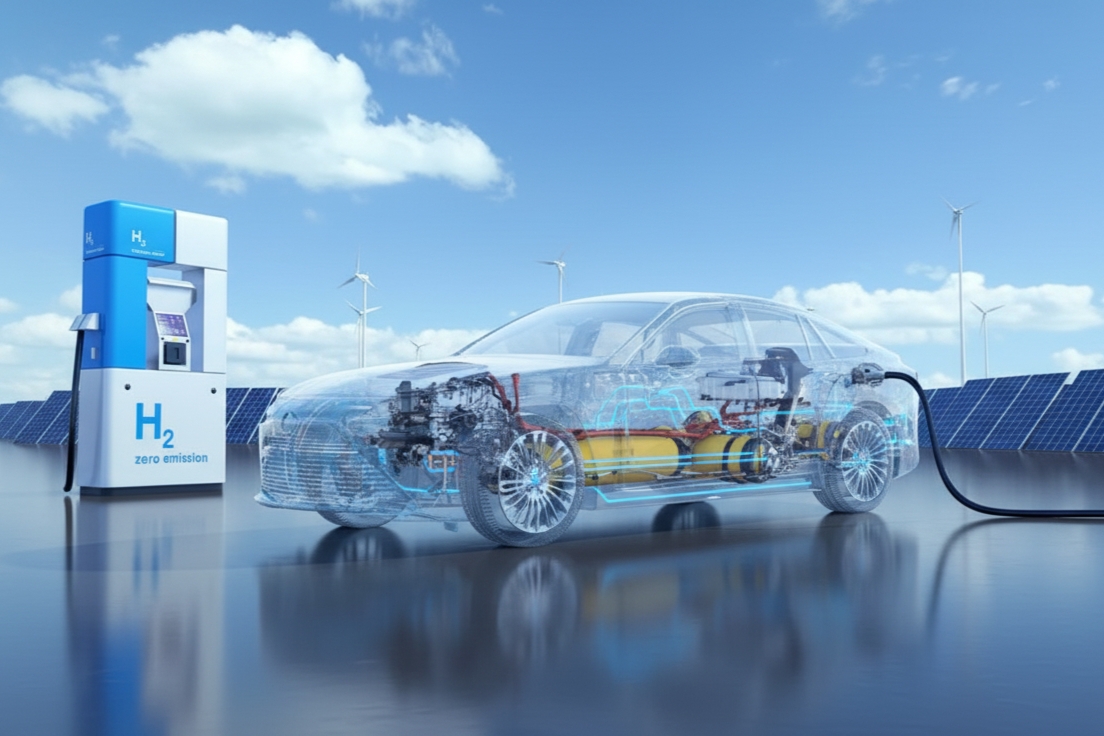
What Are Hydrogen Fuel Cell Vehicles?
To understand an HFCV, you first need to look at the engine. Like a battery-electric car, a hydrogen car has an electric motor to rotate the wheels. The difference lies in where that electricity comes from. It does not rely on a massive, heavy battery pack. Rather, it has a fuel-cell stack. This stack takes pure hydrogen (H2) stored in carbon-fiber tanks and combines it with oxygen (O2) from the air.
This chemical process happens inside a Polymer Electrolyte Membrane (PEM) fuel cell. Hydrogen flows into the anode side where a catalyst splits the molecules into protons and electrons. Next, the electrons pass through an external circuit generating the electricity that drives the motor. Finally, they recombine with oxygen to create water vapor, which leaves the car through the tailpipe.
Technically, these cars are series hybrids. They often carry a small battery—similar to a standard hybrid—to help with intense acceleration, as fuel cells prefer a steady power output. Current models on the road include the Toyota Mirai and the Hyundai Nexo. Honda also released the CR-V e:FCEV, which is a rare plug-in car that uses hydrogen with a rechargeable battery pack.
Are they safe? Yes. The tanks are armored with carbon fiber and hold gas at an immense pressure of 10,000 pounds per square inch (psi). They are engineered to be resistant to leaks that occur due to high-speed car crashes. To date, there have been no recorded injuries or deaths specific to hydrogen components in these vehicles.
MORE ON AUTOMOTIVE INNOVATION V2X Communication Technology in Safer Transport
Benefits of Hydrogen Fuel Cell Technology
Hydrogen technology has its own benefits. It addresses certain issues that battery-electric owners have to solve every day.
A. Environmental Advantages
The most significant benefit is the lack of pollution. HFCVs emit zero carbon dioxide. The only byproduct is water vapor. This supports global efforts to decarbonize transport. Additionally, these vehicles perform exceptionally well in extreme weather. Battery-electric cars often lose range in freezing temperatures. Hydrogen systems, however, operate efficiently even in sub-zero conditions.
B. Practical Perks
The most important selling point is the fueling experience to a majority of drivers. There is no need to wait hours to get charged. A hydrogen tank can be refilled in between three and five minutes. This resembles the comfort of a typical gasoline station. When they are full, these automobiles have tremendous freedom. Current models boast ranges of 300 miles or more.
The driving experience is smooth and quiet, similar to any electric car. For longer trips, the weight advantage is real. Hydrogen is the lightest energy carrier. This renders it possibly more superior to heavy loads in which heavy batteries would be a burden.
C. Market Growth Potential
The industry sees money in this technology. The global market for hydrogen fuel cells is projected to jump from approximately $6 billion in 2025 to over $35 billion by 2034. While passenger cars are rare, the sector is expanding for commercial uses. Heavy-duty applications, such as trucks and buses, are particularly attractive targets for this growth.
Is Your Dealership Ready for the Future?
As the industry shifts toward complex technologies like hydrogen and EVs, your Fixed Ops department becomes your financial lifeline. Contact Chris Collins Inc. today to optimize your service drive and protect your profitability.
Challenges Facing Hydrogen Fuel Cell Vehicles
Though it has its advantages, hydrogen vehicles have high barriers. The road to mass adoption is bumpy and expensive.
A. Infrastructure Limitations
You cannot drive a car if you cannot fuel it. This is the biggest problem. In the United States, the network is incredibly thin. California is the only state with a retail hydrogen network, and it has 54 retail and 8 non-retail stations. Reliability is also an issue. Frequently, stations are down due to repressurization or repairs.
Drivers often rely on apps to check for “green dots” indicating a working station before they leave the house. The situation can be fragile. In 2019, a supply disruption in the Bay Area forced drivers to park their cars or hunt for fuel in the middle of the night. Even large energy firms such as Shell have shut down a few of their hydrogen outlets in recent years.
B. High Costs
Hydrogen fuel is a specialized commodity. It is expensive. In 2023, True Zero, a major supplier, raised its price to $36 per kilogram. Since a Toyota Mirai holds about 5 kilograms, a full tank could cost nearly $180. That is compared to charging an EV at home, which only costs a fraction of that amount.
The cars themselves are also pricey. They often start around £60,000 in the UK or require expensive leases in the US. Automakers like Toyota have offered up to $15,000 in free fuel to attract buyers, but once that perk expires, the driver pays full price.
C. Green Hydrogen Production Complexities
Hydrogen is the most common element in the universe, but it is rarely found alone. We have to make it. Nowadays, fossil fuels such as natural gas are used to produce the majority of hydrogen. This process creates carbon dioxide, which reduces the environmental benefit.
“Green hydrogen”—made using renewable energy to split water—is the goal. However, it is not yet cost-competitive. Furthermore, the process is inefficient. Converting electricity to hydrogen, compressing it, transporting it, and converting it back to electricity in the car results in energy losses. A fuel cell is only about 60% efficient at turning hydrogen into power.
Also Read: Sustainable Vehicle Recycling: Breakthrough Methods
D. Maintenance and Culture
Servicing these vehicles requires highly specialized safety protocols. Technicians are dealing with gas stored at 10,000 psi. This brings us to a critical operational point: technology is only as good as the team managing it.
Adopting new systems—whether it’s hydrogen infrastructure or a new DMS—exposes cracks in a business’s foundation. A chaotic service department cannot safely or efficiently handle high-tech advancements.
As noted in recent industry training, a lack of clear vision and standards destroys performance. Service Department Culture Killers: The Hidden Factors Destroying Team Performance highlights that if your team doesn’t know the mission, they’ll make up their own, leading to slipped standards.
Remember, innovation requires a “play to win” mindset. Dealerships stuck in “the way we’ve always done it” mode are dying a slow death. So what are you waiting for? Start fixing the culture so you can handle the technical demands of tomorrow. Book a 15-minute strategy session today and find out how to unlock the real value of your dealership.
Hydrogen vs. Battery Electric Vehicles
The automotive world is witnessing a lopsided battle. Battery Electric Vehicles (BEVs) are winning the sales race, but hydrogen refuses to disappear.
A. Why BEVs Remain Dominant
The numbers tell the story. There are millions of EVs on the road, compared to roughly 18,000 hydrogen cars in the U.S., mostly in California. Manufacturers are laser-focused on EVs, aiming for dominance by 2030.
BEVs win on convenience for homeowners. You can “refuel” them in your garage while you sleep. Hydrogen drivers remain tethered to a scarce public station network. Battery technology also keeps improving. Costs are falling, and manufacturers are switching to cheaper chemistries like lithium iron phosphate (LFP).
B. Hydrogen as a Complementary Option
Hydrogen is not necessarily a replacement for EVs. Rather, it is a partner. It serves drivers who cannot charge at home or who live in areas with poor electrical grids. It is also applicable to high-mileage drivers who are unable to afford 30-minute charging stops.
For heavy transport, hydrogen makes sense. The fuel system is also lightweight and fast to refuel, which is an advantage to long-haul trucks and buses. While a battery for a semi-truck might weigh thousands of pounds, a hydrogen system is lighter, preserving payload capacity.
Future Outlook for Hydrogen + Battery Electric Ecosystem
Is the hydrogen car dead? Not necessarily. While it may not replace the battery electric car in your garage anytime soon, it is carving out a vital niche.
A. Projecting Parallel Pathways
Major automakers like Toyota and BMW are refusing to give up. BMW plans to launch a hydrogen version of the iX5 SUV in 2028, viewing hydrogen as the “missing piece” of the sustainable mobility puzzle. Toyota is also striving in technology development via racing, which sees them test liquid-hydrogen engine capable of enduring the harsh motorsport endurance.
The industry consensus is shifting toward a “multi-pathway” strategy. This means a future where BEVs handle passenger commuting while HFCVs handle heavy lifting and long-distance transport.
B. Viable Use Cases for Hydrogen
The immediate future of hydrogen likely lies in commercial fleets rather than personal driveways. Heavy-duty trucks, public transit buses, and specialized fleets operate on fixed routes, making it easier to build dedicated fueling infrastructure. Under such a situation, the short refueling duration provides a real operational superiority to batteries.
C. Strategic Actions for Automakers
Moving forward, the challenge for companies is balancing investment. They must develop hydrogen-ready capabilities without losing ground in the booming EV market. If the costs of green hydrogen drop and infrastructure stabilizes, hydrogen vehicles could emerge as a powerful parallel to electric cars, ensuring that we have a diverse and resilient green transportation network.
Also Read: Extended-Range Electric Vehicles Around the World
Bottom Line
In conclusion, hydrogen fuel cell vehicles offer a glimpse into the future of clean transportation, combining innovation with the promise of zero emissions. Their popularity might not be as high as that of electric cars yet, but their promise to help diminish the use of conventional fuels and combat climate change cannot be denied. If this sparked your interest, consider sharing it with someone curious about new ways to drive smarter and greener. Follow us for more automotive innovation insights!
Achieving and exceeding your goals is possible when you have the right systems in place. With Service Drive Revolution OnDemand, you’ll gain access to the proven systems that have made thousands of SERVICE MANAGERS IRREPLACEABLE. Start transforming your department today!
Need help updating your playbook? Let us know how we can support your team’s growth.
Book a 15-minute strategy session with our team. We’ll explore how to unlock your dealership’s real value.