Your service bays are full, technicians are turning wrenches nonstop, and repair orders are stacking up. Yet, when you review the monthly financial statements, the numbers simply fall flat. Rising operational costs and relentless competition from local independent shops constantly eat into your margins. What a dealership’s nightmare. It just feels so frustrating to put in all that hard work, only to see gross profits shrink instead of grow.
Now, if you really want to achieve true service and parts profitability, you need a unified strategy that connects your fixed operations. Because when your front lane and back counter operate as a single team, you basically lock in better margins and cover your total operating expenses. Does that make you curious? Continue reading to understand how linking key performance metrics, pricing strategies, and tight inventory management can transform your operations and drive long-term dealership success.
Key Takeaways
- Fixed operations function as the financial backbone, offering reliable income during market downturns.
- Maintaining a one-to-one labor-to-parts ratio maximizes revenue, yielding 50% to 55% gross profit margins.
- Routine maintenance generates high-margin labor revenue faster than complex mechanical repairs.
- Dealerships capture internal revenue by completing all used vehicle reconditioning in-house.
- Managers monitor profitability by tracking metrics like Fixed Absorption Rate and Effective Labor Rate.
- Target gross profit margins must hit 70% to 76% for labor and 40% to 50% for parts.
- Daily mini physical inventories and strict purchase order requirements prevent parts shrinkage and theft.
- Digital vehicle inspections with visual evidence build trust and increase customer repair approvals.
How Service and Parts Collaborate for Profit
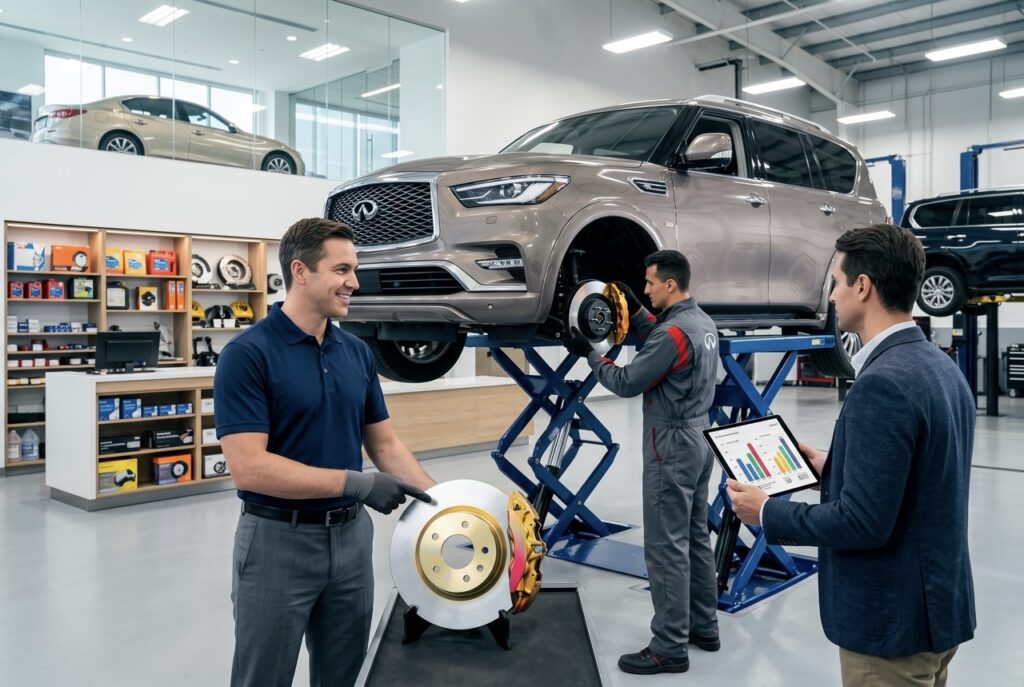
The alignment of service and parts is crucial to a dealership’s financial success.
● Synergy of Fixed Operations
Fixed operations act as the financial backbone of any dealership. While vehicle sales often fluctuate based on market conditions, the steady, high-margin income generated by the service and parts departments provides a reliable buffer during economic downturns or periods of low vehicle inventory. By maintaining a strong focus on fixed operations, dealerships can establish a highly resilient business model that ensures consistent cash flow.
● 1-to-1 Balanced Relationship
For every dollar of labor charged on a healthy repair order, there is typically one dollar in parts sold. Keeping this equal balance helps dealerships hit a highly profitable sweet spot, yielding a combined gross profit margin of 50% to 55% across both departments. Balancing labor and parts sales prevents one department from carrying the other and maximizes the revenue potential of every service bay.
● Maintenance vs. Repairs
Routine maintenance and major repairs drive revenue in very different ways. Quick maintenance check-ups are highly efficient because they generally require fewer labor hours and fewer parts. These visits involve standard multi-point inspection checklists that identify minor vehicle needs, allowing dealerships to generate high-margin labor revenue quickly with minimal parts overhead. In contrast, major mechanical repairs consume expensive parts and complex labor, which can reduce overall profit margins despite the higher total ticket price.
● Keep Reconditioning In-House
One of the most effective ways to boost internal profitability is to treat the pre-owned vehicle department as a major internal fleet customer. Rather than outsourcing reconditioning work to external independent repair shops, dealerships should perform all used vehicle inspections and repairs in-house. Keeping this work within the dealership ensures that parts and labor revenues are captured internally, keeping the profit margins in the business and utilizing open shop capacity.
Key Performance Metrics (KPIs) to Track
To achieve consistent growth, managers must actively monitor specific operational metrics such as the following:
● Fixed Absorption Rate
The fixed absorption rate measures how effectively gross profits from the service, parts, and collision departments cover the dealership’s overall operating expenses. Recent industry reports place the average fixed absorption rate for U.S. dealers at 57%. Dealerships strive for NADA’s published target of 115%, meaning fixed ops covers every dollar of overhead plus a 15% cushion. When managers hit a 100% absorption rate, every single vehicle sale translates directly into pure net profit, making the dealership highly secure regardless of the volatility in vehicle sales.
● Effective Labor Rate (ELR)
The Effective Labour Rate (ELR) reflects the actual revenue earned per billed labour hour. It is calculated by dividing total labor sales by the total labor hours billed. This metric is a direct indicator of profitability. Optimizing ELR through accurate pricing and reduced discounting will guarantee that the dealership is actually earning its posted rate on every job.
● Hours Sold Per Repair Order (HPRO)
Hours Sold Per Repair Order measures how effectively the service team leverages each customer visit. Increasing HPRO helps ensure that technicians have a steady volume of billable work. To optimize this metric, service advisors should analyze at least 100 repair orders per month to identify opportunities to move beyond single-item transactions and provide comprehensive maintenance recommendations.
● Technician Efficiency & Productivity
Managing shop capacity relies heavily on how well technicians utilize their time.
- Tracking Billable Hours: Managers should compare the actual hours spent on work orders against the flat-rate hours billed to identify workflow bottlenecks.
- Minimizing Unapplied Time: Paying technicians for hours they are not actively billing represents a direct loss. Documenting unapplied time helps determine if technicians are performing non-billable shop tasks or facing parts delays.
- Dual-Timecard System: Implementing a dual-timecard system can help track efficiency. The first timecard must track the technician’s overall on-site hours, while the second tracks the specific hours billed to individual repair orders.
● Parts Inventory Metrics
A successful parts department needs continuous inventory oversight. That said, managers should track daily sales volume, total transaction counts, and average transaction values to monitor upselling performance. Moreover, tracking backorders and documenting lost sales help identify demand trends, ensuring the right parts are on the shelves and preventing customers from turning to online competitors.
Pricing and Margin Strategies
Setting clear pricing structures protects profit margins and ensures the department bills enough to cover operating costs.
Target Profit Benchmarks
If you want to achieve consistent profitability, you must meet specific gross profit goals for every transaction. You can use the following as a guiding point:
- Dealerships should target a minimum gross profit margin of 70% to 76% on all labor sales.
- Parts department should maintain a minimum gross profit margin of 40% to 50%.
- Accessories typically carry lower profit margins, generally ranging from 10% to 30%, and pricing must be managed carefully to stay competitive.
Pricing Calculation Rules
To eliminate guesswork and protect margins, always use mathematical formulas to establish pricing structures.
- Setting the Labor Rate
To hit a target labor gross profit margin of 70%, divide the technician’s average hourly pay rate by 0.30 (100% minus the $70 target margin).
Hourly Rate = $150.30 = $50 per hour
- Setting Parts Retail Prices
To secure a 40% gross profit margin on parts, divide the wholesale cost of the part by 0.60 (100% minus the 40% target margin).
Retail Price = $150.60 = $25
- Using a Markup System
Many electronic parts catalogs and management programs use markup rather than profit margins. To achieve a 40% profit margin on financial reports, the parts system must be set to at least a 67% markup over cost.
- Managing Sublet Work
Dealerships should aim to achieve a minimum gross profit of 15% on outsourced sublet services, including towing, tires, and glass replacement. If shop space and qualified technicians are available, these jobs should be completed in-house to capture the full profit margin directly.
- Auditing Parts Pricing
Dealerships must perform weekly parts pricing audits. These regular checks help the parts department adjust to manufacturer cost increases and maintain a competitive pricing structure compared to local independent shops.
Inventory Management and Loss Prevention
Protecting physical inventory is just as important as generating sales; take note of that.
● Preventing Parts Theft
The parts department has a high potential for shrinkage and theft. To prevent losses, dealerships should require purchase orders for all ordered parts. These purchase orders must include the specific repair order number or the vehicle stock number for internal reconditioning jobs, allowing managers to conduct random audits.
● Daily Mini Parts Physicals
To maintain inventory accuracy, parts personnel should conduct mini physical inventories every working day. By dividing the total number of parts bins by the working days in the month, staff can determine how many bins to count daily and verify against the inventory system.
● Variance Reports
Parts managers should run monthly variance reports to compare physical counts against system records. Resolving these differences early prevents parts shortages from cutting directly into gross profits.
● Handle Open Repair Orders
Completed work should be closed out promptly rather than keeping repair orders open for long periods. If a part is backordered, close the completed items and open a new repair order for the remaining parts to keep monthly sales and inventory values accurate.
Operational Best Practices and the Customer Experience
Wanna be on top? Well, a seamless customer experience is essential for driving repeat business and long-term retention. Here’s what you can do:
● Streamline the Service Lane
Implementing standardized check-in procedures helps minimize customer wait times, creating a smooth and professional first impression.
● Boost Transparency with Technology
Using digital vehicle inspections (MPIs) with integrated photos and video evidence builds immense trust. Customers are much more likely to approve recommended repairs when they can see the wear or damage themselves.
● Capture “Low-Hanging Fruit”
Service advisors should be trained to look for quick, high-margin maintenance items during check-in, such as cabin air filters, wiper blades, and batteries. Capturing these small items significantly boosts average repair order values with minimal effort.
● Align Staffing with Demand
Dealerships should schedule technician shifts to align with peak customer drop-off and appointment times. Such coordination reduces unproductive downtime in the shop and keeps work flowing smoothly.
● Address the Tech Shortage
To combat the ongoing technician shortage, dealerships must establish structured training, apprenticeship programs, and clear career paths to attract and retain talented technicians. The sooner you do this, the better. According to TechForce Foundation, the labor shortage poses a severe threat to service capacity, projecting a cumulative five-year shortfall of 1.2 million workers.
To bridge operational gaps and resolve labor challenges, coaching firms like Chris Collins Inc. work with dealerships to implement structured training and accountability systems. Such programs help service managers, advisors, and technicians optimize fixed operations and improve overall shop performance.
● Engage the Team with KPIs
Managers should hold regular goal-review meetings and post a highly visible scoreboard. Always keep performance metrics in front of the team so they drive healthy competition and align everyone with the dealership’s goals.
Frequently Asked Questions (FAQs)
Service departments usually generate strong profits by maintaining high technician productivity and keeping bay occupancy steady throughout the day. On top of that, dealers can rely on a healthy mix of routine maintenance and high-margin repairs to offset fixed facility costs.
Parts departments boost the bottom line by selling wholesale components directly to independent repair shops and retail customers. They can also capture high margins by supplying the internal service bay technicians with the exact pieces needed for immediate repairs.
These departments thrive when they synchronize inventory tracking so technicians never have to wait for a component to finish a job. Moreover, jointly offering bundled service-and-parts specials can help pull more customers into the dealership.
Bottom Line
Your fixed operations department always remains as the backbone of the dealership, providing a steady stream of revenue even when the showroom floor is quiet. Thus, mastering service and parts profitability requires consistent oversight through weekly pricing audits and a sharp focus on high-margin items like filters and batteries. When you tighten these inventory controls and empower your advisors to hunt for low-hanging fruit, you already secure a path to long-term financial success for the entire business. So there you have it! We hope you found these tips useful! If so, we’d really appreciate it if you could share this article with your industry colleagues. Stay tuned for more!
Achieving and exceeding your goals is possible when you have the right systems in place. With Service Drive Revolution OnDemand, you’ll gain access to the proven systems that have made thousands of SERVICE MANAGERS IRREPLACEABLE. Start transforming your department today!
Need help updating your playbook? Let us know how we can support your team’s growth.
Book a 15-minute strategy session with our team. We’ll explore how to unlock your dealership’s real value.